Hypoxic Burden and New High Blood Pressure
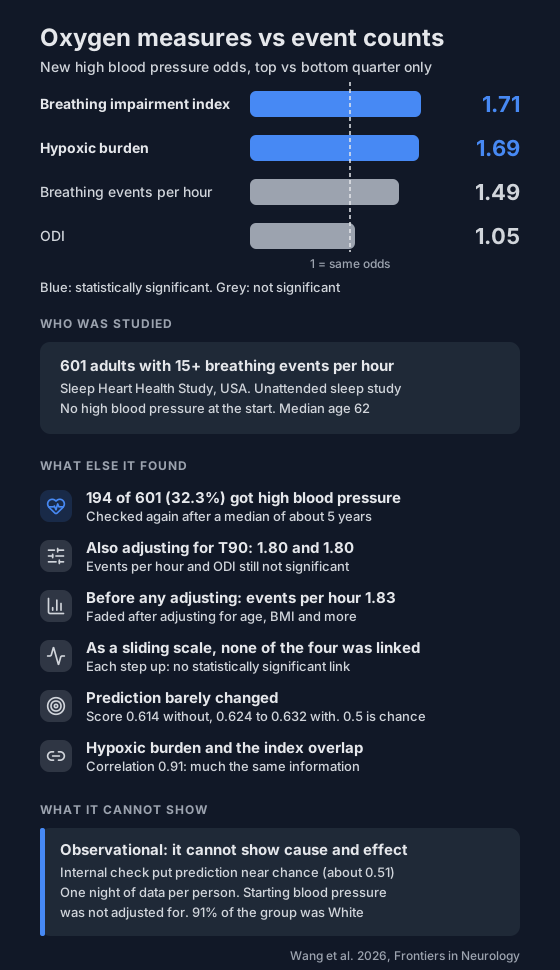
In a 2026 analysis of 601 adults with sleep apnea, only the top quarter for hypoxic burden had higher odds of new high blood pressure 5 years on, and prediction barely changed.
Sleep apnea and high blood pressure often go together. Most reports grade sleep apnea by counting events: breathing events per hour, or oxygen dips per hour (ODI). Counts don't say how deep or long each dip was.
A study published in October 2026 asked whether measures of the oxygen drop itself line up better with who goes on to develop high blood pressure. Only the top quarter of the oxygen measures was linked, and not when each measure was used as a sliding scale. Event counts weren't linked after adjusting. But none of the measures helped much with predicting who would get it.
What were the measures?
- Breathing events per hour. How many times breathing stopped or got shallow, per hour of sleep.
- ODI. How many times oxygen dipped by more than a set amount, per hour. The paper doesn't say what dip size its ODI used. See what ODI is.
- Hypoxic burden. The area of each oxygen dip tied to a breathing event, added up and divided by hours of sleep. Deeper and longer dips count for more. See long breathing pauses and hypoxic burden.
- Sleep breathing impairment index. Similar, but each dip's area is also multiplied by how long the breathing event lasted. The authors' own team developed it.
Both oxygen-area measures need the breathing events marked on a full sleep study.
Who was studied?
- 601 adults from the Sleep Heart Health Study, a US community study.
- Each had an unattended overnight sleep study between 1995 and 1998.
- All had 15 or more breathing events per hour, and none had high blood pressure at the start.
- Median age 62, 65% men, 91% White.
- Blood pressure was checked again after a median of about 5 years.
- High blood pressure meant a top reading of 140 mmHg or more, a bottom reading of 90 or more, or taking blood pressure medication.
What did it find?
194 of the 601 (32.3%) developed high blood pressure.
The researchers split each measure into quarters and compared the top quarter with the bottom. After adjusting for age, sex, race, BMI, smoking, alcohol, diabetes and COPD:
- Breathing impairment index: odds ratio 1.71 (95% CI 1.02 to 2.90)
- Hypoxic burden: 1.69 (1.02 to 2.79)
- Breathing events per hour: 1.49 (0.89 to 2.51), not statistically significant
- ODI: 1.05 (0.63 to 1.74), not statistically significant
Adding T90 to the adjustment gave 1.80 for both oxygen-area measures. Events per hour and ODI stayed not significant.
In a middle model that left out diabetes and COPD, the two oxygen-area measures just missed significance (1.67 and 1.66).
Before any adjustment, the top quarter of breathing events per hour was linked too (1.83). That faded once age, BMI and the rest were taken into account.
Does that make them good predictors?
No.
- A model with just age, BMI and the other basics scored 0.614 at telling apart who got high blood pressure. 0.5 is a coin toss and 1.0 is perfect.
- Adding any of the four measures raised it to between 0.624 and 0.632. None of those rises was statistically significant.
- None of the other three did statistically better or worse than the breathing impairment index.
- When the authors checked the models for over-fitting by resampling the data, the score fell to about 0.51, close to chance.
The authors say a link seen mainly in the top quarter adds little for predicting any one person.
What can't it tell you?
- Cause. It's an observational study, so it shows what went together, not what caused what.
- That oxygen measures beat event counts. The study didn't test whether 1.71 and 1.49 differ from each other, and the oxygen measures' ranges only just cleared 1.
- A dose-response. When each measure was used as a sliding scale instead of quarters, none was linked to high blood pressure. The authors call the quarter results exploratory.
- One night. Each measure came from a single sleep study, and nights vary.
- Starting blood pressure. It wasn't adjusted for, because the authors think low oxygen from sleep apnea may already have pushed it up a little. People who went on to develop high blood pressure already started higher: median top reading 124 vs 116 mmHg.
- Everyone. The group was mostly middle-aged or older and White, and the people included differed from those left out.
What can you do with this?
Nothing here says your own numbers predict your blood pressure.
- Your oximeter reports ODI and T90.
- In this study, hypoxic burden was worked out from breathing events marked on a full sleep study, which a home oximeter doesn't record.
- For more on the link, see oxygen dips and blood pressure.
- If your blood pressure is high, or your nights show a lot of dips, share the recordings with your doctor.
Not a medical device. Does not diagnose, treat or prevent any condition. Discuss results and changes with a clinician.
References
- Wang L, Hui X, Huang R, Xiao Y. Conventional and novel hypoxemia-related indices for obstructive sleep apnea severity and incident hypertension: a prospective cohort study. Frontiers in Neurology. 2026;17:1973505. doi:10.3389/fneur.2026.1973505