Daily Light and Wrist Temperature Rhythms
A 2026 study of 809 adults in Spain wore a light sensor and a wrist temperature sensor for a week: steadier, stronger daily rhythms went with lower triglycerides, and a stronger, steadier wrist temperature rhythm also went with lower BMI and insulin resistance.
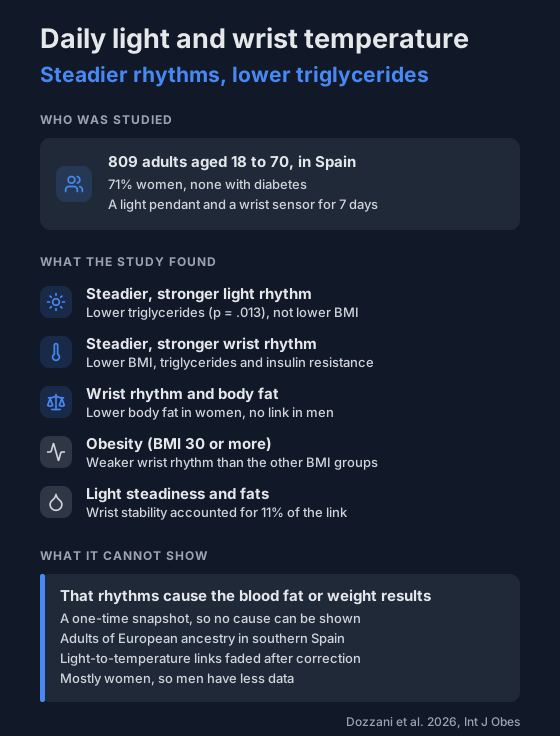
Wearables now record more than steps and sleep, including light and skin temperature across the day. A 2026 study from Spain asked whether the shape of those daily patterns lines up with blood fats, blood sugar markers and weight.
It found that adults with steadier, stronger daily rhythms tended to have lower triglycerides. A stronger, steadier wrist temperature rhythm also went with lower BMI and insulin resistance. It was a one-time snapshot, so it can't say which came first.
Who was studied?
- 809 adults aged 18 to 70, from a Spanish cohort of 889 (the ONTIME-MT study), all of European descent.
- 71% were women.
- Average age was 37 to 38 and average BMI about 26 (the text and table differ slightly).
- None had diabetes, and none took diabetes drugs, beta-blockers, hypnotics, melatonin or other sleep medication.
- BMI groups: 415 with typical weight, 241 with overweight and 153 with obesity.
What was measured?
- Light: a small logger worn as a pendant around the neck for 7 days, set on the bedside table at night.
- Wrist temperature: a sensor over the radial artery of the non-dominant wrist, every 10 minutes for 7 days.
- Blood and body: glucose, insulin, cholesterol and triglycerides, plus BMI and body fat from a body-composition scale.
- Rhythm shape: from each 7-day trace, the team worked out how similar the 24-hour pattern was from day to day (stability), how broken up it was within a day (fragmentation), and the gap between the day and night values (amplitude).
- A statistical method then folded these into three scores per sensor. The first score, which covered the most variation, stood for how robust the rhythm was: steady from day to day with a big day-night gap. For light it also meant brighter days, and for wrist temperature a less fragmented rhythm. The other two scores covered timing and overall level or fragmentation.
What did it find?
- Light: a more robust light rhythm went with lower triglycerides (p = .013). It was not linked to BMI, body fat, glucose, insulin or HDL cholesterol.
- Wrist temperature: a more robust rhythm went with lower BMI, lower insulin, lower insulin resistance (HOMA-IR), lower triglycerides and higher HDL cholesterol (all p ≤ .001). It also went with slightly higher total cholesterol, with no link to LDL.
- Body fat: a more robust wrist rhythm went with lower body fat in women (p = .0002), but not in men.
- Obesity group: people with obesity had weaker wrist temperature rhythms than those with overweight or typical weight.
- Triglyceride thirds: the third with the highest triglycerides tended to have less robust light rhythms.
- Light and temperature: steadier light from day to day went with steadier wrist temperature (p = .007). After the authors corrected for testing many links at once, this was no longer statistically significant and became a trend.
- A possible pathway: the stability of the wrist rhythm accounted for about 11% of the link between light stability and triglycerides (p = .021). The wrist rhythm score as a whole was not a significant go-between.
- Other scores: in the tables, the light timing score was also linked with triglycerides (p = .001) and waist size, and the wrist timing score with glucose and body fat in men. The paper's text doesn't discuss these.
- Extra checks: the wrist-BMI and light-triglyceride links held after allowing for season, physical activity and diet. The wrist link with total cholesterol did not hold after allowing for season.
What can't it show?
- It's a cross-section, so it can't show that irregular light or temperature rhythms raise triglycerides or weight. Weight and blood fats could also shape the rhythms, and the paper notes this.
- The group was adults of European ancestry in southern Spain, where habits such as a siesta may shape daily patterns. It may not apply elsewhere.
- It was mostly women, and the wrist rhythm link with body fat appeared in women only.
- The paper's tables have a few oddities, such as the insulin average (about 302 mIU/L, from 149 people) and a HOMA-IR average of 0.05. Its text and tables also differ slightly on averages: age 37.5 or 38.0, BMI 25.75 or 25.84. The conclusions don't hinge on these figures, but they were not explained.
- Funding came from US National Institutes of Health grants and Spanish research grants. Some authors reported unrelated consulting fees and, for one, research funding from Novo Nordisk.
How does this relate to tracking?
The study used research sensors, but some consumer wearables log light or skin temperature too. Compare it with daylight, evening light and sleep, temperature swings and sleep apnea wearables and social jetlag versus sleep regularity. Triglycerides also come up in time below 90% and triglyceride particles.
What can you do with it?
- If your wearable shows skin or wrist temperature, look at how similar your overnight curve is from night to night.
- Note when your light exposure is highest, and whether it's the same on work days and free days.
- Use these as a self-experiment on your own weeks, not as a score to compare with others.
- If you're concerned about your weight, triglycerides or blood sugar, discuss it with a clinician.
Not a medical device. Does not diagnose, treat or prevent any condition. Discuss results and changes with a clinician.
References
- Dozzani I, Rodríguez-Martín M, Dashti HS, Vetter C, Fernández-Breis JT, Florez JC, Saxena R, Scheer FAJL, Garaulet M. Disrupted daily rhythms in light exposure and wrist temperature are associated with metabolic risk markers and obesity. International Journal of Obesity. 2026 Oct 10. Online ahead of print, no volume or pages yet. doi:10.1038/s41366-026-02225-w