Social Jetlag vs Sleep Regularity
A 2026 study of 74 young adults found that the weekday-weekend gap in sleep timing explained 21% of the variation in the sleep regularity index in people with sleep disorders, so the two are related but should not be assumed to be interchangeable.
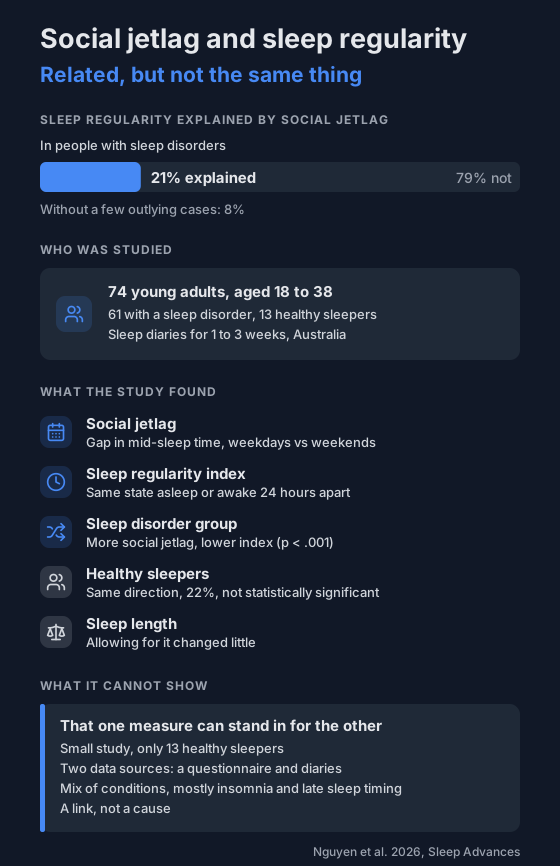
If your sleep is "irregular", there are two common ways to put a number on it. One compares weekdays with weekends. The other looks at how consistent you are every single day. A 2026 study asked how closely the two agree.
It found they overlap, but only partly. Social jetlag explained about a fifth of the variation in day-to-day regularity in people with sleep disorders.
What are the two measures?
- Social jetlag: the gap between your mid-sleep time on work days and on free days, using the midpoint of each sleep period. As an example of our own, not from the paper: sleeping 23:00 to 07:00 on work days and 01:00 to 09:00 on free days gives a gap of 2 hours.
- Sleep regularity index (SRI): the chance you're in the same state, asleep or awake, at any two moments 24 hours apart. It runs from 0 to 100, and higher means more regular.
Social jetlag compares two averages. The SRI picks up day-to-day swings, including broken sleep, naps and a late night on a Wednesday.
Who was studied?
- 74 young adults aged 18 to 38, all enrolled in medicine, paramedicine or nursing degrees.
- 61 met criteria for a sleep disorder and 13 were healthy sleepers. None had a known sleep disorder before the trial, and a sleep psychologist confirmed or ruled one out during it.
- The group was recruited for a trial on sleep education and shift work, so it leaned towards sleep disorders.
- Among the 61: insomnia 43%, delayed sleep-wake phase disorder 33%, obstructive sleep apnea 31%, excessive daytime sleepiness 11%, insufficient sleep 6%, other 15%. Many had more than one.
- Average age was about 25. In the sleep disorder group 59% were women, and in the healthy group 54%.
What was measured?
- SRI: from sleep diaries, kept for 1 to 3 weeks before the sleep psychologist's assessment. The median was 21 days.
- Social jetlag: from the Munich Chronotype Questionnaire, filled in during a lab stay.
- Each group was analysed on its own.
What did it find?
- People with sleep disorders: more social jetlag went with a lower SRI. Social jetlag explained 21% of the variation in SRI (p < .001).
- Without the outliers: the authors also ran it without a few unusual cases, and the figure fell to 8% (p = .02). They kept the outliers in the main result because they reflected real differences in regularity.
- Healthy sleepers: the direction was the same and the figure was 22%, but with only 13 people it wasn't statistically significant (p = .061).
- Sleep length: allowing for it didn't meaningfully change the result. The paper says the data weren't shown.
So most of the variation in day-to-day regularity wasn't accounted for by the weekday-weekend gap. The authors read that as two related but different measures, and say they shouldn't be assumed to be interchangeable.
Why might they differ?
The authors suggest a few reasons, starting with the mix of conditions.
- Insomnia can scatter sleep and waking across the night, which lowers the SRI without necessarily adding social jetlag.
- Delayed sleep-wake phase disorder can mean a big weekend shift, which raises social jetlag without necessarily lowering the SRI.
- Shifts in timing within work days, or within free days, are invisible to social jetlag.
- Shift work, naps, how long it takes to fall asleep, and mental and physical health may explain the SRI better, but the study did not measure them.
What can't it show?
- It's a small, exploratory cross-section. A link in this group doesn't show one measure causes the other.
- Only 13 healthy sleepers, so that result is preliminary.
- Two data sources were used, a questionnaire and diaries. Some of the unexplained variation may come from the methods, not from the measures.
- Work days and free days couldn't be picked out from the diaries, because many of the students worked placements with irregular hours.
- The mix of conditions was mostly insomnia and delayed sleep timing, so the result may not apply to other groups.
- Social jetlag captures a later sleep period, not extra weekend sleep. The authors suggest studying catch-up sleep next.
- It was funded by a South Australian Government grant through the Lifetime Support Authority. The authors reported no conflicts related to this study.
For another look at timing, see irregular sleep timing, training and HRV. Shift work comes up in night shifts, glucose and heart rate.
What can you do with it?
If you track sleep, one number won't tell you everything about regularity.
- Note your bed and wake times on work days and free days. The gap between the average midpoints is your social jetlag.
- Also look at how much your bedtime and wake time move night to night within each group of days.
- Compare your own weeks with each other, not with someone else's numbers.
Not a medical device. Does not diagnose, treat or prevent any condition. Discuss results and changes with a clinician.
References
- Nguyen K, Lovato N, Micic G, Dunbar C, Fitton J, Robertson G, Montero A, Loffler KA, Sansom K, Vakulin A, Adams RJ, Phillips AJK, Reynolds AC. Association between social jetlag and the sleep regularity index in young adults with and without sleep disorders. Sleep Advances. 2026;7(4):zpag102. doi:10.1093/sleepadvances/zpag102