Somnox Breathing Sleep Robot: A 2026 Trial
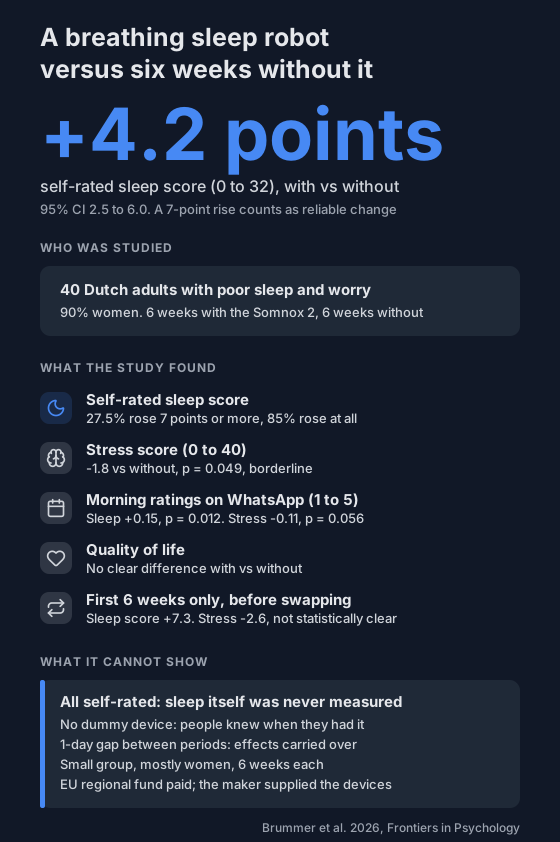
40 Dutch adults with poor sleep and worry spent 6 weeks with the Somnox 2 breathing robot and 6 weeks without. Self-rated sleep went up, stress dipped slightly, and quality of life showed no clear difference.
Slow breathing is one of the most common tips for falling asleep when your mind won't switch off. The Somnox 2 turns that into a gadget: a robot you hold in bed that "breathes". It picks up your breathing pace, matches it, then slowly slows its own rhythm so you can follow it.
A crossover trial published in September 2026 tested it in 40 adults whose worries were keeping them up. Self-rated sleep went up with the device, stress dipped slightly, and quality of life showed no clear difference. Nobody's sleep was actually measured.
Who was in the trial?
- 40 adults in The Hague, Netherlands, who finished the study.
- 90% were women.
- All reported poor sleep and stress from worrying, most often about work (70%), family (32.5%) or health (20%).
- They were recruited from a debt-advice network, a university and a hospital's staff.
- People with a known sleep disorder such as sleep apnea, a CPAP machine, heavy drinking or pregnancy were left out.
How did it work?
Each person had both periods, in random order:
- 6 weeks with the Somnox 2, used nightly and whenever they liked, with breathing speed and sounds set to taste.
- 6 weeks without it.
- A 1-week starting period first, and a single day's gap between the two 6-week periods.
Everyone filled in questionnaires on sleep (0 to 32, higher is better), stress (0 to 40, higher is worse) and quality of life. They also got two WhatsApp questions every morning: how did you sleep, and how stressed were you yesterday, each on a 1 to 5 scale.
What changed?
- Self-rated sleep score: 4.2 points higher with the device than without it (95% CI 2.5 to 6.0).
- How many people noticed: 85% scored higher after their Somnox weeks, but only 27.5% rose by 7 points or more, the change the authors call reliable.
- Average gain: the 4.2-point average was below that 7-point mark.
- Stress score: 1.8 points lower with the device, with p = 0.049, right on the usual cut-off.
- Morning sleep rating: 0.15 points higher on the 1 to 5 scale (p = 0.012).
- Morning stress rating: 0.11 points lower, which wasn't statistically clear (p = 0.056).
- Quality of life: no statistically clear difference with versus without the device.
People rated the device 7.3 out of 10 on average, and 75% called it high or very high quality.
Did the first 6 weeks agree?
The authors also compared just the first 6 weeks, before anyone swapped.
- Sleep score was 7.3 points higher in the group that started with the device, after allowing for starting scores.
- Stress score was 2.6 points lower, but that wasn't statistically clear.
- Quality of life showed no statistically clear difference.
So the sleep result held up, and the stress result wasn't confirmed.
What can't it show?
- Sleep itself. Every result is a questionnaire or a 1 to 5 rating. There was no sleep recording, wrist tracker or oximeter, and no record of how long people used the device. How you rate your sleep and what a recording shows can differ, as an almond trial found.
- The breathing part. There was no dummy device, so people knew when they had it. The authors say expectation and placebo effects can't be separated from the device.
- Clean periods. A 1-day gap wasn't long enough. The sleep effect carried over into the weeks without the device, and scores also shifted in the weeks without it compared with the start. For the stress score and the morning sleep rating, the order people got the periods in changed the results.
- Who it applies to. A small group, mostly women, with worry-driven sleep problems and no known sleep disorder.
- Longer term. Each period was 6 weeks, with no follow-up after people stopped.
- Earlier trials. The authors cite a 3-week trial in insomnia that found no statistically clear change, and a trial in PTSD where distress fell more than without the device but sleep quality showed no clear change.
- Registration. The trial wasn't registered in advance.
- Funding. It was paid for by Kansen voor West, an EU regional development fund. Somnox supplied the devices, and the authors declared no conflicts of interest.
What can you do with this?
If worry keeps you awake, slow-paced breathing is something you can try without a device. Progressive muscle relaxation and light-guided slow breathing have their own studies.
Whatever you try, run it as a self-experiment. Rate each morning the same way, and if you wear an overnight pulse oximeter, compare a run of nights before and after rather than one night on each side.
Poor sleep that lasts has many possible causes. If you snore loudly, someone has heard you stop breathing, or you're very tired during the day, the sleep apnea risk check can help you decide whether to talk to a doctor.
Not a medical device. Does not diagnose, treat or prevent any condition. Discuss results and changes with a clinician.
References
- Brummer HS, Haanstra TM, De Witte LP. Evaluating the effectiveness of an innovative sleep technology to support individuals who experience sleep problems and worry-related stress: a crossover randomized controlled trial. Frontiers in Psychology. 2026;17:1912736. doi:10.3389/fpsyg.2026.1912736