Yoga Nidra and Sleep: A Heart Disease Trial
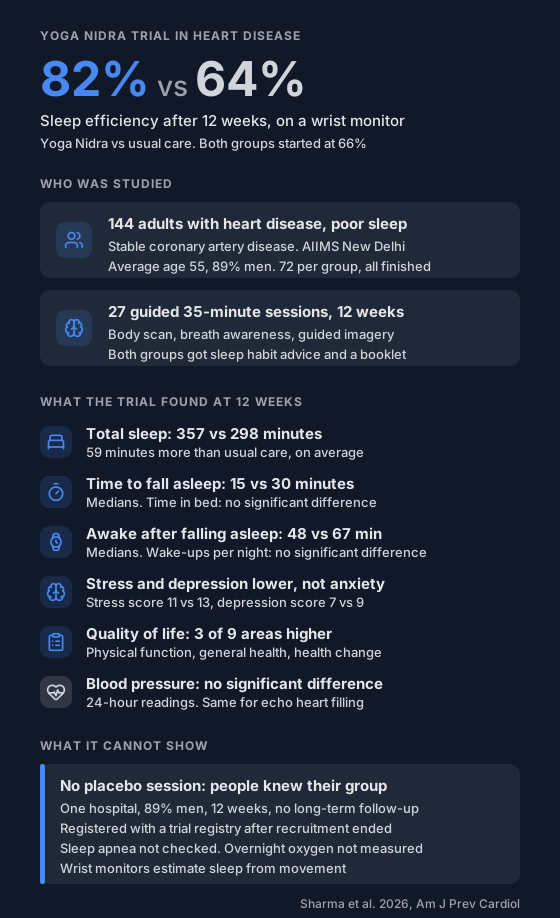
144 adults with stable coronary artery disease and poor sleep did 12 weeks of guided Yoga Nidra or usual care. On a wrist monitor, median sleep efficiency was 82% against 64%. Blood pressure and anxiety scores showed no statistically significant difference.
Poor sleep is common in people with heart disease, and sleeping pills carry their own risks for them. Relaxation practices have helped self-rated sleep in small trials, but few measured sleep with a device.
A randomised trial published in July 2026 tested Yoga Nidra in people with coronary artery disease and poor sleep. It measured sleep with a wrist monitor for a week before and a week after.
What is Yoga Nidra?
It's a guided relaxation practice from Indian yoga. You follow a voice through a set sequence and aim for a sleep-like state while staying aware.
In this trial each session went through:
- Settling in and turning attention inward.
- A short personal intention (sankalpa).
- Moving attention around the body, part by part.
- Noticing the breath.
- Guided imagery.
Who was in the trial?
- 144 adults with stable coronary artery disease and poor sleep, at the All India Institute of Medical Sciences (AIIMS), New Delhi.
- 678 heart patients were checked to find them.
- Poor sleep meant a score above 5 on the Pittsburgh Sleep Quality Index, a sleep questionnaire.
- Aged 30 to 80, average age 55, 89% men.
- Over 80% took ACE inhibitors, beta blockers, statins and aspirin.
- People who already did yoga regularly, had a stent or bypass in the last 6 weeks, or had a very weak heart pump (ejection fraction 30% or less) were left out.
- All 144 finished.
What did each group do?
- Yoga Nidra group (72 people): 35-minute guided sessions, 9 a month for 3 months. That's 27 sessions: 3 a month in person at the hospital and 6 a month online from home, led by a certified instructor. They also got recorded audio to practise alone. Everyone attended at least 19 of the 27 sessions.
- Usual care group (72 people): no Yoga Nidra.
- Both groups: their usual heart care, plus advice on sleep habits based on the World Sleep Society's 10 tips, and a booklet.
What did the wrist monitor show?
Both groups wore a wrist activity monitor (actigraph) for 7 nights at the start and 7 nights after 12 weeks.
- Sleep efficiency (share of time in bed spent asleep): 66% in both groups at the start. After 12 weeks it was 82% with Yoga Nidra and 64% with usual care (medians). This was the trial's main result.
- Total sleep time: 357 against 298 minutes on average, a gap of 59 minutes. At the start it was 298 with Yoga Nidra and 314 with usual care.
- Time to fall asleep: 15 against 30 minutes (medians). At the start it was 34 with Yoga Nidra and 33 with usual care.
- Time awake after first falling asleep: 48 against 67 minutes (medians).
- Time in bed: no significant difference (458 against 472 minutes).
- Number of wake-ups a night: no significant difference (16 against 15).
So the Yoga Nidra group didn't spend more time in bed. They fell asleep sooner and lay awake less once asleep.
On a self-rated sleep questionnaire (lower is better), the Yoga Nidra group scored 5 and the usual care group 7 at 12 weeks (medians), a statistically significant gap. The Yoga Nidra group had started slightly higher, 11 against 10 on average. The paper words this result as a "reduction", but the numbers only make sense as scores.
What about blood pressure, the heart and mood?
- Blood pressure: 24-hour readings, including night-time dipping, showed no statistically significant difference between the groups. The authors note blood pressure was already well controlled on medication in both groups.
- Heart filling: an ultrasound measure of how well the heart relaxes between beats (E/E′) showed no statistically significant difference. It was within the expected range at the start.
- Stress score: 11 against 13 on average, lower with Yoga Nidra.
- Depression score: 7 against 9 (medians), lower with Yoga Nidra. The Yoga Nidra group had started higher, 11 against 9.
- Anxiety score: no significant difference.
- Quality of life: scores were higher with Yoga Nidra in 3 of 9 areas: physical function, general health and how health had changed. The other 6, including energy, pain and social life, showed no significant difference. In a second analysis of change from the start, physical function was no longer significant and energy was.
No serious side effects from Yoga Nidra were reported.
What can't it show?
- No placebo session. People knew their group, and the usual care group got no comparison routine. The authors say attention and expectation may have played a part. The people reading the results didn't know the groups.
- One hospital, mostly men. 89% were men, and the authors say the results may not apply to women.
- 12 weeks. There's no follow-up to show whether any difference lasted.
- Registered late. The trial was entered on a trial registry in May 2024, after recruitment ended and after a first look at the data.
- Wrist monitor only. It estimates sleep from movement and can be well off; see EEG headband vs actigraphy.
- Sleep apnea not checked. About a third of each group (34% with Yoga Nidra, 29% with usual care) scored high risk on a sleep apnea checklist at the start, but no one had a sleep study, and overnight oxygen wasn't measured. The authors say unrecognised sleep apnea could have affected the results.
- Medication. The analysis didn't adjust for drugs such as beta blockers and statins.
- Funding. No specific grant. The research centre holds a centre of excellence grant from India's Ministry of AYUSH, which promotes traditional medicine. The authors declare no conflicts.
What can you do with this?
This trial adds to other studies of relaxation and sleep; see the progressive muscle relaxation review. The warm footbath trial is another heart study with no sham group.
If you try an evening routine like this as a self-experiment, record several nights before and after rather than one each. An overnight pulse oximeter adds oxygen and pulse to that picture, which this trial didn't record.
Loud snoring or pauses in breathing at night are worth raising with your doctor; see snoring vs sleep apnea or take the sleep apnea risk check. If you have heart disease, discuss any new routine, and any sleep problems, with your heart team.
Not a medical device. Does not diagnose, treat or prevent any condition. Discuss results and changes with a clinician.
References
- Sharma G, Murugesan P, Gupta A, Shukla A, Makkar N, Dhanlika D, Shinkre R, Shukla A, Chhabra V, Arya A, Singh D, Sidhharthan D, Naik N, Akhtar N, et al. Effectiveness of Yoga-based guided meditation In Improving the quality of sleep in patients with coronary artery disease: The Yoga Nidra Trial. American Journal of Preventive Cardiology. 2027;31:101738. Published online 11 July 2026. doi:10.1016/j.ajpc.2026.101738