Does a Bedtime Protein Shake Hurt Sleep?
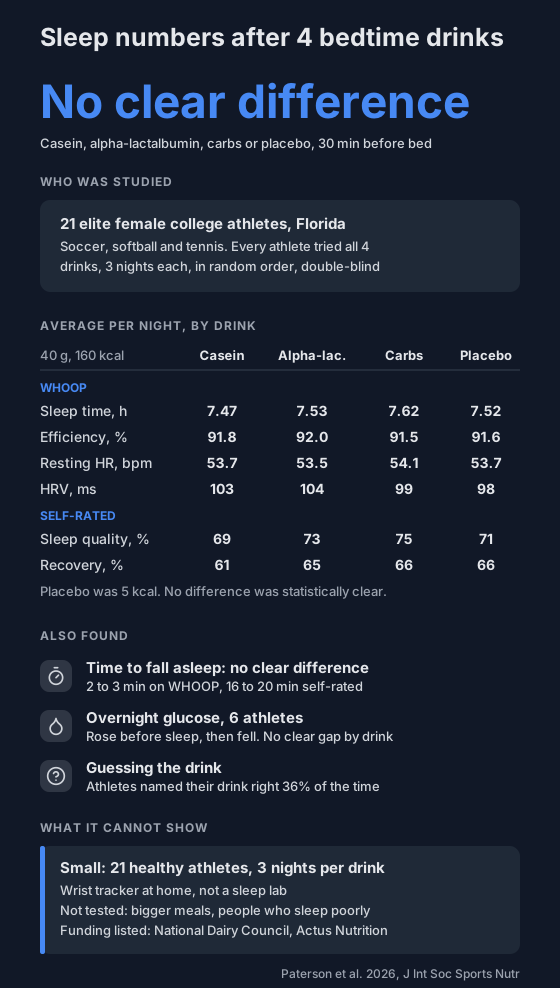
21 elite female athletes drank casein, alpha-lactalbumin, carbohydrate or placebo 30 minutes before bed, 3 nights each. WHOOP sleep time, sleep efficiency, resting heart rate and HRV showed no clear difference between drinks.
A lot of people avoid eating before bed because they've heard it wrecks your sleep. Athletes get the opposite advice: a protein shake at bedtime to help muscles recover overnight.
A trial published in October 2026 tested whether a small bedtime drink changes what a wearable records overnight. None of the four drinks made a statistically clear difference.
Who was in the trial?
- 25 female college athletes at Florida State University signed up and 21 finished.
- They played soccer (12), softball (4) and tennis (5) at NCAA Division I level, average age 21.
- None had a known sleep disorder or eating disorder.
- Two used a sleep aid on 5 to 7 nights a week.
- All had worn a WHOOP 4.0 wristband for at least three weeks before starting, as part of team monitoring.
What did they drink?
Every athlete tried all four drinks, in random order:
- Casein: 40 g of milk protein, 160 kcal.
- Alpha-lactalbumin: 40 g of a milk protein high in tryptophan, 160 kcal.
- Carbohydrate: 40 g, 160 kcal.
- Placebo: a flavoured drink with 5 kcal.
Each drink was taken about 2 hours after dinner and 30 minutes before bed, as the last thing they had that day. Each one ran for 3 nights in a row, with at least 3 days off before the next. Neither the athletes nor the researchers knew which drink was which. At the end of each block, the athletes named the right drink 36% of the time.
What did the wristband show?
No clear difference between the four drinks on anything it measured:
- Sleep time: 7.47 to 7.62 hours.
- Sleep efficiency (share of time in bed spent asleep): 91.5% to 92.0%.
- Time to fall asleep: about 2 to 3 minutes.
- Overnight resting heart rate: 53.5 to 54.1 beats per minute.
- Overnight HRV: 98 to 104 ms, a little higher after the two proteins, but not a statistically clear difference.
How did they feel in the morning?
Also no clear difference:
- Self-rated sleep quality: 69% to 75%.
- Self-rated time to fall asleep: 16 to 20 minutes.
- Self-rated recovery: 61% to 66%.
The researchers expected alpha-lactalbumin to come out ahead, because of its tryptophan. It didn't. Two earlier trials in female rugby players did find small gains with a purer form of it, and other trials found none.
What about blood sugar?
Only six athletes had complete glucose sensor data for all four blocks, mostly because sensors came off during training and matches. In those six, glucose rose before sleep and drifted down through the night, with no clear difference by drink. Six is too few to say much.
What can't it show?
- Size and length. 21 athletes and 3 nights per drink. The authors say that's too short to show longer-term effects.
- A wristband, not a sleep lab. The authors note WHOOP data are less precise than a lab sleep study.
- Who it applies to. Young, healthy, well-supported athletes who already slept about 7.5 hours with 92% efficiency. People who sleep poorly weren't tested.
- Small drinks only. 160 kcal says nothing about a large late meal.
- Food logs. The athletes logged about 2,040 kcal a day, which the authors think is under-reported, under-eating, or both.
- Menstrual cycle. The blocks weren't timed to cycle phase.
- Funding. The publisher's record lists the National Dairy Council and Actus Nutrition, which packaged and blinded the drinks, as funders. One author sits, unpaid, on the International Protein Board.
What can you do with this?
If you want to know whether an evening snack changes your own nights, run it as a self-experiment. Pick a few nights with it and a few without, keep the rest of your evening the same, and compare. One night either way tells you little; see how many nights to record.
Wearable sleep numbers are estimates. For how they compare with lab tests, read sleep trackers for athletes and how close wearable HRV is to an ECG.
If you wear an overnight pulse oximeter, you can look at your oxygen and pulse on snack and no-snack nights side by side. This trial didn't measure oxygen.
Not a medical device. Does not diagnose, treat or prevent any condition. Discuss results and changes with a clinician.
References
- Paterson KGP, Griest TD, Angeles E, Fenner SP, Eberhardt HK, McKay CR, Helms KLW, Calderon A, Vukovich MD, Ormsbee MJ. Pre-sleep milk-derived proteins do not impair sleep or recovery in elite female athletes. Journal of the International Society of Sports Nutrition. 2026;23(1):2746899. doi:10.1080/15502783.2026.2746899