Weight Loss Surgery and Sleep Apnea Traits
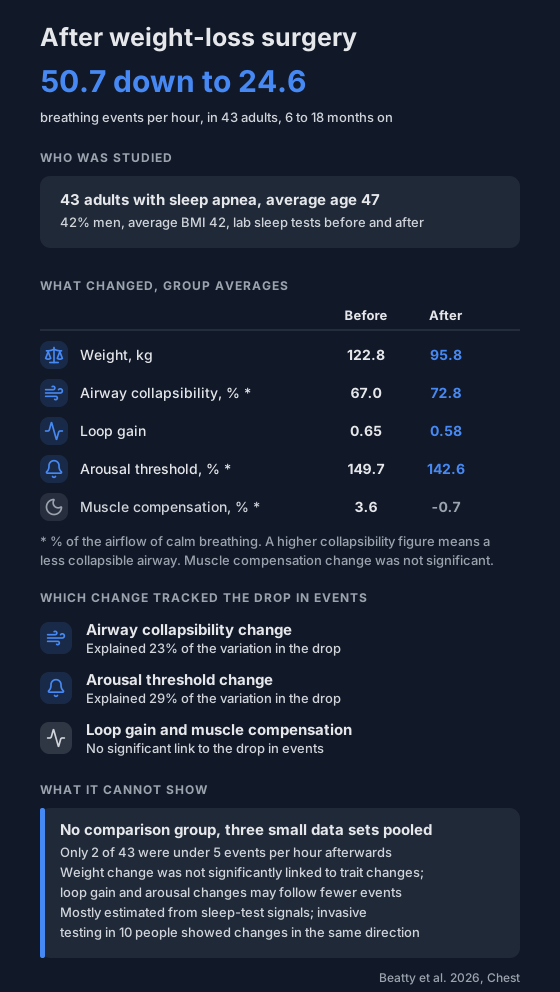
A 2026 study of 43 adults found breathing events per hour halved after weight-loss surgery, from 50.7 to 24.6. The airway and arousal threshold changes tracked the drop; the loop gain change did not.
Weight is a well-known factor in sleep apnea, but losing it doesn't work the same way for everyone. A 2026 study from Australia looked at what weight-loss surgery changed in the way people's breathing behaves in sleep.
Across 43 adults, breathing events per hour halved. Three of the four traits it measured moved too, and only two of those changes tracked the drop.
What are these traits?
Researchers describe sleep apnea by a few traits that differ between people. The study measured four:
- Airway collapsibility: how easily the airway closes during sleep.
- Loop gain: how strongly breathing overreacts to a small change in oxygen or carbon dioxide, which makes breathing swing up and down.
- Arousal threshold: how much breathing effort it takes to wake you up. A lower threshold means you wake more easily.
- Muscle compensation: how well the muscles of the throat step in to hold the airway open.
Who was in the study?
- 43 adults with sleep apnea, average age 47, 42% men.
- Average weight was 122.8 kg and average BMI 42.
- Most (70%) started at 30 or more breathing events per hour.
- Three types of surgery: sleeve gastrectomy (24), gastric banding (15) and one-anastomosis gastric bypass (4).
- The data came from three studies pooled together: one planned for this question and two earlier ones re-analysed.
- Each person had an overnight lab sleep test before surgery and again 6 to 18 months after.
What changed after surgery?
Average weight fell 27.0 kg, a 21.8% loss, and BMI fell from 42.1 to 32.8.
| Before | After | |
|---|---|---|
| Breathing events per hour | 50.7 | 24.6 |
| Airway collapsibility (higher = less collapsible) | 67.0% | 72.8% |
| Loop gain | 0.65 | 0.58 |
| Arousal threshold | 149.7% | 142.6% |
| Muscle compensation | 3.6% | -0.7% (not significant) |
Percentages are a share of the airflow of calm breathing. Oximeter numbers moved too (medians): lowest SpO2 went from 80.0% to 84.0% and ODI 3% from 36.1 to 14.8 per hour.
Which change tracked the drop in events?
- Airway collapsibility: a bigger change went with a bigger drop in events (R2 0.23).
- Arousal threshold: a bigger fall went with a bigger drop in events (R2 0.29).
- Loop gain and muscle compensation: no statistically significant link to the drop.
The change in BMI wasn't significantly linked to the change in any trait. The authors say that could be low numbers, noisy estimates or different routes to the same result. They also say the lower loop gain and arousal threshold may follow from fewer breathing events, since CPAP and upper airway surgery have shown similar changes without weight loss.
Who changed most?
The study also looked at starting traits. On their own, none held up after correcting for multiple tests. A more collapsible airway at the start leaned towards bigger drops, but not significantly. With the starting events per hour taken into account, the direction flipped: people with a less collapsible airway at the start saw bigger drops, and so did people with a lower loop gain. The loop gain link was borderline, and it stopped being significant in the model with all four traits. These models were exploratory and not corrected for multiple tests. The authors also warn that part of the link with starting events per hour may be regression to the mean.
What doesn't it tell you?
- Cause. There was no comparison group, so the study can't separate surgery from other changes over 6 to 18 months.
- Size. 43 people from three small data sets. The authors couldn't test whether the traits explain the link between weight loss and fewer events.
- Other factors. The authors couldn't look at whether sleep position or face and jaw shape explain why people responded differently.
- Still apnea. Average events stayed at 24.6 per hour, only 2 people ended under 5, and most were still living with obesity.
- Individual results. Some people got worse or stayed the same.
- Trait estimates. Most came from sleep-test signals. Invasive methods in 10 people showed changes in the same direction.
- Other weight-loss routes. Medication and lifestyle change weren't studied.
- Funding. Grants came from the American Thoracic Society, the Australian NHMRC and the US NIH. Several authors report ties to CPAP makers, weight-loss drug makers and surgical device makers.
What can you do with this?
Your own oximeter can't measure these traits. It can show your overnight oxygen and how it moves with your breathing events. For more on weight and apnea, see tirzepatide and sleep apnea and why most sleep apnea isn't linked to obesity.
Not sure about your own risk? The sleep apnea risk check takes about a minute and helps you decide whether to talk to a doctor.
Not a medical device. Does not diagnose, treat or prevent any condition. Discuss results and changes with a clinician.
References
- Beatty CJ, Wong AM, Landry SA, Thomson LDJ, Collet J, Odeke V, Joosten SA, Playfair J, Malhotra A, Kee K, Naughton MT, Sutherland K, Cistulli PA, Patel SR, et al. The Impact of Weight Loss on the Physiological Endotypes Associated With OSA. Chest. 2026;170(1):250-261. doi:10.1016/j.chest.2026.02.003