Weight-Loss Surgery: Oximetry or Sleep Test?
A 2026 Dutch study of 1,388 people having weight-loss surgery compared hospitals that ran a sleep test first with one that used extra oxygen and ward oximeter monitoring after surgery. Sleepiness and quality of life over the next year were similar.
Sleep apnea is common in people having weight-loss surgery, and most of it has never been found. Some hospitals run a sleep test before the operation, and others skip it and watch oxygen closely afterwards instead.
A 2026 Dutch study looked at whether that choice made a difference to how sleepy people felt in the year after surgery. It found no statistically significant difference.
What were the two approaches?
This was a prospective cohort study, not a trial. The approach was set by each hospital's own routine, not by the study.
- Sleep test approach (6 hospitals, 691 people). Everyone had a sleep test before surgery. If it showed sleep apnea, they started CPAP-type therapy. 48.9% were found to have sleep apnea.
- Oximetry approach (1 hospital, 697 people). No sleep test before surgery. After the operation, people got extra oxygen through a nasal tube and were monitored with a pulse oximeter on the ward. Nurses were alerted when oxygen fell below 90%, and woke the person or turned up the oxygen if it stayed low.
So the "oximetry" here is hospital monitoring after surgery, during a one-night stay. It isn't a home oximeter used in place of a sleep test.
The idea behind skipping the test is that sleep apnea often eases as the weight comes off. An earlier report from the same project found similar rates of complications or unplanned intensive care admissions in the two approaches, and lower costs for the oximetry one.
Who was in the study?
- 1,388 adults having a gastric bypass or sleeve operation, 2018 to 2020.
- Average age 45, 79% women, median BMI 42.
- Nobody had been tested for sleep apnea before.
The oximetry group was a little younger, had fewer men, and had less high blood pressure and high blood fats.
What did it measure?
Questionnaires before surgery and at 1, 3, 6 and 12 months after:
- Daytime sleepiness, on the Epworth Sleepiness Scale (0 to 24, higher is sleepier).
- How sleepiness affects daily life, on a 5 to 20 scale (higher is better).
- Quality of life across 9 areas, such as physical function, energy and mood.
- Weight lost.
What did it find?
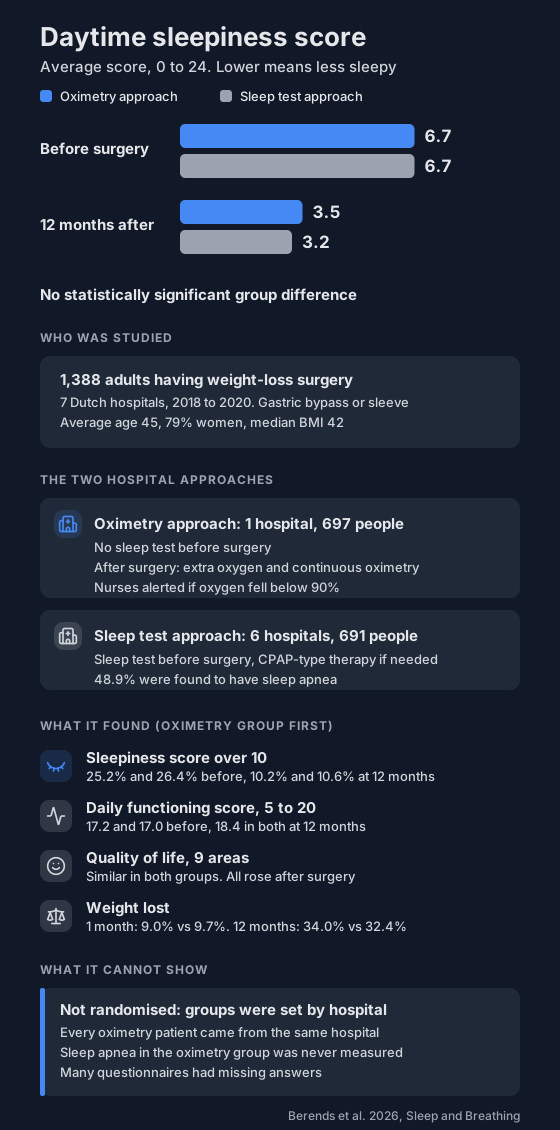
- Sleepiness. No statistically significant difference between the approaches. The average score went from 6.7 to 3.5 with oximetry, and from 6.7 to 3.2 with the sleep test.
- Sleepiness score over 10. 25.2% and 26.4% before surgery, down to 10.2% and 10.6% at 12 months.
- Daily functioning. No statistically significant difference. 17.2 and 17.0 before, 18.4 in both groups at 12 months.
- Quality of life. Similar in both groups. All 9 areas went up after surgery, though two (limits from physical and emotional health) dipped at 1 month first.
- Weight. The oximetry group had lost a little less at 1 month (9.0% vs 9.7%) and a little more at 6 months (26.5% vs 25.9%) and 12 months (34.0% vs 32.4%). These gaps were statistically significant, but the authors say a gap that size, about 1 to 2 kg, isn't clinically relevant.
The authors suggest the groups looked alike because sleepiness in people with obesity isn't only down to sleep apnea, and weight loss itself lifts quality of life. For more on that, see sleep apnea without sleepiness.
What can't it tell you?
- Cause. It wasn't randomised. Every oximetry patient came from one hospital, so differences between hospitals could explain some results. The authors adjusted for age, BMI and sex only.
- Who had sleep apnea. Nobody in the oximetry group was tested, and nobody was retested after surgery. So the study can't say whether sleepiness fell because of weight loss or because there was less sleep apnea.
- Missing answers. Many questionnaires came back incomplete.
- Longer term. Follow-up stopped at one year.
The study was funded by ZonMw, the Dutch public health research funder, and the authors report no conflicts of interest.
The authors write that their results lend further support to the hospital oximetry approach around weight-loss surgery. That's the authors' view of hospital care around one operation, not a claim about home oximeters. The study says nothing about whether a home oximeter can stand in for a sleep test.
What can you do with this?
If you're having weight-loss surgery, ask your team how they handle sleep apnea before and after the operation.
An overnight oximeter can't tell you whether you have sleep apnea. It can show how your oxygen changes as your weight does, which you can share with your doctor. For how home oximetry compares with a lab study, see home oximetry ODI vs a sleep study.
Not a medical device. Does not diagnose, treat or prevent any condition. Discuss results and changes with a clinician.
References
- Berends C, Heusschen L, van Veldhuisen SL, de Castro SMM, van Veen RN, Wiezer MJ, Liem RSL, van Dielen FMH, Demirkiran A, Boerma EG, Fabius TM, Hazebroek EJ. Excess daytime sleepiness, daily functioning and health-related quality of life during the first year after metabolic and bariatric surgery in patients with a known and unknown obstructive sleep apnea status. Sleep and Breathing. 2026;30(4):188. doi:10.1007/s11325-026-03729-5
- van Veldhuisen SL, Keusters WR, Kuppens K, de Raaff CAL, van Veen RN, Wiezer MJ, Swank DJ, Demirkiran A, Boerma EG, Greve JM, van Dielen FMH, de Castro SMM, Frederix GWJ, Hazebroek EJ. Cost-effectiveness and safety of continuous pulse oximetry for management of undiagnosed obstructive sleep apnea in bariatric surgery: a nationwide cohort study. Surgery for Obesity and Related Diseases. 2024;20(12):1244-1252. doi:10.1016/j.soard.2024.06.009