Wearables, Sleep Apnea and Blood Pressure
A 2026 scoping review found 13 studies of wearables that tracked both breathing during sleep and blood pressure or heart measures. They can flag risk, but can't replace a sleep study or a cuff.
PulseOxTracker Team
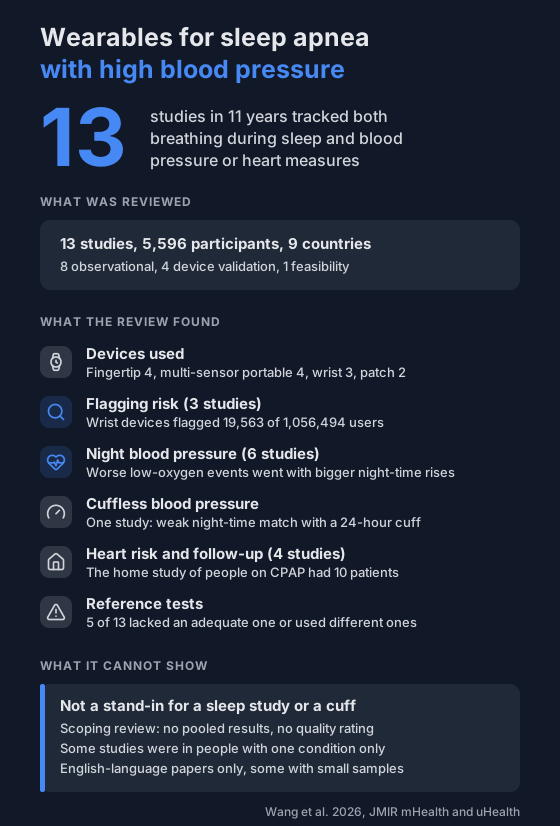
Sleep apnea and high blood pressure often turn up together. A scoping review published in July 2026 asked what wearables add for people with both.
What did the review cover?
- 739 records from four databases (January 2015 to February 2026), and 13 studies fitted.
- 5,596 participants across 9 countries, a total that can't include every user in the wrist-device study below.
- 8 observational studies, 4 device validation studies and 1 feasibility study.
- Devices: fingertip sensors (4 studies), multi-sensor portable systems (4), wrist-worn devices (3), and patches or single-lead devices (2).
What can wearables do?
- Flag risk. In one study, wrist devices checked 1,056,494 users and flagged 19,563 as high risk for sleep apnea. Of those who went on to a home sleep test or lab sleep study, 1,054 had it confirmed.
- Work in primary care. In a study of 2,573 older adults with high blood pressure, a wearable ECG helped pick out those at high risk of sleep apnea.
- Show oxygen and blood pressure together. The review says the worse the low-oxygen events, the bigger the rise in night-time systolic blood pressure and its variability, citing two studies.
- Follow people at home. A feasibility study of 10 people on CPAP used wearables to follow sleep, activity and blood pressure.
What can't they do?
- Replace a sleep study. The review says most wearables have no brain wave channels, so they can't fully stage sleep or catch every kind of breathing event.
- Replace a cuff. In one study, cuffless estimates matched a 24-hour cuff monitor only weakly at night, and tended to run high in people with more frequent breathing events.
The authors say wearables suit trend watching and risk warnings for now.
How strong is the evidence?
- It's a scoping review, so results weren't pooled and study quality wasn't rated.
- 5 of the 13 studies lacked an adequate reference test or used different ones.
- Some studies were in people with only one of the two conditions.
- Some had small samples, and only English-language papers were included.
What can you do with it?
Twelve of the 13 studies counted breathing events or oxygen dips per hour, and nine used low-oxygen measures such as time below 90%. An overnight oximeter logs both.
- Record several nights, not one.
- Look at your dips per hour.
- If you have high blood pressure and your nights look unsettled, show your doctor the recordings.
Not a medical device. Does not diagnose, treat or prevent any condition. Discuss results and changes with a clinician.
References
- Wang H, Cheng A, Li Y, Zhang H, Fan S, Shen R, Zhang W, Li H, Wang J. Wearable Devices for Monitoring and Management of Comorbid Obstructive Sleep Apnea and Hypertension: Scoping Review. JMIR mHealth and uHealth. 2026;14:e84506. doi:10.2196/84506