Wearable Sleep Efficiency and Grip Strength
A 2026 study of 165 older outpatients in Tokyo found that lower sleep efficiency from a wrist device, but not shorter sleep, went with a weaker grip. The device's sleep figures were lower than in earlier reports.
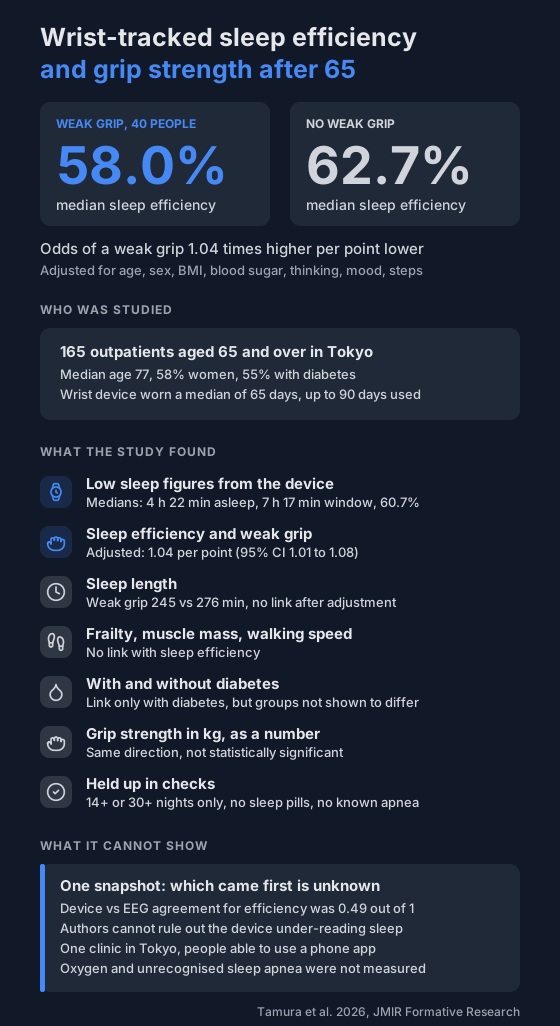
Earlier studies linked poor sleep with a weaker grip, but most of them asked people how they slept. A 2026 study from Tokyo used a wrist device instead, worn for weeks at a time.
Lower sleep efficiency went with a weaker grip. Sleep length didn't, once other factors were taken into account.
What's sleep efficiency?
It's the share of time in bed that you spend asleep. 7 hours in bed with 6 hours asleep is about 86%.
Here the window came from the device's own sleep and wake status. It ran from the first switch to sleep after 6 pm that lasted 30 minutes, to the last switch to waking before 9 am that lasted 30 minutes. Waking in between counted against efficiency.
Who was studied?
- 165 outpatients aged 65 and over at a geriatrics hospital in Tokyo, recruited through its frailty clinic.
- Median age 77, and 58% were women.
- Most had heart and metabolic conditions: 55% had diabetes, 64% high blood pressure and 73% abnormal blood fats.
- They wore a Silmee W22 wrist device (TDK) and a step counter on the ankle.
- Each person needed at least 7 valid nights, and up to 90 were used. The median was 65 days of wear.
- Grip was tested with a hand dynamometer. Under 28 kg for men and under 18 kg for women counted as weak, an Asian guideline cut-off.
- 40 of 162 people with a grip test (24.7%) had a weak grip.
How low were the sleep figures?
- Median time in the window: 437 minutes, about 7 hours 17 minutes.
- Median time asleep: 262 minutes, about 4 hours 22 minutes.
- Median sleep efficiency: 60.7%.
The authors say sleep length and efficiency were both lower than in earlier reports. They give three possible reasons:
- The group was older and had several long-term conditions.
- Depression is common in patients like these, and one sleep lab study of older adults with depression found efficiency of about 60%.
- The device may record less sleep than there really was. They say they can't rule this out.
An earlier check of this device against a portable EEG, by the same institute, scored its sleep efficiency agreement at 0.49 out of 1, averaged over several nights. Total sleep time scored 0.75. That's why the paper calls it "wearable-estimated" sleep efficiency.
For how wrist trackers compare with brain-wave sleep scoring, see EEG headband vs actigraphy in older adults.
What did they find?
- Sleep efficiency: 58.0% in people with a weak grip, 62.7% in the rest.
- After adjustment: each 1-point drop in efficiency went with 1.04 times the odds of a weak grip (95% confidence interval 1.01 to 1.08). The model adjusted for age, sex, BMI, blood sugar (HbA1c), memory and thinking scores, mood and daily steps.
- Sleep length: 245 minutes against 276 in people without a weak grip. In the regression models, sleep length wasn't significantly linked to a weak grip. Short (under 4 hours) or long (7 hours or more) sleep wasn't linked to frailty or the strength and muscle measures either.
- Other measures: sleep efficiency wasn't linked to frailty, low muscle mass, slow walking, or sarcopenia (low muscle mass plus weakness or slow walking).
- Grip as a number: with grip in kilograms instead of a weak/not weak cut-off, the result pointed the same way but wasn't statistically significant.
- More broken daily rhythm: people with a weak grip had more fragmented rest-activity patterns. Adding any one of the rhythm measures to the model, the main link stayed statistically significant.
Did diabetes matter?
The link showed up in the 90 people with diabetes (odds 1.05 per point) and not in those without. But the test for a difference between the two groups wasn't statistically significant (P=.46), so the paper finds no evidence that diabetes changes the link. Adjusting for how long people had had diabetes, or for GLP-1 and SGLT2 drugs, left the diabetes result just short of significance.
Did it hold up?
Yes. The main result stayed the same when the authors:
- Kept only people with at least 14 or at least 30 valid nights.
- Left out the 15 people on sleep medication or antipsychotics.
- Left out the 11 people with known sleep apnea.
What can't it show?
- Cause or direction. It's a cross-sectional study, one snapshot. Poor sleep could weaken grip, a weaker body could disturb sleep, or something else could drive both.
- Accuracy of the sleep numbers. The authors say the device's limited accuracy may have affected the results.
- Size. The odds rise 1.04 times per point, and the low end of the 95% confidence interval is 1.01, close to no link.
- Everyone. It's one clinic, and nearly everyone used a smartphone app, which the authors flag as possible selection bias.
- Other factors. Pain, diet, inflammation, nerve damage from diabetes and unrecognised sleep apnea weren't measured.
- Oxygen. No one's overnight oxygen was recorded.
The Tokyo Metropolitan Government funded it. One author reported research funding from two companies and another speaker fees from a drug company.
What can you take from it?
- A wrist tracker's sleep efficiency is an estimate. Compare your own nights over weeks rather than against someone else's number.
- The study needed at least 7 nights per person, because earlier actigraphy research found that's what it takes to estimate sleep measures. See one sleep study vs 3 months of tracking.
- Studies that test wearable accuracy rarely include older adults. See who wearable accuracy studies leave out.
- Broken sleep in older adults can have many causes, sleep apnea among them. See sleep apnea in older adults.
If you sleep badly most nights or notice your strength dropping, tell your doctor.
Not a medical device. Does not diagnose, treat or prevent any condition. Discuss results and changes with a clinician.
References
- Tamura Y, Gong R, Murao Y, Kobayashi F, Kobayashi S, Kodera R, Oba K, Shirobe M, Toyoshima K, Kubo K, Chiba Y, Kawai H, Ishikawa J, Sasai H, et al. Association Between Wrist-Worn Device-Estimated Sleep Efficiency and Hand Grip Strength in Older Outpatients With Cardiometabolic Diseases: Cross-Sectional Study. JMIR Formative Research. 2026;10:e95303. doi:10.2196/95303