Oura Ring in Hospital: A Pilot in Over-65s
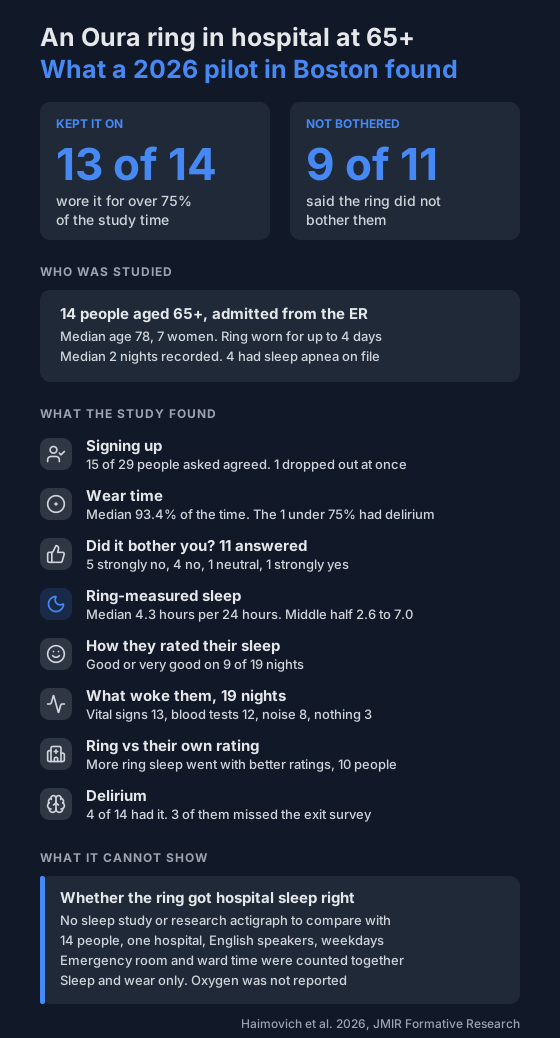
A 2026 Boston pilot gave an Oura ring to 14 people aged 65 and over admitted from the emergency department. 13 kept it on for over 75% of the time, 9 of 11 said it didn't bother them, and the ring logged a median 4.3 hours of sleep per 24 hours.
Sleep in hospital is hard to come by, and it's hard to measure too. Much of what's known about sleep while waiting in the emergency department comes from what patients say or from logs of when staff came in.
A pilot study from Boston, published in 2026, asked a simpler question first. Will older people who've just been admitted through the emergency department keep a sleep-tracking ring on, and does it bother them?
Who was in the study?
- 14 people aged 65 and over, admitted to a medical ward from the emergency department of one Boston hospital.
- Median age 78, range 65 to 92. 7 were women.
- 4 had obstructive sleep apnea on their records, and 3 had dementia or memory problems.
- They wore an Oura Ring Gen 3 for up to 4 days, or until they went home. The median was 2 nights.
- Recruitment ran in February and March 2025, on weekday afternoons and evenings.
The ring stayed on through the wait in the emergency department and the move to the ward.
Did they keep it on?
Mostly, yes.
- 15 of 29 people asked agreed to take part (51.7%). 1 dropped out straight away.
- 13 of the 14 who stayed wore the ring for more than 75% of the time (92.9%).
- The median wear was 93.4% of the time.
- The one person who didn't reach 75% had delirium from the start and wore it about 8% of the time.
Did it bother them?
11 people answered the exit survey. They were asked whether the ring bothered them.
- 5 strongly disagreed and 4 disagreed: 9 of 11 (81.8%).
- 1 was neutral.
- 1 strongly agreed.
The 3 who didn't answer all had delirium at the time. One of them moved to intensive care and the ring came off.
How much did they sleep?
In the 13 people who wore it enough, the ring logged a median of 4.3 hours of sleep per 24 hours. The middle half ranged from 2.6 to 7.0 hours.
The authors note that's below the roughly 5.8 hours a previous meta-analysis found for older adults in hospital. They list several possible reasons, including the different way it was measured and the time spent in the emergency department.
What patients said, over 19 nights of surveys:
- Good or very good sleep on 9 nights (47.4%).
- Something woke them on 16 of the 19 nights.
- Staff checking vital signs: 13 nights. Blood tests: 12. Noise: 8. Medication rounds: 6.
In 10 people with both kinds of data, those who rated their sleep better tended to have more ring-measured sleep (Kendall tau 0.54, P = .04).
If you've been on a ward, the list of interruptions won't surprise you. A separate study looked at hospital lighting and snoring after a stroke.
What can't it show?
- Whether the ring was right. Its sleep figures weren't checked against a sleep study or a research actigraph, and its algorithm wasn't built for people who are acutely ill.
- Precise figures. 14 people is very small, so the percentages could be quite a bit higher or lower in a bigger group.
- Everyone. One hospital, English speakers only, and recruited on weekday afternoons and evenings.
- Comfort for the sickest. The 3 with delirium at the exit survey weren't counted, which may make the ring look more acceptable than it was.
- Emergency department vs ward. The time in each was pooled, because the data didn't say when people moved.
- Oxygen. The study reports wear time and sleep only.
The authors call for bigger studies that compare the ring with a sleep study in hospital. Oura had no role in the funding or the study.
What can you do with this?
It's a small feasibility study, so it mostly suggests most older patients will keep a ring on in hospital, though delirium made it harder. It doesn't tell you how accurate the sleep numbers are there.
For how rings do against a sleep lab outside hospital, see how accurate smart rings are for sleep. For a look at the numbers wearables give you in general, read how valid smartwatch numbers are.
If you or someone you care for is in hospital and sleeping badly, mention it to the care team.
Not a medical device. Does not diagnose, treat or prevent any condition. Discuss results and changes with a clinician.
References
- Haimovich AD, Lacourciere A, Palihnich K, Mulqueen S, Jansen N, Bertisch SM, Schonberg MA, Naik AD, Berry SD, Marcantonio ER, Shapiro NI, Mullington JM. Feasibility and Acceptability of Oura Ring Sleep Monitoring in Older Adults Admitted From the Emergency Department: Prospective Cohort Study. JMIR Formative Research. 2026;10:e92359. doi:10.2196/92359