Do Wearable Oxygen Reports Change CPAP Use?
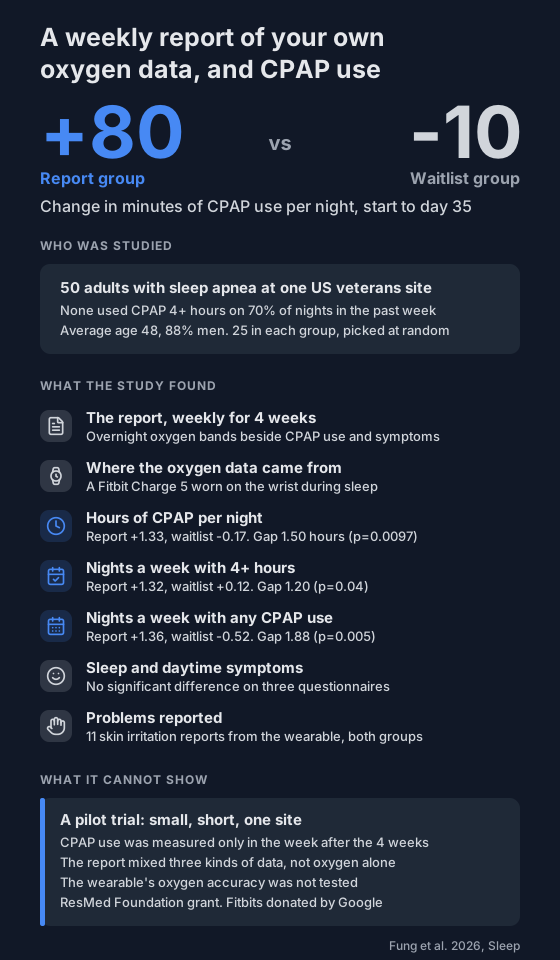
A pilot randomised trial gave 50 adults on CPAP a weekly report of their own overnight oxygen data from a wearable. CPAP use went up by about 80 minutes a night in the report group.
Most people prescribed CPAP struggle to use it regularly. Clinics have tried remote monitoring, behavioural programmes and apps that show your usage.
A pilot trial published in the journal Sleep in 2026 tried something different. It showed people their own overnight oxygen numbers from a wrist wearable, next to the nights they did and didn't use CPAP. The paper says PAP, positive airway pressure, the family of machines that includes CPAP.
Who was in the trial?
- 50 adults with obstructive sleep apnea at one US veterans medical centre in Los Angeles.
- Average age 48, ranging from 24 to 73. 88% were men.
- All had been prescribed CPAP for at least 7 days and had a smartphone. None had used it for 4 or more hours on 70% of nights in the past week.
- People with chronic lung disease, heart failure or home oxygen were left out.
- 25 were picked at random to start the programme straight away. The other 25 went on a waitlist.
Everyone kept their usual clinic care during the trial.
What did the report group get?
- A Fitbit Charge 5 to wear during sleep.
- A weekly report for 4 weeks, put together by the research team.
- The report showed how much of each night was spent in each oxygen band, such as above 92%, 88% to 92%, and below 88%.
- Next to that, it showed whether CPAP was used that night, and the person's own answers to weekly questions about symptoms like daytime sleepiness.
- One check-in of 10 to 30 minutes with non-clinical research staff in the first week, to sort out setup and explain the report. Staff encouraged people to look for patterns between CPAP use and low oxygen.
What did the trial find?
CPAP use was read from the machine's own modem data, by staff who didn't know which group each person was in. It was compared between the start and day 35, a week after the 4 weeks ended.
Average CPAP use per night:
- Report group: up 1.33 hours (about 80 minutes).
- Waitlist group: down 0.17 hours (about 10 minutes), a change that was not statistically significant (p=0.67).
- Difference between the groups: 1.50 hours, or 90 minutes (95% CI 0.38 to 2.62, p=0.0097).
Nights per week with 4 or more hours of CPAP:
- Report group: up 1.32 nights.
- Waitlist group: up 0.12 nights (not statistically significant).
- Difference: 1.20 nights (p=0.04).
Nights per week with any CPAP use:
- Report group: up 1.36 nights.
- Waitlist group: down 0.52 nights (not statistically significant).
- Difference: 1.88 nights (p=0.005).
The authors say the 80 minute rise is comparable to the roughly 79 minutes earlier studies found for behavioural programmes, which are typically delivered by a healthcare provider. For what a separate review found goes with more and less CPAP use, read sticking with CPAP.
Did people feel any different?
Not measurably. There was no statistically significant difference between the groups on two sleep questionnaires or a daytime sleepiness scale.
Were there any problems?
- 11 reports of skin irritation from the wearable, which the authors call a surprising number. That count covers both groups, as the waitlist group did the programme later.
- One person reported a bruise from it.
- One person was hospitalised for an unrelated leg injury and infection.
What can't it tell you?
- Whether it lasts. The programme ran for 4 weeks and CPAP use was measured once, in the week after. The authors call that a short follow-up for a therapy that's usually lifelong.
- Whether it holds for everyone. It was a pilot with 50 people at one clinic, mostly men.
- Which part did the work. The report put oxygen data, CPAP use and symptoms side by side, and there was a check-in too. The trial tested the whole package, not the oxygen numbers on their own.
- Whether the oxygen numbers were right. The trial didn't test the wearable's accuracy. The authors note a patient could be falsely reassured if a wearable consistently read wrong, and raise the open question of accuracy on darker skin. See smartwatch SpO2 vs a pulse oximeter and skin tone, oximeters and wearables.
- Whether people guessed their group. They weren't told, but the authors say some may have worked it out.
The trial was funded by a grant from the ResMed Foundation, and Google donated the Fitbit devices. The authors state the funders had no role in the design, analysis or write-up. One author declared an advisory role with a digital health company, services received from three others and a provisional patent, and says none of them influenced the study.
What can you do with this?
This was a programme run by a research team alongside clinic care, in one small group. It doesn't show that looking at your own oximeter data will change how much you use CPAP.
If you're on CPAP and want to keep a record of your overnight oxygen, read tracking oxygen with CPAP. Questions about your therapy go to your sleep clinic, and you can share your oximeter data with your doctor.
Not a medical device. Does not diagnose, treat or prevent any condition. Discuss results and changes with a clinician.
References
- Fung CH, Mak S, Ash G, Der-McLeod E, Jason Ereso BS, Naeem S, Liu J, Ghadimi S, Te TT, Chan V, Hurtado J, Wong S, Zeidler M, Liang LJ. Augmenting management of obstructive sleep apnea with consumer wearable devices to increase use of positive airway pressure therapy: a pilot randomized trial. Sleep. 2026;49(4):zsaf342. doi:10.1093/sleep/zsaf342