Does a Vibrating Device Stop Back Sleeping?
A pilot study of 20 healthy volunteers found a vibrating chest device cut back sleeping from 56% of sleep time to 7.8% for one night, with no significant change in total sleep time.
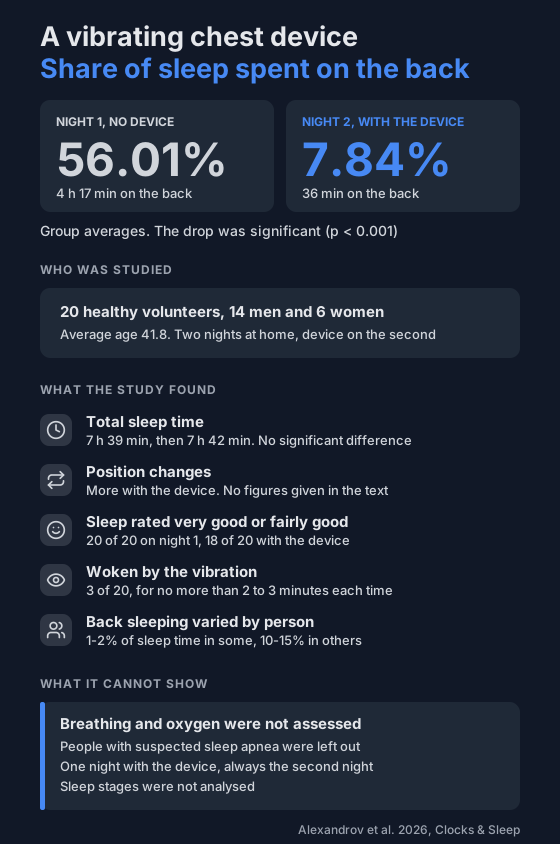
Devices that buzz when you roll onto your back are sold to snorers and to people whose breathing is worse in that position. The obvious worry is that being buzzed all night costs you sleep.
A pilot study published in Clocks & Sleep in 2026 tested one such device on 20 healthy volunteers. On the one night they wore it, they spent far less time on their backs, and 18 of 20 rated their sleep very good or fairly good. It didn't measure breathing, snoring or oxygen.
Who was in the study?
- 20 volunteers who rated their own health as good: 14 men and 6 women.
- The average age was 41.8 and the average BMI was 24.8.
- Eight said they snored now and then.
- Anyone with suspected sleep apnea on a risk checklist, a known sleep disorder, a long-term illness or medication that affects sleep was left out.
What did they do?
- Each person slept at home for two nights in a row.
- On both nights a home sleep recorder logged body position.
- On the second night they also wore the device, SoftSleep, on an elastic strap over the lower breastbone.
- It weighs about 21 g and vibrates when it senses you're on your back.
- Each morning they rated their sleep on a four-point scale and said whether the vibration had woken them.
Did it keep people off their backs?
Yes.
- Without the device: an average of 4 hours 17 minutes on the back, or 56.01% of sleep time.
- With the device: 36 minutes, or 7.84%.
- The drop was statistically significant (p < 0.001).
It wasn't the same for everyone. Back sleeping fell to 1-2% of sleep time in some volunteers and stayed at 10-15% in others.
A trial in people with sleep apnea found a similar effect on position from a different chest-worn alarm, while whole-night snoring did not fall significantly.
Did it disturb their sleep?
Not much, going by what the study measured.
- Total sleep time. 7 hours 39 minutes without the device and 7 hours 42 minutes with it. The difference was not statistically significant.
- Sleep rating. All 20 rated the first night very good or fairly good. With the device, 18 did.
- The two who rated it lower. They put it down to getting used to wearing the device, not to the vibration.
- Waking up. Three people said the vibration woke them. None of those awakenings lasted more than 2 to 3 minutes.
- Position changes. People changed position more often with the device. The paper shows this in a chart and gives no figures in the text.
- Discomfort. 90% reported no significant discomfort, which is 18 of 20.
Nobody stopped using the device during the night.
What doesn't it tell you?
- Anything about breathing. The study didn't assess breathing or oxygen. The authors call the change in position a first step, to be tested next in people whose sleep apnea depends on position.
- Sleep depth. Sleep stages weren't analysed. Sleep quality came from one four-point question each morning.
- The long run. It was one night with the device. The authors say people may get used to the vibration over time.
- A fair comparison. There were 20 people, not chosen at random. The device night was always the second one, and there was no dummy device to compare with.
The paper also contradicts itself in places. It says the results support the device not altering sleep structure, then lists the lack of sleep structure analysis as a limitation. It describes other devices cutting back sleeping by 10-15% as an equivalent result.
The authors declare no conflict of interest and no external funding. The paper doesn't say whether they have a link to SoftSleep LLC, the maker.
What can you do with this?
This study shows a device changed sleep position for one night in healthy volunteers. It doesn't show any effect on snoring, breathing or oxygen. Whether position matters for you is a separate question.
- If you record overnight oxygen, you can compare back and side nights.
- For how often breathing depends on position, see positional sleep apnea in 12,000 patients.
- Loud snoring with pauses in breathing or daytime exhaustion is worth a visit to your doctor. See snoring vs sleep apnea for the signs.
Not a medical device. Does not diagnose, treat or prevent any condition. Discuss results and changes with a clinician.
References
- Alexandrov AR, Kiselev AR, Agaltsov MV, Alexandrova AR, Kudashov IA. Evaluation of the Efficacy of a Vibrotactile Device for Positional Therapy of Sleep-Disordered Breathing: A Pilot Study in Healthy Volunteers. Clocks & Sleep. 2026;8(1):14. doi:10.3390/clockssleep8010014