Smartwatch Breathing Alert and AFib: One Case
A 2026 case report describes one 79-year-old man whose smartwatch ECG showed atrial fibrillation on mornings after the watch flagged disturbed breathing overnight. It is one person, and a watch alert is not a sleep study.
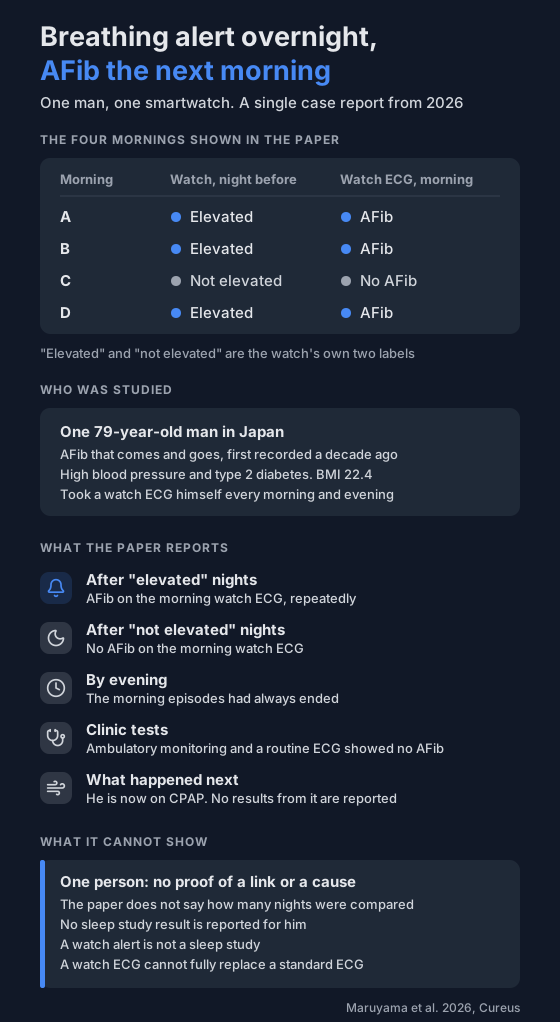
Some smartwatches now do two things at once: take an ECG when you ask, and flag disturbed breathing while you sleep. A case report published in 2026 describes one man whose watch showed the two lining up.
It's a single case. That's the weakest kind of evidence there is, so read it as an observation and nothing more.
Who was the patient?
- A 79-year-old man in Japan.
- He had atrial fibrillation (AFib) that comes and goes, first recorded on a 12-lead ECG a decade earlier.
- He also had high blood pressure, a blood lipid disorder and type 2 diabetes, all managed with medication.
- A blood test suggested a form of heart failure, the authors say.
- He was slim, with a BMI of 22.4.
- Ambulatory monitoring and a routine ECG had shown no AFib, so his doctors had put off an ablation procedure.
What did the watch show?
He started wearing an Apple Watch Series 11. A few months in, he went to his doctors about its breathing disturbance notifications.
The watch rates breathing disturbance overnight with one of two labels: "elevated" or "not elevated". He also took a watch ECG himself every morning and evening, whatever the watch had said about the night.
The paper reports:
- AFib showed up repeatedly on the morning ECG after an "elevated" reading.
- It didn't show up on mornings after a "not elevated" reading.
- The morning episodes had always ended by the evening.
The paper shows four mornings as examples. Three followed an "elevated" reading and showed AFib. One followed a "not elevated" reading and didn't.
What happened next?
He is now on CPAP therapy. His doctors will consider ablation depending on what happens to the AFib episodes on CPAP. The paper doesn't report any results from CPAP.
What can't one case show?
Almost everything you'd want to know.
- It's one person. A pattern in one man can be chance.
- No counts. The paper doesn't say how many nights or mornings were compared in total, only that the pattern repeated.
- No sleep study result. The paper doesn't report one for him. The authors say sleep apnea should be confirmed with an overnight sleep study.
- The watch label isn't a sleep study number. The authors say the watch tracks small body movements with its motion sensor, and that its reading is not equivalent to breathing events per hour on a sleep study.
- A watch ECG has limits. The authors say it cannot completely substitute for a conventional ECG.
- No cause. The authors suggest low oxygen at night may be involved, but they didn't measure it. They call for more cases with a sleep study and ECG recorded together.
The authors declared no funding and no conflicts of interest.
Larger studies have looked at sleep apnea and the heart. See the CPAP and heart health review.
What can you take from it?
- A watch notification is a reason to talk to your doctor, not an answer. That's what this man did.
- If you log more than one thing, like a morning ECG and an overnight reading, keeping the dates lets you and your doctor look at them side by side.
- Watch numbers vary in quality. See how valid smartwatch numbers are and smartwatch SpO2 against a pulse oximeter.
- Got overnight recordings? Here's how to share them with your doctor.
Not a medical device. Does not diagnose, treat or prevent any condition. Discuss results and changes with a clinician.
References
- Maruyama T, Hieda M, Fukata M. Smartwatch-Detected Atrial Fibrillation on the Morning After a Nocturnal Sleep-Disordered Breathing Notification: A Case Report. Cureus. 2026;18(5):e109701. doi:10.7759/cureus.109701