Slightly Low Oxygen and Memory in Smokers
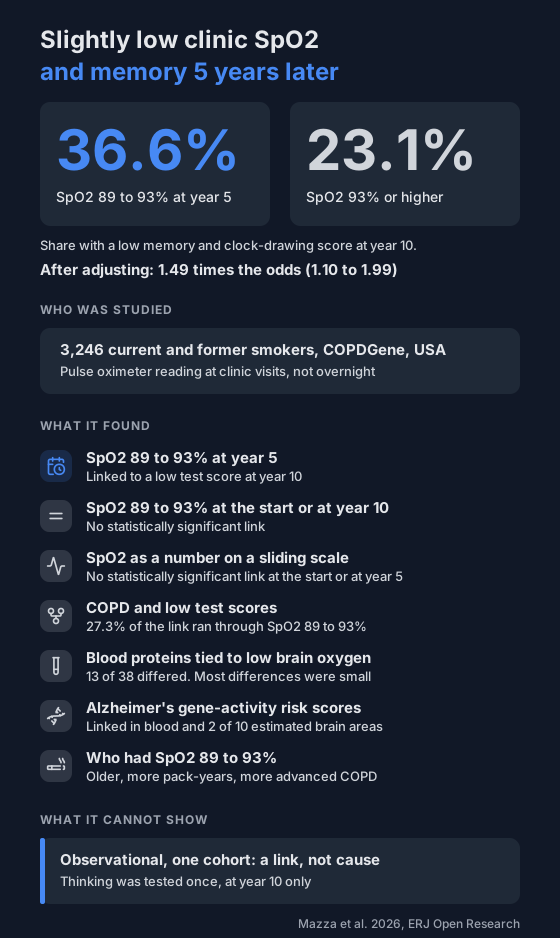
A 2026 COPDGene study of 3,246 current and former smokers found that an SpO2 reading of 89 to 93% at a clinic visit was linked with a low memory test score 5 years later. It was a clinic reading, not an overnight recording.
Very low oxygen, 88% or under, is already known to go with memory and thinking problems in people with COPD. Much less is known about readings just above that, from 89 to 93%.
A 2026 study of current and former smokers found that a reading in that range at one clinic visit was linked with a low memory test score 5 years later.
Who was studied?
- 3,246 people from COPDGene, a long-running US study of current and former smokers.
- Everyone had smoked at least 10 pack-years and was 45 to 80 when they joined.
- They had clinic visits at the start, at 5 years and at 10 years.
- SpO2 was measured with a pulse oximeter at each visit.
- At the 10-year visit they did the Mini-Cog: recall three words and draw a clock, scored out of 5.
- A score of 3 or lower counted as cognitive impairment.
Wait, was this overnight oxygen?
No. It was a pulse oximeter reading taken at a clinic visit. The paper doesn't describe when in the day it was taken or how long it lasted.
That's different from what an overnight oximeter records. Most people read a point or two lower asleep than awake, so a night that dips into the low 90s is not the same as a clinic reading of 89 to 93%. See what SpO2 means for more on that.
What did it find?
The study split readings into three bands: 93% or higher, 89 to 93%, and 88% or lower.
At the 5-year visit, 153 people read 89 to 93%.
- 36.6% of them had a low Mini-Cog score at 10 years.
- 23.1% of those reading 93% or higher did.
- After adjusting for age, race, sex, education and lung function, the 89 to 93% group had 1.49 times the odds of a low score (95% confidence interval 1.10 to 1.99).
The timing mattered:
- Reading at the start (10 years before the test): no statistically significant link.
- Reading at the 10-year visit itself: no statistically significant link.
- SpO2 as a sliding scale rather than bands: no statistically significant link at the start or at 5 years.
What about COPD?
COPD at stage 2 or higher went with a low score too, with 1.21 times the odds. The authors estimated that 27.3% of that link ran through SpO2 of 89 to 93%.
The people reading 89 to 93% were older, had smoked more pack-years and had lower lung function. At the 5-year visit, 39% of them had COPD at stage 3 or 4, against 8.5% of those reading 93% or higher.
What did the blood tests show?
The researchers looked at 38 blood proteins that earlier studies tied to low oxygen in the brain.
- 13 of them differed between people reading 89 to 93% and those reading 93% or higher.
- One was BDNF, a protein that helps nerve cells survive. It was lower in the 89 to 93% group.
- The authors say most differences were small, and some went the opposite way to what they expected.
Gene activity in blood was also compared. Risk scores built for Alzheimer's disease were linked with the 89 to 93% group in blood and in 2 of 10 brain areas, which were estimated from blood rather than measured.
What did it say about oxygen therapy?
This study didn't test oxygen therapy. The authors note that earlier trials by other groups suggested no survival benefit from oxygen therapy for people in the 89 to 93% range. They say it remains possible that oxygen could lower the chance of memory problems in this group, and that future studies should work out who would be most likely to benefit.
What can't it show?
- Cause. It's an observational study, so it shows a link, not that low oxygen caused the low scores.
- When the memory problems began. Thinking was tested once, at year 10, so the study can't say whether low scores were already there earlier.
- One cohort. The blood and gene findings weren't checked in a second group.
- Everyone. Everyone had smoked, many had COPD, and the results may not apply to people who never smoked.
- One test. The Mini-Cog is a short check, not a full assessment.
- Funding. The study was funded mainly by US government grants, with COPDGene also supported by the COPD Foundation through an advisory board of drug and device companies. Several authors reported consulting fees from drug companies.
What can you do with this?
If you've smoked and your oximeter often shows 89 to 93% during the day, tell your doctor. The same goes if you notice changes in your memory.
An overnight oximeter shows what your SpO2 did across a night. That's a different measurement from this study's clinic reading, and you can share it with your doctor either way.
For a related study on lungs and night-time oxygen, see lung function and overnight oxygen. For memory and sleep apnea risk, see sleep apnea risk and memory.
Not a medical device. Does not diagnose, treat or prevent any condition. Discuss results and changes with a clinician.
References
- Mazza TM, Hill C, Pergel D, Burke DJ, Pratte KA, Bowler RP, Hersh CP, Glatt SJ, Hess JL, Hoth KF, Ghosh AJ. Moderate hypoxaemia and cognitive impairment in individuals with cigarette smoke exposure. ERJ Open Research. 2026;12(4):01562-2025. doi:10.1183/23120541.01562-2025