Sleepiness Subtypes and Mood in Sleep Apnea
A 2026 study of 1,083 adults with sleep apnea in Chile split them into three symptom groups. The very sleepy and disturbed sleep groups scored higher for depressive symptoms than the not sleepy group.
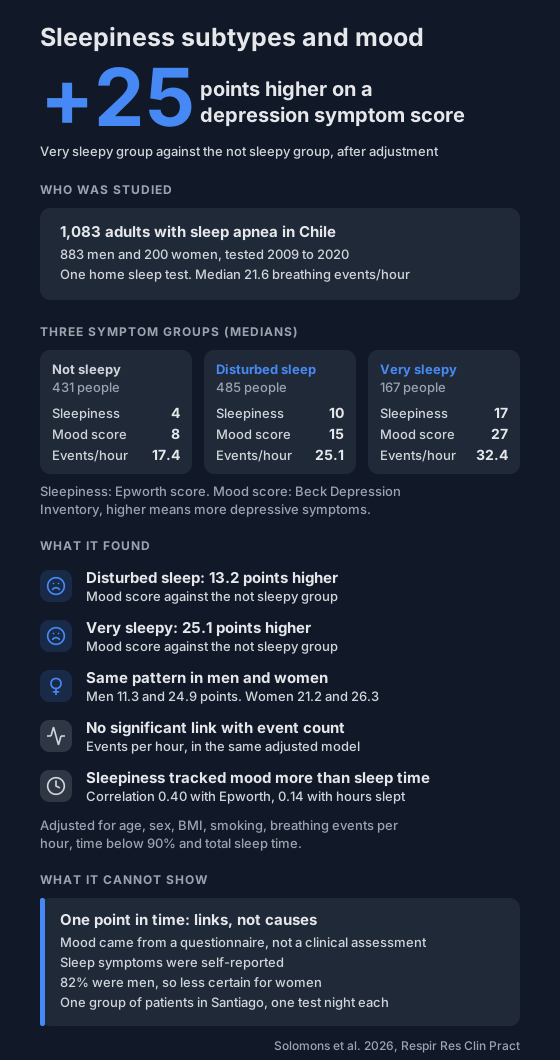
Sleep apnea and low mood often turn up together. Most research groups people by how many breathing events they have per hour. A 2026 study from Chile grouped them by their symptoms instead, and asked which groups had more depressive symptoms.
Who was studied?
- 1,083 adults with sleep apnea from a Santiago clinic database, tested between 2009 and 2020.
- 883 men and 200 women.
- Each had one home sleep test. The median was 21.6 breathing events per hour.
- Each filled in the Epworth sleepiness scale, a set of sleep symptom questions and the Beck Depression Inventory, a depressive symptoms questionnaire.
What were the three groups?
A statistical method sorted people by their symptom answers and some health conditions into:
- Not sleepy: 431 people. Median Epworth score 4.
- Disturbed sleep: 485 people. Median Epworth score 10.
- Very sleepy: 167 people. Median Epworth score 17.
The sleepier groups also had more breathing events per hour (medians 17.4, 25.1 and 32.4) and spent longer below 90% oxygen (medians 3.5%, 5.9% and 9.0% of sleep time).
What did it find?
Median depression symptom scores were 8, 15 and 27 across the three groups.
The authors then adjusted for age, sex, BMI, smoking, breathing events per hour, time below 90% and total sleep time. Against the not sleepy group:
- The disturbed sleep group scored 13.2 points higher.
- The very sleepy group scored 25.1 points higher.
In that same model, breathing events per hour had no statistically significant link to the depression symptom score.
The Epworth score lined up with the depression score more closely than hours slept did (correlation 0.40 against 0.14).
Was it the same for men and women?
The pattern held in both.
- Men: 11.3 points higher for disturbed sleep, 24.9 for very sleepy.
- Women: 21.2 and 26.3.
The authors describe the link as stronger in women, but their test for a difference by sex wasn't statistically significant, and there were only 200 women. The group differences also didn't vary significantly by age or by how many breathing events people had.
What can't it show?
- Cause. Everything was measured once, so it shows what went together, not what caused what.
- Depression. The questionnaire measures symptoms. Nobody had a clinical assessment for depression.
- Self-report. The sleep symptoms were people's own answers.
- Who it applies to. 82% were men, all from one clinic group in Chile.
The senior author's funding included a ResMed Foundation grant, alongside other research grants.
What can you do with this?
In this study, how sleepy people felt lined up with mood more than their event count did. If you're very sleepy in the day, sleeping badly or feeling low, tell your doctor about all of it, not just the sleep.
For more on sleepiness and mood with sleep apnea:
- What goes with sleepiness in sleep apnea
- Sleep apnea without sleepiness
- Sleep apnea risk and mental health
Not sure whether to bring up sleep apnea? The sleep apnea risk check takes about a minute. If you record your nights, you can share the data with your doctor.
Not a medical device. Does not diagnose, treat or prevent any condition. Discuss results and changes with a clinician.
References
- Solomons D, Henríquez-Beltrán M, Sanchez M, Jorquera J, Labarca G. Association between obstructive sleep apnea symptom subtypes and mental health. Respiratory Research & Clinical Practice. 2026;52(1):e20250058. doi:10.36416/1806-3756/e20250058