Sensor Pants That Track Sleep Position
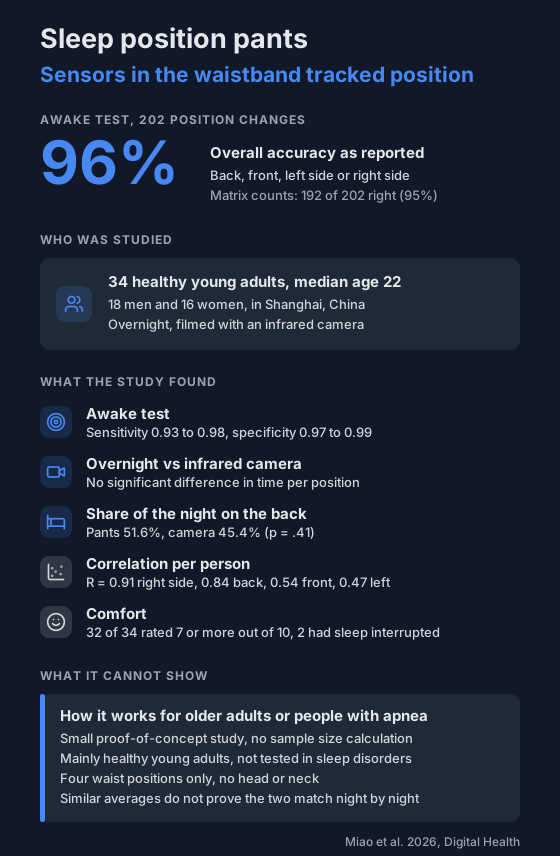
A 2026 study of 34 young adults found pressure-sensor pants named back, front, left and right side positions with 96% reported accuracy while awake, and their overnight position times did not differ significantly from an infrared camera's.
An overnight oximeter shows when your oxygen dipped. It doesn't show which way you were lying at the time. A 2026 study tested a way to log that: pyjama trousers with pressure sensors in the waistband.
While awake, the pants named four positions with 96% reported accuracy. Overnight, the time they logged in each position did not differ significantly from an infrared camera's.
Why does sleep position matter for overnight oxygen?
Sleep lab studies often find that breathing events are more frequent on the back. Two earlier posts cover this:
- Positional sleep apnea in 12,036 patients: 66.3% of sleep centre patients had breathing events at least twice as frequent on their back, and that group had fewer events and higher overnight oxygen.
- Does a vibrating device stop back sleeping?: a pilot in 20 healthy volunteers.
If you want to compare back and side nights in your own data, you need to know how you slept. See back vs side sleeping and your oxygen levels. This study is about logging position, not oxygen. It didn't measure oxygen at all.
What were the pants?
- Four flexible capacitive pressure sensor arrays in a waistband, with a small silicone control box about 6 cm across.
- The pants sort position into back, front, left side or right side from differences in pressure around the waist and how long they last.
- Data goes to a phone app over Bluetooth in real time.
- The battery lasts about 10 hours.
Who was studied?
- 34 young adults: 18 men and 16 women, median age 22.
- Recruited openly on campus, with data collected in Shanghai, China, between March and October 2025.
- People with neck or back pain, or a history of spinal surgery or injury, were excluded.
- The authors describe them as mainly healthy young adults. The paper doesn't report any check for sleep disorders.
What did it find?
Awake test. Participants moved through the four positions while awake, 202 position changes in all, checked against the true position.
- The paper reports 96% overall accuracy. Adding up its table gives 192 of 202 right, or 95%.
- Sensitivity ranged from 0.93 to 0.98 and specificity from 0.97 to 0.99, depending on the position.
- 9 of the 10 mistakes mixed up the back or front with a side. The authors think this happened when someone lay near the boundary between two positions.
- Repeat tests after about a month of use, and with a 3.5 kg blanket over the person, gave similar results. The paper shows these in supplementary figures.
Overnight against an infrared camera. Researchers marked position changes by hand from the video and compared the share of the night in each position.
| Position | Infrared camera | Pants | p |
|---|---|---|---|
| Back | 45.4% | 51.6% | .41 |
| Front | 7.4% | 7.4% | .84 |
| Left side | 22.7% | 21.5% | .74 |
| Right side | 24.6% | 19.6% | .28 |
- Mean sleep time was 431 minutes by camera and 414 by pants (p = .13).
- None of the differences was statistically significant.
- Per person, the position shares correlated at R = 0.91 for the right side, 0.84 for the back, 0.54 for the front and 0.47 for the left side. Total sleep time correlated at only 0.28.
Comfort.
- 32 of 34 rated it 7 or more out of 10, and 17 gave 10.
- 2 said it interrupted their sleep, and 31 said their sleep was not affected. The paper's table of how badly lists 2 slight and 1 serious, which doesn't match the 2.
- The authors put the disturbance mainly down to the control box, and note slight pressure on the body when lying on the front.
- 28 found it easy to use. 6 said it was average and had to work through the instructions first.
What can't it show?
- It's a small feasibility study, 34 people, with no sample size calculation.
- All were young and healthy. The authors say it may not carry over to older adults or people with sleep disorders, and plan to test those groups.
- Only four waist-based positions. Head and neck position, or a twisted body, can't be told apart.
- It uses simple pressure thresholds, which the authors say may struggle with subtle or in-between positions.
- A difference that isn't statistically significant in 34 people doesn't prove the two methods agree. The right side was 5 percentage points lower by pants, and the back 6 points higher.
- The correlations for the front and left side were modest, and for total sleep time weak.
- Bluetooth reliability wasn't measured.
- It was funded by Chinese national, Shanghai and Yunnan science grants, which had no role in the study.
- A company, Ningbo Elas Tech, helped develop the system. The authors reported no conflicts of interest.
What can you do with it?
The paper doesn't say whether the pants are on sale. The point for your own tracking is that position changes what you can read into a night.
- If you want to compare positions, note how you went to bed and how you woke, or add a note in the session viewer.
- Compare a few back-sleeping nights with a few side-sleeping nights over time, not one night with another.
- Bring a pattern you notice to your doctor. Don't change anything about your care on the basis of position data.
Not a medical device. Does not diagnose, treat or prevent any condition. Discuss results and changes with a clinician.
References
- Miao Y, He J, Chen J, Zhao Y, Fan Y, Yang S, He S. Flexible pressure sensor pants for app-supported sleep posture monitoring: Feasibility, accuracy, and user experience study. Digital Health. 2026;12:20552076261470647. doi:10.1177/20552076261470647 (PubMed 42688711)