Sleep Apnea and Sudden Cardiac Death: Review
A 2025 meta-analysis pooled 14 studies and 527,069 people. It found no statistically significant link between sleep apnea and sudden cardiac death overall, and calls the evidence insufficient.
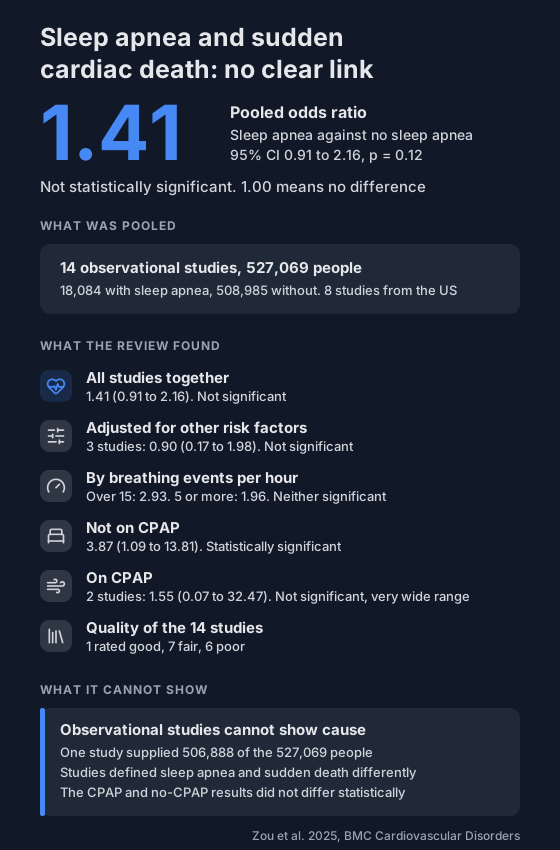
Sleep apnea is often described as a risk factor for sudden cardiac death. A meta-analysis published in October 2025 pooled the studies that compared people with and without sleep apnea.
Its conclusion: the evidence isn't enough to say there's a definite link.
What was pooled?
- 14 observational studies published from 2001 to 2024. 8 were from the United States.
- 527,069 people: 18,084 with obstructive sleep apnea and 508,985 without.
- One study supplied 506,888 of them. The other 13 shared about 20,000.
- Sudden cardiac death often meant an unexpected death from a heart cause within 1 hour of symptoms, or within 24 hours of last being seen alive. Several studies gave no definition.
- Sleep apnea was defined differently from study to study: a sleep study result, a doctor's record, or the person's own report. Two studies didn't say.
What did it find overall?
The results are odds ratios. 1.00 means no difference between people with and without sleep apnea.
- All studies together: 1.41, with a 95% confidence interval of 0.91 to 2.16 (p = 0.12).
- That interval crosses 1.00, so the result is not statistically significant.
- The studies disagreed with each other a lot (I² = 79%).
- Leaving out any one study moved the figure between 1.29 and 1.57.
Three studies adjusted for other risk factors such as heart disease. Pooled, they gave 0.90 (0.17 to 1.98), also not statistically significant, and they disagreed even more (I² = 96%).
The authors say this raises the possibility that the unadjusted link is at least partly explained by other heart conditions.
Did more breathing events mean more risk?
Not clearly.
- Studies using more than 15 breathing events per hour as the cut-off: 2.93 (0.89 to 9.63).
- Studies using 5 or more per hour: 1.96 (0.66 to 5.81).
- Sleep apnea recorded by a doctor: 1.09 (0.51 to 2.33).
- Self-reported sleep apnea: 1.14 (0.38 to 3.46).
None of these was statistically significant, and the four groups did not differ significantly from each other (p = 0.59). The two cut-off groups had only 2 or 3 studies each, and the authors call those results exploratory.
A separate sensitivity analysis grouped studies by how sleep apnea was recorded. Only the studies that didn't report a method showed a statistically significant link: 1.69 (1.27 to 2.24).
What about CPAP?
This is the result the paper highlights.
- People with sleep apnea who were not on CPAP: 3.87 (1.09 to 13.81, p = 0.04). That is statistically significant.
- People on CPAP: 1.55 (0.07 to 32.47). Not significant, from only 2 studies.
Read that with care:
- The statistical comparison between the two groups found no statistically significant difference (p = 0.90).
- The CPAP figure points the same way as the no-CPAP one. Its range is so wide that it rules nothing in or out.
- The paper's closing section says no raised risk was seen on CPAP. Its discussion says the CPAP studies show "a trend similar to untreated OSA". Those two statements don't sit well together.
For what trials say about CPAP and the heart, see CPAP and heart health and CPAP and long-term survival.
How good were the studies?
- 1 of the 14 was rated good quality, 7 fair and 6 poor.
- The main reasons for a poor rating were no adjustment for other risk factors and no information on follow-up.
- A funnel plot was lopsided, which can mean studies with no result went unpublished. A formal test for this was not significant (p = 0.19).
What can't it tell you?
- Cause. Every study was observational.
- Whether weight explains it. Not all studies adjusted for BMI, and the authors say obesity may account for some of the link.
- A single definition. Sleep apnea and sudden cardiac death were both defined in several ways.
- A firm count. The abstract says 12 studies. The text and both tables list 14, and the participant totals match the 14.
- Whether it was planned in advance. The protocol was not registered. The authors say a closely related protocol already existed.
What can you do with this?
This review doesn't settle the question either way. For related research, see oxygen dips and blood pressure.
If you snore loudly, someone has heard you stop breathing in your sleep, or you're exhausted during the day, see a doctor. The sleep apnea risk check takes about a minute and helps you decide whether to have that conversation.
Chest pain, fainting or palpitations need medical attention, whatever an oximeter shows.
An overnight oximeter can't tell you your heart risk. It records what your oxygen and pulse did, and you can share that with your doctor.
Not a medical device. Does not diagnose, treat or prevent any condition. Discuss results and changes with a clinician.
References
- Zou X, Zhou X, Yi S. Obstructive sleep apnea and the risk of sudden cardiac death: a systematic review and meta-analysis. BMC Cardiovascular Disorders. 2025;25(1):751. doi:10.1186/s12872-025-05193-7