CPAP Hours and Atrial Fibrillation Returning
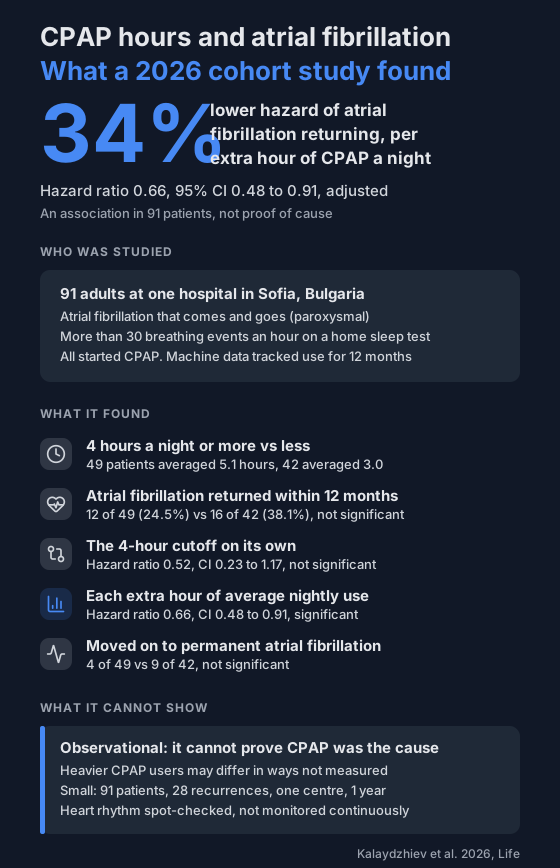
A 2026 study followed 91 adults with sleep apnea and atrial fibrillation for a year. Each extra hour of average nightly CPAP use was linked to a 34% lower hazard of the rhythm problem returning.
Sleep apnea and atrial fibrillation often turn up in the same person. CPAP use is usually judged by one cutoff: 4 hours a night or more.
A study published in 2026 looked at whether the cutoff or the actual hours lined up better with atrial fibrillation coming back. Only the hours reached statistical significance.
Who was in the study?
- 91 adults at one hospital in Sofia, Bulgaria, enrolled between 2017 and 2024.
- Average age 62, and 68% were men.
- All had paroxysmal atrial fibrillation, the kind that comes and goes.
- All had more than 30 breathing events an hour on a home sleep test. The group average was 64.
- All started CPAP. People who couldn't start or keep using it were left out.
- Hours of use came from the machines' own remote data, not from what patients reported.
They were followed for 12 months. The main outcome was how long it took for atrial fibrillation to be recorded again on an ECG or a 24-hour heart monitor.
What did the 4-hour cutoff show?
The researchers split the group by average nightly use.
- 49 people averaged 4 hours or more (5.1 hours on average).
- 42 people averaged less than 4 hours (3.0 hours on average).
The two groups showed no statistically significant differences at the start in age, other health conditions, heart measurements or medication.
Over 12 months, atrial fibrillation came back in:
- 12 of 49 (24.5%) in the higher-use group.
- 16 of 42 (38.1%) in the lower-use group.
That gap was not statistically significant (log-rank p = 0.11). After adjusting for age, BMI, breathing events per hour, heart failure, left atrium size and rhythm medication, the cutoff still wasn't significant (hazard ratio 0.52, 95% CI 0.23 to 1.17, p = 0.13).
What about the actual hours?
When the researchers used average hours per night as a number, the result was significant.
- Each extra hour of average nightly use was linked to a 34% lower hazard of a first recurrence.
- Hazard ratio 0.66, 95% CI 0.48 to 0.91, p = 0.01, after the same adjustments.
The authors read this as a graded link, not a threshold at 4 hours. They also say it supports a hypothesis and does not establish that CPAP was the cause.
Did fewer people move on to permanent atrial fibrillation?
- 4 of 49 in the higher-use group.
- 9 of 42 in the lower-use group.
The difference was not statistically significant (p = 0.29). The paper prints these counts with percentages of 10.0% and 17.6%, which do not match them, so only the counts are given here. The authors say the study was too small to answer this question.
What can't it tell you?
- Cause. It's an observational study. People who use CPAP more may also take their medication more reliably or see their doctor more often, and the study didn't fully capture that.
- A firm or long-term answer. 91 patients, 28 recurrences, one hospital, 12 months.
- Every episode. Heart rhythm was checked at visits and with 24-hour monitors, not continuously. Episodes with no symptoms could have been missed.
- How well CPAP was working. Leftover breathing events and mask leak weren't part of the analysis.
- Other groups. Everyone had a high number of breathing events and paroxysmal atrial fibrillation. People with longer-lasting forms, or who'd had an ablation, were excluded.
The authors also note that earlier short-term randomised trials did not find a significant fall in the amount of atrial fibrillation with CPAP. The study was funded by the European Union's NextGenerationEU programme through Bulgaria's national recovery plan, and the authors declared no conflicts of interest. For the wider picture, see what a review found about CPAP and heart health.
What can you do with this?
The study used the hours the machine logged, not the hours people thought they'd used it. Your CPAP machine or its app shows the same figure. The study doesn't show that changing your hours would change your heart rhythm.
- For what a 2026 review found goes with more and less CPAP use, see who sticks with CPAP.
- For a study of mask leak and nightly hours of use, see CPAP mask leak and usage.
- To log overnight oxygen and pulse next to your machine's data, see tracking your oxygen alongside CPAP.
An overnight oximeter can't tell you whether you have atrial fibrillation. Questions about your heart rhythm or your CPAP are for your doctor.
Not a medical device. Does not diagnose, treat or prevent any condition. Discuss results and changes with a clinician.
References
- Kalaydzhiev P, Ilieva R, Spasova N, Yakov S, Markov D, Georgieva N, Kinova E, Goudev A. Impact of CPAP Therapy Adherence on Time to First Recurrence of Paroxysmal Atrial Fibrillation in Patients with Severe Obstructive Sleep Apnea. Life. 2026;16(3):389. doi:10.3390/life16030389