Driving Simulator Tests Before and After CPAP
A 2026 pilot study tested 12 drivers on a driving simulator, eye tracking and thinking tests. In the 8 who went on CPAP, simple reaction times were faster after a median of 12 months. Multitasking and memory tests showed no significant change.
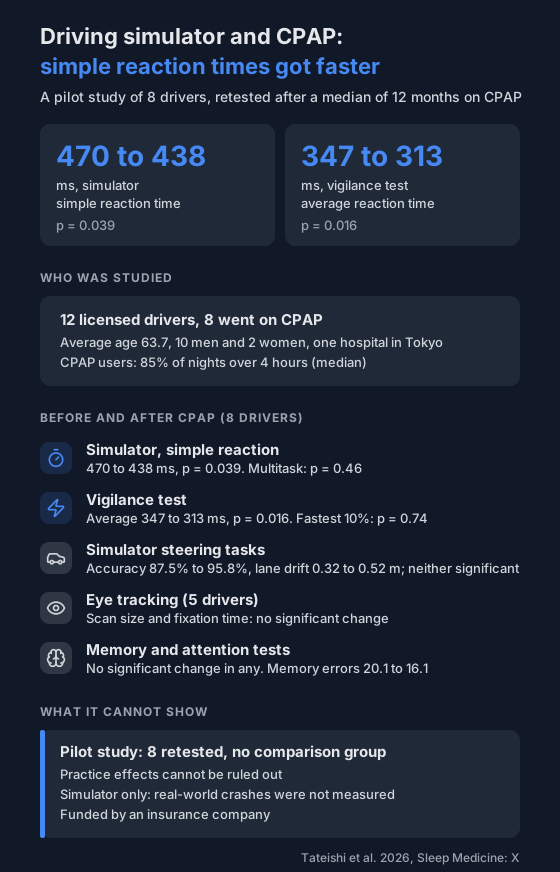
Sleep apnea is linked to more car crashes, and CPAP is the usual therapy. But "driving ability" is many things: reaction speed, steering, where you look, memory. This small pilot study from Tokyo tested several of them in the same drivers, then retested the ones who went on CPAP.
Only the simplest tests, plain reaction times, showed a statistically significant change.
Who was studied?
- 12 adult drivers with suspected sleep apnea, referred to one Tokyo hospital between 2021 and 2023.
- 10 men and 2 women, aged 46 to 77, average age 63.7.
- About 42 years of driving experience on average.
- Average BMI 24.3, which the authors call relatively low.
- Breathing events per hour on an overnight sleep study ranged from 4.9 to 98.7. The text gives an average of 32.2; Table 1 gives a median of 26.1.
- 8 of the 12 had 20 or more events per hour and were prescribed CPAP under Japanese insurance rules. Those 8 were retested.
Only drivers willing to complete a long set of tests were enrolled.
What was tested?
All done the afternoon before the sleep study:
- Driving simulator (20 minutes): simple reaction (release the accelerator when a light appears), multitask reactions (brake, release or do nothing), steering along a winding course, and both together.
- Eye tracking: glasses recorded how far the eyes jumped (saccade size) and how long they rested on each point (fixation time) during the simulator.
- Vigilance test: 5 minutes of pressing a button as fast as possible.
- Thinking tests: sustained attention, response stopping and spatial working memory.
What differed at the start?
Those links were correlations across the 12 drivers, so they don't show cause.
- Simple reaction time in the simulator was slower in drivers with more breathing events per hour (r = 0.63, p = 0.03).
- Multitask plus steering accuracy was lower in drivers who spent more of the night below 90% oxygen (r = -0.80, p = 0.003). It was not significantly linked to events per hour. See what T90 is.
- Eye tracking: shorter fixations and smaller eye jumps went with more lane drift, and shorter fixations with more mistimed responses to curves (early or late). Neither was linked to events per hour or sleepiness score.
- Memory: more spatial memory errors went with smaller eye jumps, shorter fixations and more mistimed curve responses.
- Lane drift and curve timing were not significantly linked to events per hour or time below 90%.
What changed on CPAP?
The 8 drivers were retested after a median of 12 months (range 10 to 12), per Table 3. The methods set the retest window at 6 to 12 months. They used CPAP more than 4 hours on 85% of nights (median), and events per hour on CPAP were 3.0 (median).
- Simulator simple reaction time: 470 to 438 ms (p = 0.039).
- Vigilance test average reaction time: 347 to 313 ms (p = 0.016).
- Vigilance test fastest 10% of reactions: 245 to 247 ms, no statistically significant change (p = 0.74).
- Vigilance test lapses: 3.3 to 1.8, not statistically significant (p = 0.14).
- Multitask reaction times: no significant change.
- Multitask plus steering accuracy: 87.5% to 95.8%, not statistically significant (p = 0.063).
- Lane drift while steering: 0.32 to 0.52 m, not statistically significant (p = 0.078).
- Eye tracking (5 of the 8 had data): no significant change in eye jump size or fixation time.
- Thinking tests: no significant change in any. Spatial memory errors went from 20.1 to 16.1 (p = 0.38).
The authors read this as faster basic reactions, with no clear change in the more complex measures.
Why not read more into it?
- It's a pilot. Only 8 were retested, and 5 for eye tracking.
- No comparison group. There was no healthy control group, so the authors say they couldn't tell CPAP-related change apart from practice on the tests or chance variation.
- Low power. Their calculation put the power for the accuracy result at 53.5%, and about 14 drivers would be needed. A result that missed significance isn't evidence of no effect.
- Many measures, no stated hypothesis. The authors call the study exploratory and the findings hypothesis-generating.
- A selected group. Older, low BMI, willing to do a long protocol. It may not apply to younger or heavier drivers.
- Everyone used CPAP a lot, so the study couldn't look at how much use matters.
- Simulator, not roads. It didn't measure crashes.
- Funding. An insurance company paid for it, and two authors report that funding.
For real-road results, see 24 taxi drivers on CPAP. For a drug and next-day simulated driving, see quetiapine and driving. For another simulator study, see caffeine naps for drivers on CPAP.
What can you do with this?
- If you drive and feel drowsy, talk to your doctor. A tracker can't tell you whether you're safe to drive.
- If you're on CPAP, you can watch your overnight oxygen alongside it. See tracking oxygen with CPAP.
Not a medical device. Does not diagnose, treat or prevent any condition. Discuss results and changes with a clinician.
References
- Tateishi T, Tamaoka M, Takagi S, Hasegawa T, Takahashi K, Takahashi H, Miyazaki Y. Integrated assessment of driving performance, eye movements, and cognitive function in obstructive sleep apnea: A pilot study. Sleep Medicine: X. 2026;12:100203. doi:10.1016/j.sleepx.2026.100203