Time Below 90% SpO2 and CPAP Use: A Study
In 207 adults starting CPAP or a similar device in Italy, 69.7% of those whose home test showed 30% or more of the night below 90% SpO2 averaged 4 hours a night or more, against 52.3% of the rest.
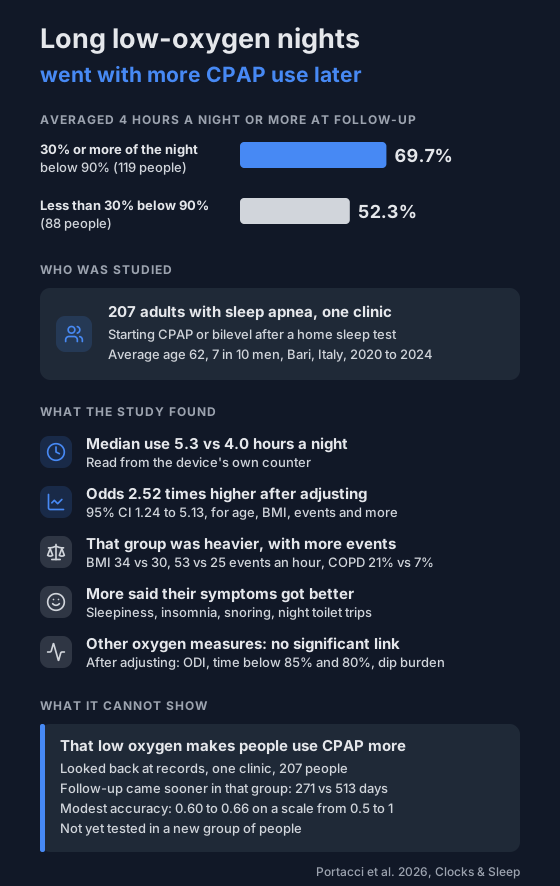
Plenty of people who start CPAP use it less over time. A 2026 study from Italy asked whether the oxygen numbers on the first home sleep test could hint at who keeps going. People whose test showed a long stretch of the night below 90% SpO2 were more likely to average 4 hours a night or more at follow-up.
What did it measure?
- Time below 90%. The share of the night with SpO2 under 90%, often called T90.
- The study split people at 30% of the night or more below 90%.
- CPAP use. Hours a night from the device's own counter, averaged from the start to the last follow-up visit.
- An average of 4 hours a night or more counted as good use.
Who was studied?
- 207 adults with obstructive sleep apnea at one sleep clinic in Bari, Italy, from 2020 to 2024.
- Average age 62, about 7 in 10 men.
- All had a home sleep test, then started CPAP, an auto-adjusting device or a bilevel device.
- 119 spent 30% or more of the night below 90%. Their median was 50% of the night.
- 88 spent less than that. Their median was 6%.
The low-oxygen group was different in other ways too:
- Heavier: median BMI 34 against 30.
- More breathing events: a median of 53 an hour against 25.
- More COPD: 21% against 6.9%.
- More often on a bilevel device (11.8% against 1.1%) or home oxygen (8.4% against 1.1%).
Before starting, there was no statistically significant difference in sleepiness scores or other symptoms between the groups.
What did it find?
- 69.7% of the low-oxygen group averaged 4 hours a night or more, against 52.3% of the others.
- Median use was 5.3 hours a night against 4.0.
- After allowing for age, sex, BMI, breathing events, COPD, other conditions, follow-up time, device type, home oxygen and mask type, the odds of good use were 2.52 times higher (95% CI 1.24 to 5.13).
- The low-oxygen group more often said their sleepiness, insomnia, concentration, snoring and night-time toilet trips had got better since starting.
- Both groups reported the same top complaints: dry nose or mouth, mask discomfort and air leaks.
What about other oxygen numbers?
In the main adjusted analysis, the 30% cut-off was the only oxygen measure with a statistically significant link. These showed no statistically significant link in any of the analyses:
- ODI, the oxygen dips per hour.
- Time below 85% and below 80%.
- Oxygen dip burden, the total depth and length of the dips. Only 103 people had this figure.
Lowest SpO2 and average SpO2 were linked to use in some analyses but not in the main adjusted one.
Breathing events per hour and daytime sleepiness showed no statistically significant link to use either, in the time-to-event analysis.
Why might it happen?
The authors suggest three ideas, and say they didn't test any of them:
- People with more low oxygen may notice a bigger change in how they feel once on CPAP.
- Seeing worse numbers on the test may make the condition feel more real.
- Low oxygen may disturb sleep stages, and steadier oxygen on CPAP may make sleep feel better. A home test can't check this.
What can't it show?
- Cause. It's a look back at clinic records, so it shows what went together, not what caused what.
- Follow-up timing. The low-oxygen group was seen sooner, a median of 271 days against 513. Less time means less time for use to drop off. The authors adjusted for it, but say it may still explain some of the gap.
- Size and setting. 207 people at one clinic, with devices chosen case by case.
- Accuracy. The link was modest, 0.60 to 0.66 on a scale where 0.5 is chance and 1 is perfect. The authors say it shouldn't be used on its own to predict use.
- No sleep stages. A home test doesn't record them.
- Author ties. Two authors report fees or grants from drug companies. No CPAP makers are listed.
What can you do with this?
If you're on CPAP, your device logs your hours and an overnight oximeter can sit alongside it. See tracking your oxygen alongside CPAP and what helps people stick with CPAP.
Got recordings from before and after starting? Here's how to share them with your doctor.
Not a medical device. Does not diagnose, treat or prevent any condition. Discuss results and changes with a clinician.
References
- Portacci A, Quaranta S, Santomasi C, Lecce VD, Quaranta VN, Amendolara M, Lazzaretti ID, Cuccaro LAS, Casparrini M, Spierto S, Picerno V, Derobertis C, Vozza A, Dragonieri S, et al. Can Sleep Hypoxic Measures Predict Long-Term Adherence to Positive Airway Pressure Treatments? Clocks & Sleep. 2026;8(4):61. doi:10.3390/clockssleep8040061