Pulse Oximeter Accuracy With Poor Circulation
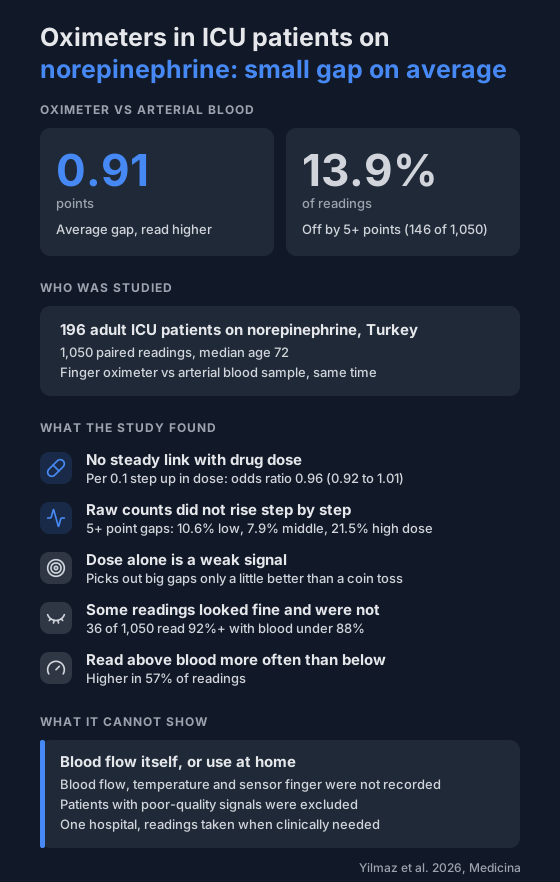
A 2026 study compared finger oximeter readings with arterial blood in 196 intensive care patients on norepinephrine. The average gap was under 1 point, but 13.9% of readings were off by 5 or more, and drug dose wasn't consistently linked with them.
Poor circulation is a known reason a finger oximeter can read wrong. Less blood reaches the fingertip, the pulse signal gets weaker, and the number gets less reliable.
A 2026 study from Turkey looked at one common cause in hospital: norepinephrine, a drug that tightens blood vessels to raise blood pressure. The question was whether a higher dose meant a bigger gap between the oximeter and a blood sample.
The answer was less tidy than you'd expect.
Who was studied?
- 196 adults in intensive care (ICU) at one hospital in Turkey, from July 2022 to July 2023.
- Median age 72, and 64% were men.
- Very ill: median APACHE II score of 28. 34% had sepsis and 31% septic shock.
- All were on norepinephrine. Readings taken while they were also on another drug that acts on the circulation were left out.
- 1,050 paired readings, a median of 5 per person.
Each pair was a finger oximeter reading and an arterial blood sample taken at the same time. The blood sample is the reference. The oximeter was a hospital bedside monitor with a Masimo finger sensor.
Patients with a poor-quality signal at any time, such as heavy movement or a faulty probe, were excluded from the study altogether.
How far off was the oximeter?
- On average, not far. The oximeter read 0.91 points higher than blood.
- Spread was wide. The standard deviation of the gap was 3.58 points.
- Typical gap: a median of 2.0 points, and a mean of 2.7.
- Big gaps happened. 13.9% of readings were off by 5 points or more (146 of 1,050).
- Higher more often than lower. The oximeter read above the blood sample in 57% of readings.
- Hidden low oxygen. In 36 readings (3.4%), the oximeter showed 92% or more while the blood sample was under 88%.
So a small average gap hid a wide scatter. For how accuracy figures are usually described, see pulse oximeter accuracy.
Did a higher drug dose mean a bigger gap?
Not consistently. The main analysis allowed for repeated readings from the same person, and for oxygen supplied, lactate, sepsis, septic shock, ventilation and age.
- Dose as a number: each 0.1 µg/kg/min step up in dose had an odds ratio of 0.96 for a big gap (95% confidence interval 0.92 to 1.01, not statistically significant).
- Dose bands: low was up to 0.25, middle 0.25 to 0.50 and high 0.50 or more, in µg/kg/min. These cut-offs come from sepsis guidance and weren't built for oximeters.
- Raw counts: big gaps were 10.6% of readings at low dose, 7.9% at middle dose and 21.5% at high dose.
- Adjusted bands: against the high band, the middle band had higher odds of a big gap (3.49, interval 1.17 to 10.44). The low band was not significantly different (1.80, interval 0.74 to 4.35).
Those results point in different directions, so the authors say the pattern isn't a steady rise with dose. The raw figures count each reading as separate. On that basis the spread of gaps did look wider at higher doses, but the authors say this was largely down to repeated readings from the same people.
Dose alone was a weak signal. It picked out big gaps with an AUC of 0.60, where 0.5 is a coin toss and 1 is perfect. The authors say dose shouldn't be used as a stand-in for how reliable the oximeter is.
Higher oxygen supply went with fewer big gaps. The authors warn against reading that as better device accuracy, since it may reflect the saturation range or how sick the person was.
What can't this study show?
- Blood flow itself. Dose is only an indirect marker. Perfusion index, capillary refill, temperature, haemoglobin, skin tone and sensor finger weren't recorded.
- Cause. It's observational. The authors say dose may stand in for how ill someone is, rather than act on the reading directly.
- Bias from timing. Blood samples were taken at set times and when something changed. Unstable moments may be over-represented.
- Poor signals. People with poor-quality signals were excluded, so the study can't say how readings behave when the signal is bad.
- Other settings. It's one ICU, one oximeter model and older, very ill patients. It says nothing about healthy people or a ring at home.
The authors declare no conflicts of interest.
What can you do with this?
This study was in hospital patients on a drug that narrows blood vessels. It didn't test cold hands, and it doesn't show how a home oximeter behaves.
What carries over is the general point:
- A small average error can sit alongside occasional big misses.
- Weak circulation is one of several reasons a finger signal can be unreliable.
- A reading that doesn't fit how you feel is worth checking before you trust it.
These general tips weren't tested in this study:
- Warm your hands and recheck. See cold fingers and false low readings.
- Try a different finger, as in which finger to use.
- Read overnight traces as a trend, not a single number. A dip recorded while the pulse signal is weak is less trustworthy. More on signal quality is in accuracy with motion and low perfusion.
For another ICU comparison with blood samples, see ICU oximeter accuracy by age and skin tone.
If your readings are low or you feel unwell, talk to your doctor. A blood test is the reference, not a finger oximeter.
Not a medical device. Does not diagnose, treat or prevent any condition. Discuss results and changes with a clinician.
References
- Yilmaz M, Erdemir M, Ozturk MC, Aydin Kayali R, Gilik BE, Cuhadar M, Ozkarakas H, Taskin G, Yamanel L. Norepinephrine Dose and Pulse Oximetry Agreement During Critical Illness: A Prospective Repeated-Measures Study. Medicina (Kaunas). 2026;62(9):1687. doi:10.3390/medicina62091687