Oxygen Drop Speed and Blood Pressure
A 2026 study of 297 adults with sleep apnea found that faster oxygen drops during breathing events went with bigger blood pressure surges afterwards.
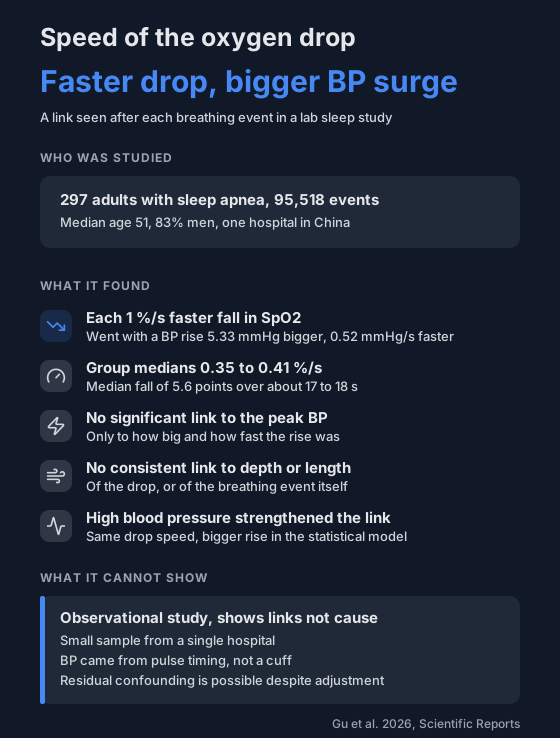
Earlier research linked blood pressure surges after breathing events to how deep or how long the oxygen dip was. A 2026 study from a Chinese hospital looked at something else: how fast oxygen falls during each breathing event.
The authors call this the oxygen desaturation rate. It's the fall in SpO2 divided by the seconds it took, measured from the start of the drop to the lowest point.
Who was studied?
- 297 adults who had a sleep study at one hospital in Huai'an, China, between January 2024 and April 2025.
- All were aged 18 to 75 and newly found to have sleep apnea, with 15 or more breathing events per hour.
- Median age 51, 83% men, median 52.8 breathing events per hour.
- 80 had no high blood pressure, 127 had high blood pressure on medication, and 90 had high blood pressure without medication.
- People with other causes of low oxygen at night, such as heart failure or COPD, or another sleep disorder were left out.
What did they measure?
- Oxygen: a fingertip oximeter during an overnight sleep study.
- Blood pressure: beat-to-beat systolic (top number), estimated from pulse transit time (how long a pulse takes to travel from the heart to the fingertip), not a cuff.
- For each of 95,518 oxygen drops after a breathing event, the study measured the speed of the drop and the blood pressure rise that followed.
- The rise was measured three ways: its peak, its size (amplitude), and how fast it climbed (surge rate).
What did they find?
- The median speed in the three groups was 0.35 to 0.41 percentage points of SpO2 per second.
- After adjusting for age, sex, BMI, smoking, alcohol, breathing events per hour, T90, sleep time, baseline SpO2, high blood pressure, diabetes, heart disease and blood pressure medication, a faster fall went with a bigger rise.
- For each 1 percentage point per second faster, the rise was 5.33 mmHg bigger (95% CI 3.00 to 7.67) and climbed 0.52 mmHg per second faster (95% CI 0.22 to 0.81).
- The middle half of each group's values fell within 0.23 to 0.51, so a full 1-point step is wider than the spread the study saw.
- The speed of the fall was not significantly linked to the peak blood pressure reached.
- Faster falls went with a higher BMI, more breathing events per hour, a higher T90 and a lower average and lowest SpO2.
- Speed was not significantly linked to how long the breathing event lasted.
- The depth of the drop and event length did not show a consistent link to the blood pressure rise.
Did it differ by blood pressure group?
- The link between drop speed and the size of the rise held in all three groups: 7.33 mmHg without high blood pressure, 5.77 on medication and 5.07 without medication.
- The link with how fast the pressure climbed held in the no-high-blood-pressure and untreated groups, but not in the group on medication.
- In the whole-group model, the authors report that high blood pressure strengthened the link: the same speed went with a bigger rise in people with high blood pressure. The per-group figures above were largest in the group without high blood pressure, and the paper does not explain the difference.
- The group without high blood pressure had the fastest drops, median 0.41 against 0.35 in both high blood pressure groups.
- The link with climb speed was stronger under age 60 (0.60) and with 50 or more breathing events per hour (0.67).
What about the ratio of the two?
The authors also divided each blood pressure measure by drop speed and called it "vascular hypoxic reactivity", meaning how big a response a given drop produces. Higher ratios went with having high blood pressure.
- Per 1 unit higher: odds of high blood pressure were 2.3% higher for amplitude, 0.2% higher for peak, and 14.1% higher for surge rate.
- This analysis was labelled exploratory. The surge rate result was close to the cut-off (95% CI 1.001 to 1.299).
- In another exploratory comparison, people on calcium channel blockers had smaller and slower rises after events than those on ACE inhibitors or ARBs, or on both. Climb speed was 1.43 mmHg per second against 1.55 and 1.60, and size was 13.73 mmHg against 14.82 and 14.87. The authors read this as a possible advantage for calcium channel blockers. It compared different people, not a trial, and the paper did not give group sizes in the text.
What can't it show?
- Cause. It's an observational study, so it shows what went together, not what caused what. The authors say residual confounding is possible despite adjustment.
- Everyone. It's a small sample from one hospital, mostly men, and all had 15 or more breathing events per hour.
- Home use. The numbers come from the oximeter in a lab sleep study, and blood pressure was estimated from pulse timing.
- Which came first. Oxygen drops and blood pressure status were measured at the same time, so it can't say whether faster drops lead to high blood pressure.
- Medication. The comparison covered only two drug groups and the authors had little data on others.
What can you do with this?
The study counted fast drops event by event in a lab recording. Your oximeter app shows the overall picture: how many dips, how low, and how long. Two dips to the same level can differ in how steep they were, and the session viewer lets you look at the shape of each one.
For more on how dips and blood pressure fit together, read oxygen dips and blood pressure and hypoxic burden and new high blood pressure. To see how a dip is counted, read what counts as an oxygen dip.
If you snore loudly, someone has seen you stop breathing in your sleep, or you're exhausted during the day, see a doctor. You can also share your oximeter data with your doctor.
Not a medical device. Does not diagnose, treat or prevent any condition. Discuss results and changes with a clinician.
References
- Gu Y, Wan Y, Shen J, Yuan Y, Ma Q, Wei G, Xie X, Xu F, Han X, Xu J. Association between respiratory event-specific oxygen desaturation rate and blood pressure surge in obstructive sleep apnea. Scientific Reports. 2026;16(1):20442. doi:10.1038/s41598-026-51395-0