Night Oxygen Dips: Asleep or Moving?
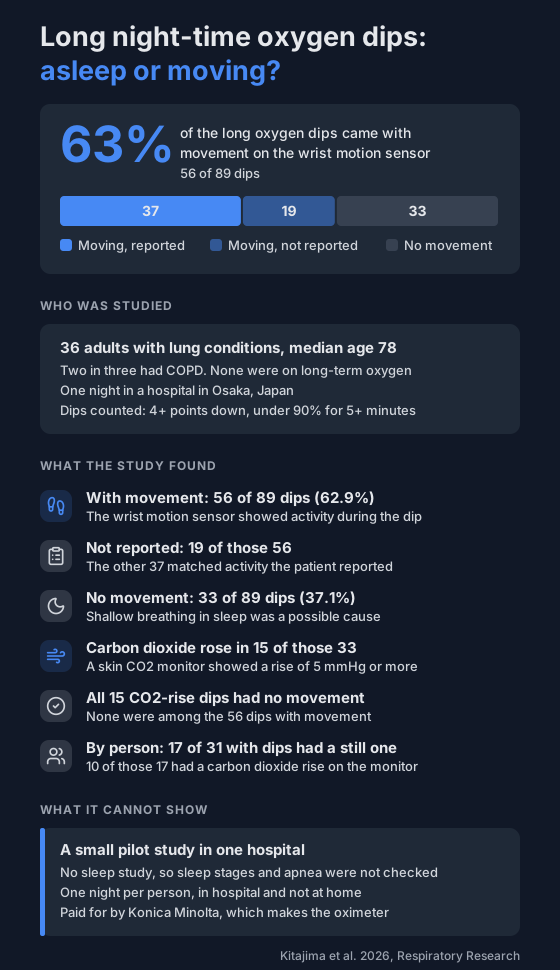
In a small 2026 study of 36 older adults with lung conditions, a motion sensor in the overnight oximeter showed that 56 of 89 long oxygen dips came with movement, and 19 of those went unreported.
A long oxygen dip on an overnight recording looks the same whether you were asleep or walking to the bathroom. The usual way to tell them apart is to ask the person to note when they got up.
A small study published in 2026 used an oximeter with a built-in motion sensor to check instead. About 63% of the long dips came with movement, and the patient hadn't reported a third of those.
Who was in the study?
- 36 adults with long-term lung conditions and worsening breathlessness on exertion, admitted to one hospital in Osaka, Japan, between July 2021 and December 2022.
- Their median age was 78.
- 66.7% had COPD and 19.4% had interstitial lung disease.
- None were on long-term oxygen, and people already known to have obstructive sleep apnea were left out.
- Across the group, the median of each person's average overnight SpO2 was 92.4%, and the median T90 was 11.1%.
What was measured?
Each person spent one night wearing two things:
- A Konica Minolta PULSOX-500i oximeter: a finger probe for SpO2 and a wrist unit with a motion sensor.
- A skin sensor that tracks carbon dioxide.
They were also asked to press an event button or write down what they did during the night.
The study only counted long dips: a fall of 4 points or more from baseline with SpO2 under 90% for at least 5 minutes. That's much longer than the short dips an ODI counts. See what counts as an oxygen dip.
What did the motion sensor show?
There were 89 long dips, in 31 of the 36 people.
- With movement: 56 of 89 (62.9%). The authors classed these as exertion-related, based on the wrist acceleration data.
- Reported by the patient: 37 of those 56.
- Not reported: 19 of those 56, about a third. That's 21.3% of all 89 dips.
- No movement: 33 of 89 (37.1%).
The authors' conclusion is that written logs of night-time activity may not be reliable on their own.
What about the dips with no movement?
This was the study's main question. In people with advanced lung conditions, breathing can get shallower during sleep. Oxygen falls and carbon dioxide rises. The carbon dioxide monitor that shows this is costly and, in Japan, mostly used in hospital. So the authors asked whether a dip with no movement could stand in for it.
- All 15 dips with a carbon dioxide rise of 5 mmHg or more had no movement.
- The other 18 dips with no movement did not reach that mark.
- The paper reports a specificity of 75.7%. By our arithmetic that is the 56 dips with movement out of the 74 dips without the rise.
By person:
- 17 of the 31 people with dips had at least one with no movement.
- 10 of those 17 had the carbon dioxide rise. All 10 people with the rise were among the 17.
- 7 did not. 5 of those 7 had a smaller rise of 3 to 5 mmHg, and the authors say it's not known what that means.
- The 17 had a higher daytime carbon dioxide level in their blood than the other 19 people: 44.3 against 39.2 mmHg (P = 0.041).
The authors also tried smoothing out short sawtooth dips before counting. That left 74 long dips: 48 with movement and 26 without, and 15 of those 26 had the carbon dioxide rise.
What doesn't it tell you?
- It's small. 36 people in one hospital, and 10 with the carbon dioxide rise. The authors call it a pilot study and say the results are exploratory.
- No sleep study. Sleep stages weren't recorded, so the authors can't exclude sleep apnea, brief awakenings or sleep stage as part of the explanation.
- Hospital, one night. The authors say the findings may not carry over to home recordings.
- A sicker group. People admitted to hospital may not be like people with the same conditions at home.
- Funding. Konica Minolta, which makes the oximeter, paid for the study, and two of the nine authors work there. The authors declared no competing interests.
- Cause. A dip with no movement was a possible sign of shallow breathing in sleep. Fewer than half of them (15 of 33) came with the carbon dioxide rise.
What can you do with this?
- If your oximeter records motion, look at it next to any long dip. The O2Ring export has a Motion column: see the O2Ring CSV export.
- Motion next to a dip tells you that you were moving. It doesn't tell you why your oxygen fell.
- A quick note of when you got up is still useful. In this study, patients' own reports missed 19 of the 56 dips with movement.
- If you have a lung condition and see long stretches under 90%, share the recording with your doctor.
For more on lungs and overnight recordings, see lung function and overnight oxygen.
Not a medical device. Does not diagnose, treat or prevent any condition. Discuss results and changes with a clinician.
References
- Kitajima T, Tajima H, Nohara E, Jinno S, Morimoto C, Inoue D, Marumo S, Miwa A, Fukui M. Detection of nocturnal desaturation and hypercapnia using accelerometer-integrated pulse oximetry: a prospective observational study. Respiratory Research. 2026;27(1):38. doi:10.1186/s12931-025-03477-2