Everest Trek: Oximetry and Altitude Sickness
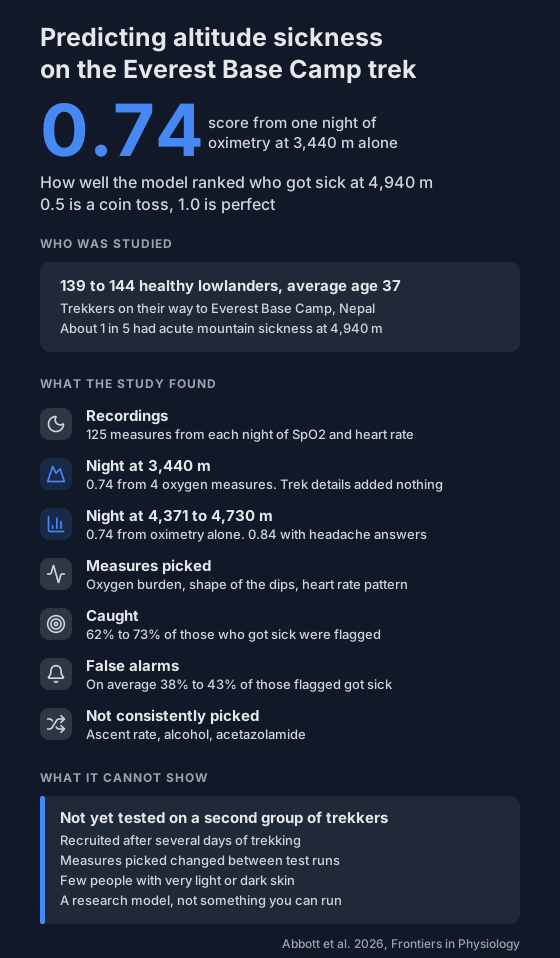
A 2026 study recorded one night of oximetry from about 140 trekkers on the way to Everest Base Camp. Models built on those nights ranked who later got altitude sickness with a score of 0.74 to 0.84, where 0.5 is a coin toss.
On the trek to Everest Base Camp, roughly 3 in 10 people get acute mountain sickness, according to earlier research the paper cites. Today it's spotted from symptoms, once they've started.
The same research group ran a pilot study of 20 people in the Alps that got a perfect score it didn't trust. This 2026 study is the bigger follow-up: about 140 trekkers in Nepal.
Who was studied?
- Healthy lowlanders aged 18 to 65 who were already trekking to Everest Base Camp.
- 209 signed up at Namche Bazaar (3,440 m), and 186 had a doctor's check at Lobuche (about 4,940 m).
- Average age was about 37, and a little under half were men.
- Each wore a wrist oximeter with a finger sensor for one night at Namche and one night at Dingboche or a nearby village (4,371 to 4,730 m).
- Usable recordings needed at least 4 hours of clean data. That left 139 people for the Namche night and 144 for the higher night.
- At Lobuche, a doctor's examination found acute mountain sickness in 30 of the 139 and 29 of the 144.
- Taking acetazolamide didn't rule anyone out.
What did they look at?
The researchers pulled 125 measures from each night's SpO2 and heart rate. They included time below 91%, the lowest reading, how deep and long the dips were, and how the heart rate moved.
They then trained models to sort people into sick and not sick at Lobuche, using:
- The oximetry measures alone.
- The oximetry measures plus other details: symptom answers, past altitude illness, ascent rate, alcohol and medication.
How well did it work?
The main score was the AUC, a measure of how well a model ranks the people who got sick above those who didn't. 0.5 is a coin toss and 1.0 is perfect.
- Night at 3,440 m, oximetry alone. 0.74. Four oxygen measures did the work, including time below 91% and the lowest reading. Adding the other details changed nothing.
- Higher night, oximetry alone. Also 0.74, from nine measures.
- Higher night, plus other details. 0.84, in the 117 people with complete details, 20 of whom got sick. Two headache answers were added: headache that morning and a past altitude headache. With the morning headache taken out, it was 0.81.
The Namche night came about four days before Everest Base Camp.
The measures the models picked included:
- How much time oxygen spent low, the idea behind oxygen burden.
- The shape of the dips: how varied their depth, length and slope were.
- At the higher night, how often heart rate crossed its own average.
- Others described the overall spread of readings and how SpO2 rose and fell over the night.
Ascent rate, alcohol and acetazolamide were not consistently picked. The authors say that doesn't mean they don't matter.
How many false alarms?
Plenty.
- The models flagged 62% to 73% of the people who went on to get sick.
- Of the people flagged, on average 38% to 43% got sick. The rest were false alarms.
- All the models tended to overestimate risk.
The authors see it as an early warning to sit alongside a doctor's check, not a test that decides who is sick. They suggest it could help decide who to watch more closely or when to slow the ascent.
What can't it show?
- No second group. The models were tested by holding back part of the same group, over and over. They weren't tried on new trekkers.
- Unstable picks. The measures chosen changed between runs, so the authors say no single measure should be read as the key one yet.
- Late recruitment. People joined after several days of trekking. Those who got sick or turned back earlier may be underrepresented.
- Skin tone. Most people had mid-range skin types, with few at either end.
- Small dataset. About 140 people is small for machine learning, so the margins are wide. For the Namche model, the 95% range ran from 0.64 to 0.83.
- Rough ascent measure. Ascent was summed up as an average rate, which misses how long each person stayed at each height.
It's also a research model built on a Nonin wrist oximeter and the researchers' own software. You can't run it on your own recording.
What can you do with this?
Your own recording can't tell you whether you'll get sick. Symptoms and how you feel still come first, and the paper notes acute mountain sickness can progress to life-threatening illness.
If you want to log a trip:
- Read what to expect from your blood oxygen at altitude.
- See what a larger study of overnight oxygen and altitude sickness found, and how common altitude sickness is.
- Open your nights in the session viewer and note any headache or poor sleep next to each one.
Not a medical device. Does not diagnose, treat or prevent any condition. Discuss results and changes with a clinician.
References
- Abbott H, Cutts LR, Stanley B, Kansakar S, Broughton SE, Scott T, Davis S, Clarke S, Clark T, Simpkins C, Goves J, Howes E, Pattinson KT, Garcia A, et al. Prediction of acute mountain sickness from overnight pulse oximetry during ascent to Everest Base Camp: a field-based machine learning study. Frontiers in Physiology. 2026;17:1939874. doi:10.3389/fphys.2026.1939874