Night-Time Heart Attacks and Sleep Apnea
A 2025 study of 713 heart attack patients found that those with 15 or more breathing events per hour more often had their heart attack start between midnight and 6 am, 26.9% against 18.4%.
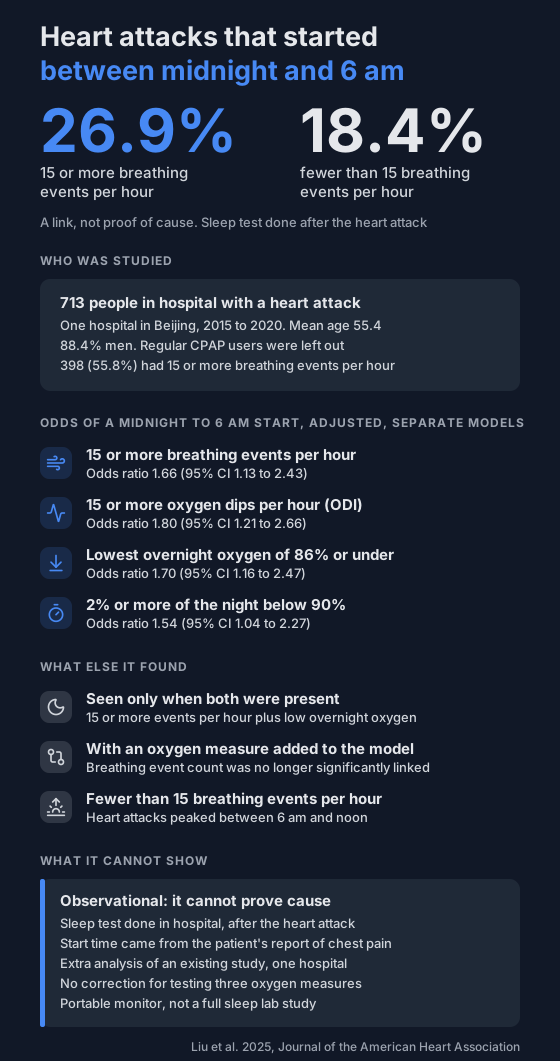
A 2025 study from Beijing looked at what time of day heart attacks started, in people with and without sleep apnea. It also looked at overnight oxygen. The authors say no earlier study on heart attack timing had done that.
Who was studied?
- 713 people admitted to one Beijing hospital with a heart attack, between June 2015 and January 2020.
- Mean age 55.4. 88.4% were men.
- Each had an overnight sleep test in hospital once they were stable, using a portable monitor.
- 398 of them (55.8%) had 15 or more breathing events per hour on that test.
- People already using CPAP regularly, and people with mainly central sleep apnea, were left out.
The start time of the heart attack was the time the patient said the chest pain began.
What did it find?
The researchers split the day into four 6-hour blocks.
- With 15 or more breathing events per hour, 26.9% of heart attacks started between midnight and 6 am.
- With fewer than 15, it was 18.4%.
- The group with fewer than 15 had the usual morning peak, between 6 am and noon.
- In the group with 15 or more, that morning peak was flatter, because more of their heart attacks started at night.
After adjusting for age, sex, BMI, smoking, diabetes, high cholesterol and high blood pressure, 15 or more breathing events per hour went with higher odds of a midnight to 6 am start (odds ratio 1.66, 95% CI 1.13 to 2.43).
Everyone whose heart attack started in those hours was asleep when the chest pain began.
What about overnight oxygen?
The study used three oxygen measures from the same sleep test. Each was tested in its own model, with the same adjustments. Each one was linked to higher odds of a midnight to 6 am start:
- 15 or more oxygen dips per hour (ODI): odds ratio 1.80 (1.21 to 2.66).
- Lowest overnight oxygen of 86% or under: odds ratio 1.70 (1.16 to 2.47).
- 2% or more of the night below 90% (T90): odds ratio 1.54 (1.04 to 2.27).
86% and 2% were the middle values for the whole group, which is why they were used as cut-offs.
Two more results point at oxygen:
- In subgroup analyses, the odds of a midnight to 6 am start were significantly higher only in people who had both 15 or more breathing events per hour and low overnight oxygen. The paper shows this in a chart and says it held for each of the three oxygen measures.
- In a second set of models, each oxygen measure was added alongside the number of breathing events, one at a time. In all three, 15 or more breathing events per hour was no longer significantly linked to a midnight to 6 am start (odds ratios 0.98, 1.44 and 1.33, each with a 95% CI that includes 1).
The authors read this as the link running mainly through low overnight oxygen. In those same models, only the lowest oxygen reading stayed significantly linked (odds ratio 1.53, 95% CI 1.03 to 2.26). ODI (1.82, 0.82 to 4.04) and T90 (1.40, 0.92 to 2.13) did not. These second-set figures are from the paper's Table 4, so they differ from the ones in the list above, which are from Table 3.
Another study on this blog looked at ODI and coronary artery disease.
What does it say about CPAP?
It didn't test CPAP. People who already used CPAP regularly were left out. In their discussion, the authors give their opinion that interventions including CPAP should be offered to people with coronary artery disease who have both 15 or more breathing events per hour and low overnight oxygen. That is the authors' view, not a result of this study. They also say that whether CPAP lowers the chance of a night-time heart attack still needs to be studied.
For what trials have found so far, see the review of CPAP and heart health.
What can't it show?
- Cause. It's an observational study, and an extra analysis of a project set up for a different question. Other differences between the groups could explain the result.
- What breathing was like before the heart attack. The sleep test was done in hospital afterwards. The authors say a test this soon after a heart attack may overstate the number of breathing events.
- Exact timing. The start time relied on what patients remembered about their chest pain. 82 people with no clear start time were left out.
- Whether a chance result crept in. Three oxygen measures and several subgroups were tested with no correction for multiple comparisons. The authors say that raises the chance of a false positive.
- Other groups. One hospital, mostly men. The type of heart attack and what triggered it weren't recorded.
The test was a portable monitor, not a full sleep lab study, and the authors say that could undercount breathing events.
Earlier studies disagree, too. The paper lists three that found the usual morning peak in people with sleep apnea, and two that found a night-time peak like this one.
What can you do with this?
Not much on your own, and the study doesn't claim otherwise. It's about people who had already had a heart attack, tested in hospital. It says nothing about what a home oximeter reading means for you.
- Chest pain can be an emergency at any hour. If you have it, call your local emergency number.
- If you have heart disease and your overnight recordings show a lot of dips, take them to your doctor. Here's how to share them.
The study was funded by Chinese national and Beijing municipal research grants. One author reported research grants to the institution from Boston Scientific, Abbott and three pharmaceutical companies.
Not a medical device. Does not diagnose, treat or prevent any condition. Discuss results and changes with a clinician.
References
- Liu X, Wang B, Hao W, Qiu Y, Guo Q, Guo Y, Xin Q, Fan J, Que B, Gong W, Zheng W, Wang X, Nie S. Association of Obstructive Sleep Apnea and Nocturnal Hypoxemia With the Circadian Rhythm of Myocardial Infarction. Journal of the American Heart Association. 2025;14(3):e036729. doi:10.1161/JAHA.124.036729