Neck Collar for Sleep Apnea: A 2025 Trial
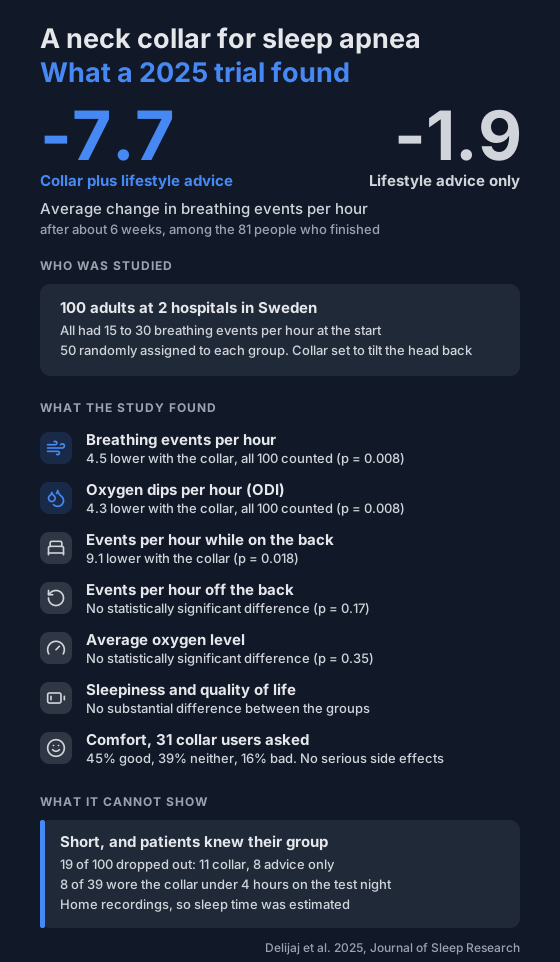
A Swedish randomised trial gave 50 of 100 adults with sleep apnea a neck collar that tilts the head back during sleep. Among the 81 who finished, breathing events per hour fell by 7.7 with the collar and 1.9 with lifestyle advice alone.
Tilting the head back is a standard way to open the airway in first aid and under anaesthetic. A Swedish team tested whether a neck collar that holds the head tilted back during sleep changes the numbers in obstructive sleep apnea.
It did, mostly for sleep on the back. The trial was short, and it found no clear difference in how people felt.
Who was in the trial?
- 100 adults referred to two hospital clinics in Sörmland, Sweden, between 2019 and 2022.
- All had 15 to 30 breathing events per hour on a home recording.
- About two thirds were men, and the average age was 55 in one group and 58 in the other.
- Nobody had a BMI of 35 or more, and anyone with a history of whiplash or other neck pain was left out.
They were randomly split into two groups of 50:
- Advice only: stop smoking, avoid alcohol, lose weight, be more active, and avoid sleeping on the back.
- Collar plus advice: the same advice, plus a neck collar to sleep in.
The collar was an off-the-shelf model made for neck injuries. People were told to use its highest setting, which tilts the head back 24 degrees. Anyone who found that uncomfortable could lower it a step at a time.
Everyone had a second home recording about 6 weeks after starting. The collar group wore the collar for it.
What did it find?
81 people finished: 39 in the collar group and 42 in the advice group. These are the average changes among them:
- Breathing events per hour: down 7.7 with the collar, down 1.9 with advice only.
- Oxygen dips per hour (ODI): down 7.2 with the collar, down 1.5 with advice only.
- Events per hour while on the back: down 15.0 with the collar, down 3.2 with advice only.
- Events per hour off the back: down 1.4 with the collar, up 1.4 with advice only.
The main analysis counted all 100 people and carried the starting numbers forward for the 19 who dropped out. On that count, the collar group ended up:
- 4.5 breathing events per hour lower than the advice group (p = 0.008).
- 4.3 oxygen dips per hour lower (p = 0.008).
- 9.1 events per hour lower while on the back (p = 0.018).
There was no statistically significant difference for events off the back (p = 0.17), average oxygen level (p = 0.35) or the share of the night spent on the back (p = 0.34).
Among those who finished, 17 people in the collar group were below 10 events per hour on the second recording, against 8 in the advice group. 7 were below 5, against 1.
Did people feel better?
Not measurably. Daytime sleepiness, quality of life and self-reported sleep problems didn't differ much between the groups.
The authors give two possible reasons:
- Only a minority were sleepy at the start.
- About 6 weeks may be too short for symptoms to change.
Was the collar comfortable?
- No serious side effects were reported.
- 31 people in the collar group rated it: 45% said good, 39% neither good nor bad, and 16% bad.
- The complaints were about comfort: pressure on the jaw, a congested feeling and sharp edges.
- The positive comments mentioned less snoring, gasping and choking at night, and feeling more alert in the day.
- 11 people in the collar group dropped out, against 8 in the advice group. The authors say discomfort may have caused some of the dropouts.
Everyone who finished said they used the highest setting. The authors say the collar isn't designed for long-term use in sleep apnea, and that its design and comfort need work.
What doesn't it tell you?
- It was short. One follow-up recording after about 6 weeks. The authors call for long-term follow-up of both the effect and how well people tolerate it.
- It wasn't blinded. Patients and the investigator knew who had a collar. The technician who scored the recordings did not.
- 19% dropped out. There's no follow-up data for them.
- Collar use wasn't checked. It was self-reported, and 8 of the 39 said they wore it for under 4 hours on the test night. Their recordings were still counted.
- Home recordings. Sleep time was estimated from the trace and a diary, not measured.
- One night each. Breathing events vary from night to night, and the "before" recording was the one that got people referred, on average more than 4 months before the second.
- It wasn't compared with CPAP or a mouthpiece. The authors suggest a collar could be a second-line option, especially when events mostly happen on the back.
- One collar, one angle. The authors point to two earlier small studies of collars that held the neck without much tilt and found no effect.
Whether a collar suits you is a question for your doctor. The trial left out anyone with neck problems.
What can you take from it?
The collar's effect showed up on the back. Sleep position is something you can log yourself. If you record overnight oxygen, you can compare nights on your back with nights on your side and see whether your dips per hour differ.
Not a medical device. Does not diagnose, treat or prevent any condition. Discuss results and changes with a clinician.
References
- Delijaj F, Lindhagen L, Johnsson L, Kristiansson P, Lindberg E. Treatment effect of head extension by cervical collar on moderate obstructive sleep apnea - A randomized controlled trial. Journal of Sleep Research. 2025;34(4):e14463. doi:10.1111/jsr.14463