Morning vs Evening Exercise and HRV
In a 2026 study of 30 women aged 50 to 60, one hard treadmill test at 6am shifted pulse-based sympathetic and parasympathetic readings and brain-wave measures more than at 6pm. The overall HRV index fell in both groups, with no statistically significant gap. Post-exercise readings were taken only right after.
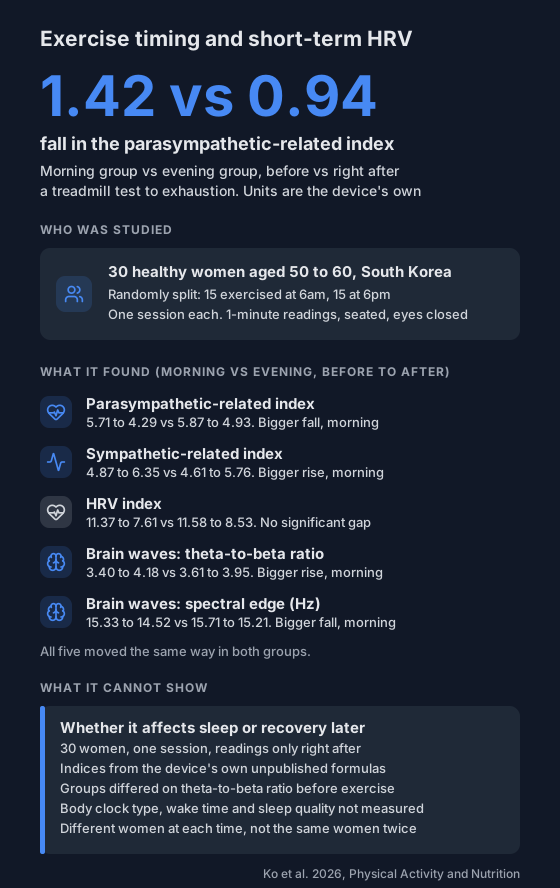
Hard exercise lowers heart rate variability (HRV) for a while afterwards. That's expected, whatever the time of day. A small exploratory Korean study published in September 2026 asked whether the size of that dip depends on when you exercise.
In women aged 50 to 60, the overall HRV reading fell at both times, with no statistically significant difference between them. But its "rest and digest" part fell further, and its "fight or flight" part rose further, after a 6am session than after a 6pm one.
Who was in the study?
- 30 healthy women aged 50 to 60, recruited from community centres and gyms in Ilsan, near Seoul.
- None had heart or nervous system conditions, and none were on hormone therapy.
- They were randomly split into two groups of 15: one exercised at 6am, the other at 6pm.
- Each woman did one session: a treadmill test that gets faster and steeper every three minutes until you can't go on.
- They were asked to sleep 7 to 8 hours the night before and skip caffeine for 24 hours.
What was measured?
A portable device recorded brain waves and the pulse wave together, for one minute before and one minute right after exercise, seated with eyes closed.
- From the pulse wave (PPG): an HRV index, plus a sympathetic-related index ("fight or flight" side) and a parasympathetic-related index ("rest and digest" side).
- From two forehead brain-wave sensors (EEG): the theta-to-beta ratio and the spectral edge frequency. The authors read a higher ratio and a lower edge frequency as lower alertness and a fatigue-like pattern.
The device calculates all of these with its own formulas, which the authors couldn't check. So the HRV numbers have no standard units.
What did it find?
Every measure moved the same way in both groups. In four of the five, the change was significantly bigger in the morning.
Morning group, then evening group, before to after:
- Parasympathetic-related index: 5.71 to 4.29, against 5.87 to 4.93. The fall was bigger in the morning.
- Sympathetic-related index: 4.87 to 6.35, against 4.61 to 5.76. The rise was bigger in the morning.
- HRV index: 11.37 to 7.61, against 11.58 to 8.53. Both fell, with no statistically significant difference between groups.
- Theta-to-beta ratio: 3.40 to 4.18, against 3.61 to 3.95. The rise was bigger in the morning.
- Spectral edge frequency: 15.33 to 14.52 Hz, against 15.71 to 15.21 Hz. The fall was bigger in the morning.
The authors suggest the body is in a less alert state at 6am, so the same exercise shifts it further. They didn't test that.
For how accurate HRV from a pulse sensor is, see wearable HRV vs ECG.
What can't it show?
- Anything about sleep. Nobody was measured after the one-minute reading.
- Whether a bigger dip is good or bad. The study doesn't say which time of day is better.
- Whether it lasts. It was one session, with no follow-up over weeks.
- One-minute readings are much shorter than standard HRV recordings, the authors note.
- The two groups already differed on the theta-to-beta ratio before exercising.
- Body clock type, usual wake-up time and sleep quality weren't measured. The authors say these, and grogginess from an early start, may have affected the morning result.
- Each woman exercised at only one time, so the study can't show how one person responds at different times.
- It's 30 women aged 50 to 60, so it may not apply to men or other ages.
- The paper doesn't report how long the women lasted on the treadmill, or their heart rate or effort ratings, so it's unknown whether the two groups worked equally hard.
- The authors write that time of day relates to exercise performance, but the study measured no performance.
- It received no external funding, and the authors declare no conflicts of interest.
A 2026 meta-analysis found no clear best time to exercise for sleep. A separate small study looked at exercise timing and night-time blood pressure.
What can you do with this?
A pulse oximeter logs your pulse rate all night, so you can run your own comparison:
- Exercise in the morning on some days and in the evening on others.
- Note which nights followed which.
- Compare your overnight pulse rate across several nights of each in the session viewer.
One night of each tells you little. Here's how many nights to record. If you have a heart condition, talk to your doctor before changing how or when you exercise.
Not a medical device. Does not diagnose, treat or prevent any condition. Discuss results and changes with a clinician.
References
- Ko JM, So WY, Jung JH. Effects of morning versus evening high-intensity exercise on electroencephalographic and autonomic responses in middle-aged women. Physical Activity and Nutrition. 2026;30(3):24-31. doi:10.20463/pan.2026.0036