Migraine, Insomnia and Sleep Apnea: A Study
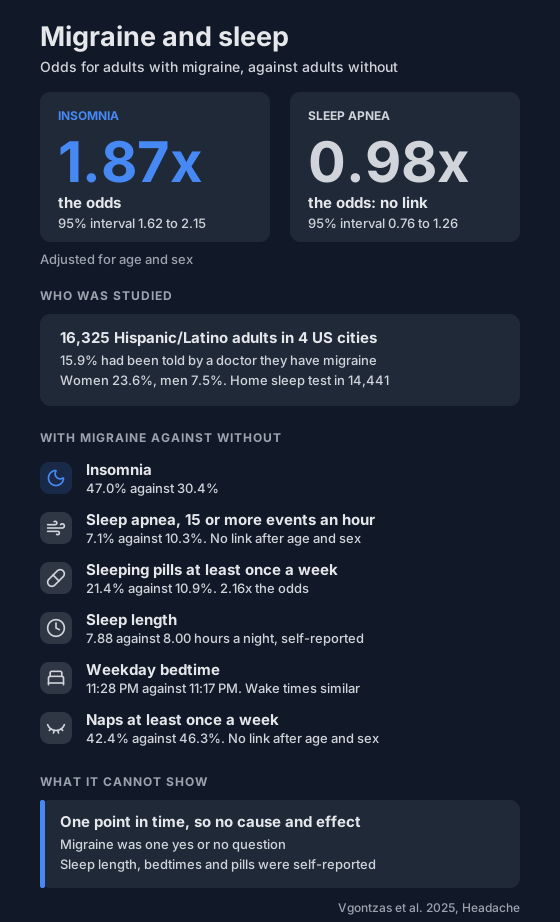
A study of 16,325 Hispanic/Latino adults in the US found that people with migraine had 1.87 times the odds of insomnia, but no higher odds of sleep apnea on a home sleep test.
People with migraine often say poor sleep sets off an attack. So is the sleep problem behind it sleep apnea, insomnia, or both?
A 2025 study surveyed 16,325 adults and gave most of them a home sleep test. Migraine was linked to insomnia. It was not linked to sleep apnea.
Who was in the study?
- 16,325 adults aged 18 to 74 from the Hispanic Community Health Study/Study of Latinos.
- They were recruited from households in the Bronx, Chicago, Miami and San Diego between 2008 and 2011.
- Average age was 41, and 52.2% were women.
- 39.5% had a BMI of 30 or more.
- 2,569 of them said yes when asked whether a doctor had ever told them they have migraine.
After weighting to match the US Hispanic/Latino population, that is 15.9%: 23.6% of women and 7.5% of men. The highest figure was in women aged 25 to 34, at 28.2%.
People with migraine were more often not employed (50.8% against 36.2%) and more often had a household income under $20,000 a year (50.9% against 45.5%).
What was measured?
- Sleep apnea: an overnight recording with a self-applied home monitor that recorded airflow, snoring and head position. The study counted sleep apnea as 15 or more breathing events an hour, each with a 3% oxygen dip. 14,441 people had usable test data.
- Insomnia: a score of 9 or more on a standard insomnia rating scale.
- Everything else: people reported their own bedtimes, wake times, naps and sleeping pill use.
Was migraine linked to sleep apnea?
No.
- 7.1% of people with migraine had sleep apnea on the home test, against 10.3% of people without.
- That raw gap went away once age and sex were accounted for: 0.98 times the odds (95% interval 0.76 to 1.26). More than three quarters of the migraine group were women (77.4%).
- Adding BMI to the model changed nothing: 0.97 times the odds.
- A model with age, sex, income, education, work, health insurance and heritage gave 1.02 times the odds.
The authors say a migraine history should not be read as raising or lowering your chance of sleep apnea. They add that the usual sleep apnea risk factors still deserve a check whether or not you have migraine.
An earlier US survey put 37% of adults with episodic migraine at high risk of sleep apnea. That survey used a checklist, not an overnight test, which the authors think explains the difference. A study of 533 adults in Norway that used full sleep studies also found no link.
What about insomnia?
- 47.0% of people with migraine met the insomnia cut-off, against 30.4% of people without.
- That is 1.87 times the odds after age and sex (95% interval 1.62 to 2.15).
- Accounting for anxiety and depression symptoms lowered it to 1.65 times. Both were more common in the migraine group: anxiety symptoms 39.0% against 26.2%, depression symptoms 39.4% against 25.0%.
The authors note that several earlier studies found cognitive behavioural therapy for insomnia effective in people with migraine. This study did not test any therapy.
For another group where insomnia and sleep apnea were measured side by side, see the diabetes study.
What else differed?
- Sleeping pills: 21.4% of people with migraine took one at least once a week, against 10.9%. That is 2.16 times the odds, and still 1.76 times after accounting for insomnia, anxiety and depression. The study did not record which pills, or whether they were prescribed. The authors suggest some people may take them to sleep through an attack, which they call an unsupported strategy.
- Sleep length: 7.88 hours a night against 8.00. The paper's text puts the gap at 10.8 minutes, and its age and sex model gives 0.20 hours, which is 12 minutes.
- Bedtime: 11:28 PM against 11:17 PM on weekdays, and 12:21 AM against 12:08 AM at weekends. After age and sex that was about 17 minutes later. The gap was no longer statistically significant after accounting for income, education, work, insurance and heritage.
- Wake time: similar in both groups in the age and sex model.
- Naps: 42.4% napped at least once a week, against 46.3%. No link after age and sex.
- Daytime sleepiness: 20.9% against 18.4%. The paper's text says there was no difference, but its table gives 1.20 times the odds (95% interval 1.02 to 1.40) after age and sex, 1.10 (0.93 to 1.29) after anxiety and depression, and 1.22 (1.03 to 1.44) in the income and heritage model.
What can't this study show?
- It is a snapshot. Everyone was measured once, so it cannot say whether migraine leads to insomnia, insomnia leads to migraine, or something else drives both.
- Migraine came from one yes or no question about a doctor's opinion. The authors say this likely misses people, especially men and older adults, and may pick out people with more disabling migraine.
- People with migraine were more often insured (55.9% against 49.5%), so access to a doctor shaped who was counted.
- Sleep length, bedtimes, naps and pills were self-reported. People can misjudge their own sleep.
- The sleep apnea result is for 15 or more events an hour on a home test. The study did not look at lower event counts.
- No power calculation was done; the sample was whatever data existed.
- The study was funded by US government health institutes. Several authors report consulting fees or grants from drug and sleep device companies.
What can you do with this?
- In this study, insomnia was far more common than sleep apnea in people with migraine: 47.0% against 7.1%. If you have migraine and sleep badly, trouble falling or staying asleep is worth raising with your doctor.
- In this study, migraine was not linked to higher or lower odds of sleep apnea. If you snore, wake unrefreshed or carry other risk factors, the sleep apnea risk check gives you something to take to a doctor.
- An overnight oximeter records oxygen dips and pulse. It does not measure insomnia. A plain sleep diary of bedtimes and wake times covers that side.
- Curious what your own nights look like? Here's what an overnight pulse oximeter shows.
Not a medical device. Does not diagnose, treat or prevent any condition. Discuss results and changes with a clinician.
References
- Vgontzas A, Mittleman MA, Castro-Diehl C, Isasi CR, Lipton RB, Patel SR, Ramos A, Sotres-Alvarez D, Agudelo C, Daviglus ML, Zee PC, Redline S, Bertisch SM. Migraine and sleep apnea, insomnia, and sleep patterns in the Hispanic Community Health Study/Study of Latinos (HCHS/SOL). Headache. 2025;65(10):1716-1726. doi:10.1111/head.14926