Liraglutide, COPD and Overnight Oxygen Dips
A 2026 exploratory analysis of a 40-week trial in 40 adults with COPD and obesity or overweight: oxygen dips per hour fell by about 10 against placebo on liraglutide. Sleepiness did not change, and Novo Nordisk supplied the drug and running costs.
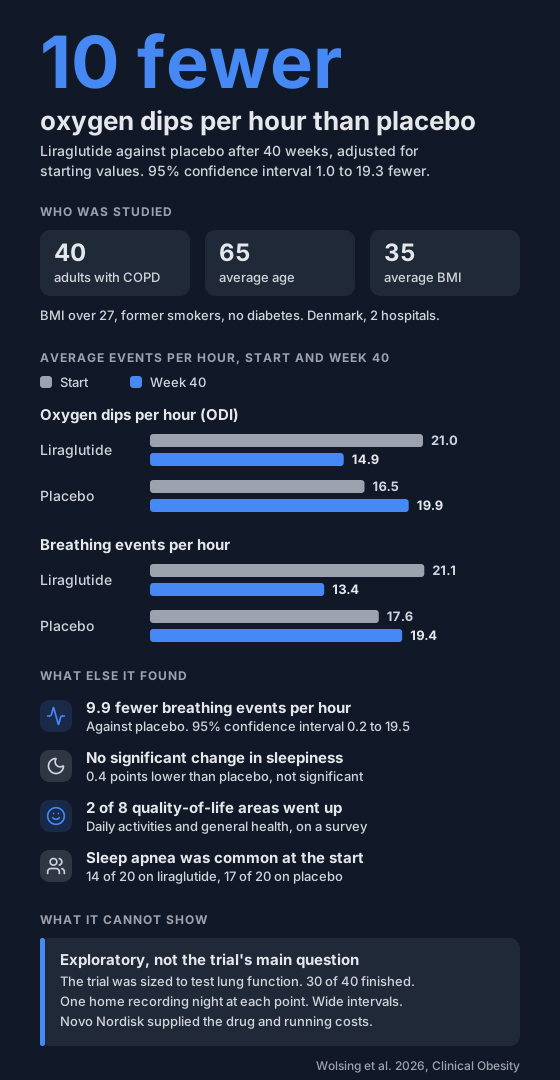
Weight-loss drugs have been tested in people with obstructive sleep apnea, but the authors say those trials often left out people with COPD. A 2026 paper looked at liraglutide in people who have COPD and carry extra weight.
After 40 weeks, the liraglutide group had about 10 fewer oxygen dips per hour than the placebo group. It was a small, exploratory analysis, and Novo Nordisk, which makes liraglutide, supplied the drug and running costs.
Who was in the study?
- 40 adults at two hospitals in Denmark, all with COPD and a BMI over 27.
- Average age was 65 and average BMI was 35.
- All were former smokers, and none had diabetes.
- They were 40 to 70 years old: 24 men and 16 women.
- Half got liraglutide injections, stepped up to 3.0 mg, and half got placebo, for 40 weeks.
- Neither the participants nor the staff knew who got which.
Most of them had sleep apnea at the start. The paper's text says 84%, while its table lists 14 of 20 in the liraglutide group and 17 of 20 in the placebo group, which is 31 of 40, or 78%.
What was measured?
Each person wore a home sleep recorder for one night at the start and one night at week 40. It gave two numbers:
- The oxygen desaturation index (ODI): oxygen dips per hour.
- Breathing events per hour: pauses and shallow breaths.
They also filled in a daytime sleepiness score and a quality-of-life survey.
What did it find?
Average oxygen dips per hour:
- Liraglutide: 21.0 at the start, 14.9 at week 40.
- Placebo: 16.5 at the start, 19.9 at week 40.
Average breathing events per hour:
- Liraglutide: 21.1 at the start, 13.4 at week 40.
- Placebo: 17.6 at the start, 19.4 at week 40.
Adjusted for starting values, age, sex and body weight, the liraglutide group ended up:
- 10.2 oxygen dips per hour lower than placebo (95% confidence interval 1.0 to 19.3, p = 0.029).
- 9.9 breathing events per hour lower than placebo (95% confidence interval 0.2 to 19.5, p = 0.044).
Those intervals are wide. The true difference could be close to zero or close to 20.
What about sleepiness and quality of life?
- The sleepiness score did not differ significantly between the groups (0.4 points, p = 0.71). It was already low at the start, about 5 out of 24 in both groups.
- Two of the eight quality-of-life areas scored higher on liraglutide than on placebo: one covering limits on daily activities from physical health (9.1 points higher, meaning fewer limits), and one covering how people rated their general health (13.1 points higher).
- The authors say both gains are at the border of the size usually counted as meaningful for people with COPD: 12.5 and 15 points.
- The other six areas showed no significant difference.
The authors note that an earlier liraglutide trial and a weight-loss surgery study also found no significant change in the sleepiness score. Not everyone with sleep apnea feels sleepy: see sleep apnea without sleepiness.
What doesn't it tell you?
- It wasn't the trial's main question. The trial was designed and sized to test lung function. The sleep results are a secondary, exploratory analysis, run after the researchers knew who got which drug.
- It's small. 30 of the 40 were in the complete-case analysis: 16 on liraglutide and 14 on placebo. The main result came from a model that used every available recording, and the paper doesn't say how many people had a recording at both points.
- One night each time. Oxygen dips vary from night to night.
- The groups didn't start level. The liraglutide group had significantly better lung function at the start, and more oxygen dips per hour, though that gap was not statistically significant. The authors say lung function may have influenced the result.
- CPAP muddies the sleepiness result. Of 22 people with 15 or more breathing events per hour, 15 accepted CPAP when it was offered, and some later stopped.
- People without sleep apnea were included in the analysis, which the authors say may have diluted the effect.
- Side effects. Some participants had stomach side effects. The numbers are in the main trial paper, not this one.
- Funding. Novo Nordisk supplied the study drug and running costs under its investigator-sponsored studies programme. One author is a speaker for the company and declares no financial interest in this study. A Danish research foundation, a hospital research council and the regional health authority gave partial support.
The authors call the findings exploratory and say larger trials are needed.
What can you do with this?
This is one small study, not a reason to start or change any medication. That's a decision for you and your doctor.
If you have COPD and you snore loudly, wake up gasping, or someone has seen you stop breathing in your sleep, tell your doctor. The sleep apnea risk check takes about a minute and helps you decide whether to have that conversation.
If you're already making a change with your doctor, an overnight oximeter lets you log your ODI over many nights and see the trend. It can't tell you whether you have sleep apnea.
For more on weight-loss drugs and sleep apnea, read early weight loss on tirzepatide and GLP-1 drugs, SGLT2 drugs and exercise.
Not a medical device. Does not diagnose, treat or prevent any condition. Discuss results and changes with a clinician.
References
- Wolsing SK, Dogan ADA, Juhl CB, Hess S, Jensen TT, Bladbjerg EM, Hilberg O. Exploratory Analysis of Liraglutide Effects on Obstructive Sleep Apnea and Health-Related Quality of Life in Individuals With Obesity and COPD: A Secondary Analysis of a Randomised Controlled Trial. Clinical Obesity. 2026;16(2):e70079. doi:10.1111/cob.70079