Can a Home Sleep Test Miss Sleep Apnea?
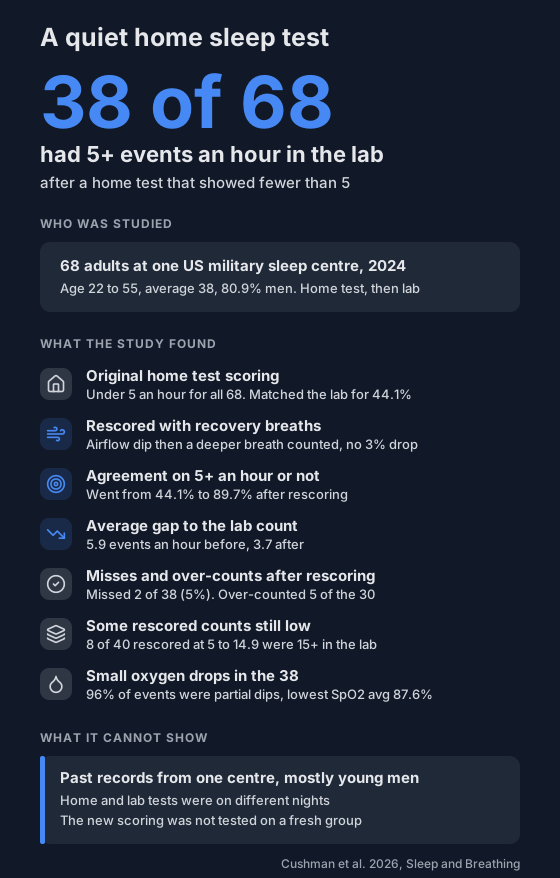
A 2026 study found 38 of 68 people whose home sleep test showed fewer than 5 breathing events an hour had 5 or more in a later lab study. Rescoring that also counted dips followed by a deeper breath matched the lab for 89.7% of people, up from 44.1%.
A home sleep test that shows fewer than 5 breathing events an hour is usually read as a quiet night. The paper notes that US sleep medicine guidance already says a negative home test in someone at higher risk should be followed by a lab study. This 2026 study looked at what those lab studies found.
Of 68 people whose home test came back under 5, 38 had 5 or more an hour in the lab.
Why would a home test miss events?
In the lab, a partial breathing dip counts if airflow drops by 30% and either oxygen falls by 3% or the brain briefly wakes (an arousal, seen on EEG). A typical home test has no EEG. So it can only count a partial dip when oxygen falls by 3% or more.
Dips that wake you briefly without much of an oxygen drop go uncounted.
Who was studied?
- 68 adults who had a home sleep test and then a lab study at one US military sleep centre in 2024.
- All had symptoms that pointed to a higher chance of sleep apnea, and all home tests showed fewer than 5 events an hour.
- Ages 22 to 55, average 38. 80.9% were men.
- Mostly active-duty military (86.8%), the rest veterans or other beneficiaries.
It was a retrospective study: the team went back through existing records.
What did they change?
They rescored the home tests by hand. A partial dip still counted with a 3% oxygen drop. It now also counted when it was followed by a recovery breath at least 50% bigger than usual breathing, even with less than a 3% oxygen drop.
That deeper breath was used as a stand-in for the arousal the home test can't see. The scorers didn't know the lab results.
What did they find?
- Before rescoring, the home test agreed with the lab on "5 or more an hour or not" for 44.1% of people.
- After rescoring, agreement rose to 89.7%.
- The average gap from the lab count went from 5.9 to 3.7 events an hour.
- Rescoring missed 2 of the 38 people with 5 or more in the lab (5%).
- It also put 5 of the 30 people under 5 in the lab at 5 or more.
The 5 over-counted people may still have had breathing problems that the 5-an-hour cut-off doesn't capture, the authors say.
Did the oxygen drops look big?
No, and that's the point for anyone using an oximeter. Among the 38 with 5 or more in the lab:
- 96% of their events were partial dips, not full pauses.
- Their lowest SpO2 averaged 87.6%.
- Most had 5 to 14.9 events an hour (29 of 38). 9 had 15 or more.
Every person with 5 or more, by the lab or the rescore, met the criteria for a pattern where breathing events wake people easily and come with only small oxygen drops. The authors say this may partly explain why counting recovery breaths helped here.
Rescoring still came in low for some people. 8 of the 40 people it put at 5 to 14.9 had 15 or more in the lab.
What can't it show?
- It looked back at existing records from one centre, mostly young men.
- The home and lab tests were on different nights. Counts can change a lot from night to night, and the gap between tests and sleep position weren't recorded.
- The rescoring rule was only checked on these 68 people, not on a new group.
- Only people with a negative home test were included, so it can't say how often home tests miss overall.
What does this mean for your oximeter?
An oximeter only sees oxygen and pulse, not airflow. Like the original home test scoring here, it misses breathing dips that end in a brief wake-up without much of an oxygen drop.
So a night with few oxygen dips isn't the same as a sleep study result. If you snore, wake unrefreshed or feel sleepy in the day, mention it to your doctor even if your oxygen looks steady.
- Record several nights, since one night can mislead.
- Try the sleep apnea risk check.
- Share your recordings with your doctor.
For how far an oximeter-only count can sit from a sleep study, see oximeter-only home test accuracy.
Not a medical device. Does not diagnose, treat or prevent any condition. Discuss results and changes with a clinician.
References
- Cushman P, Radtke A, Kang J, Burch A, Tchopev ZN, Brock MS, Scheuller HS. Modified scoring criteria to improve the accuracy of the home sleep apnea test. Sleep and Breathing. 2026;30(1):52. doi:10.1007/s11325-026-03598-y