Overnight Oxygen in Teens Living at Altitude
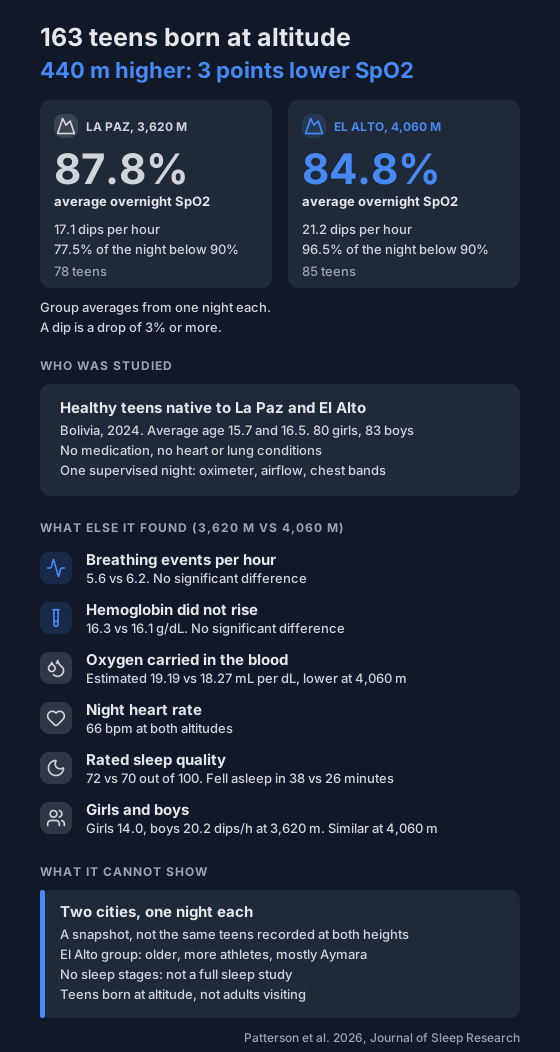
A 2026 study recorded one night in 163 healthy teenagers born and living at 3,620 m and 4,060 m in Bolivia. 440 m higher, average overnight SpO2 was 3 points lower and oxygen dips were more frequent, with similar breathing-event counts.
Most reference ranges for overnight oxygen come from people sleeping near sea level. Up high, everyone reads lower. But how much lower is "typical" for people who live there?
A 2026 study recorded one night in 163 healthy teenagers in two Bolivian cities that sit 440 m apart in height. The higher group averaged 3 points lower overnight, with more oxygen dips per hour, but about the same number of breathing events.
Who was studied?
- 163 healthy teenagers, born in and still living in La Paz (3,620 m) or El Alto (4,060 m).
- 78 in La Paz and 85 in El Alto, roughly half girls in each.
- Average age 15.7 in La Paz and 16.5 in El Alto.
- It's a cross-sectional study: each teen was recorded once.
- Nobody was on medication or had a heart or lung condition.
- Recorded between April and June 2024.
Each teen spent one night in a field sleep lab with staff watching. The kit was a breathing monitor: a pulse oximeter, a nasal airflow sensor, chest and belly bands, and a position sensor. It doesn't record brain waves, so it can't tell sleep stages or wake-ups.
What did the higher city show?
| La Paz, 3,620 m | El Alto, 4,060 m | |
|---|---|---|
| Average overnight SpO2 | 87.8% | 84.8% |
| Oxygen dips per hour (ODI) | 17.1 | 21.2 |
| Share of the night below 90% (T90) | 77.5% | 96.5% |
| Breathing events per hour | 5.6 | 6.2 |
| Night heart rate | 66 bpm | 66 bpm |
These are group averages. A dip here is a drop of 3% or more.
- At 4,060 m, average SpO2 was significantly lower, and dips and time below 90% significantly higher.
- The breathing-event count from the airflow sensor was not significantly different, and neither were its blocked-airway and central parts.
- About 55% of breathing events in both cities were the blocked-airway kind, mostly partial ones.
So the extra dips at 4,060 m weren't matched by more breathing events. The authors think small swings in breathing, too small to count as events, may explain the extra dips.
Didn't their blood make up for it?
Not in this study.
- Hemoglobin was 16.3 g/dL in La Paz and 16.1 in El Alto, not a significant difference.
- So the estimated oxygen carried in the blood was lower at 4,060 m: 18.27 against 19.19 mL per dL.
In their results the authors call that limited adaptation. In their discussion they note both figures are still close to the roughly 18.4 a teen at low altitude would carry.
How did they feel the next morning?
Much the same.
- Sleep quality was rated 72 and 70 out of 100.
- Night wake-ups, morning heart rate and upper blood pressure were similar.
- The lower blood pressure figure was slightly lower in El Alto: 62 against 65 mmHg.
- El Alto teens said they fell asleep faster: 26 minutes against 38.
- Daytime sleepiness on the Epworth Sleepiness Scale was higher in La Paz: 9.2 against 7.2.
- 41% of La Paz teens scored above 10 on it, against 17.6% in El Alto.
The authors see the differences at 4,060 m as adaptation, not a sign of a problem.
Did girls and boys differ?
At 3,620 m, yes.
- Girls had fewer dips (14.0 against 20.2 per hour) and fewer breathing events (4.0 against 7.5) than boys.
- At 4,060 m, girls and boys had similar counts.
- In the paper's sex comparison, average overnight SpO2 didn't differ significantly.
Why does this matter for sea-level numbers?
Breathing events in both cities averaged around 6 per hour. The authors compare that with under 1 per hour reported for teens at low altitude.
They used adult scoring rules, because there are no agreed rules for teens at altitude. They say cut-offs built from sea-level adults could wrongly flag healthy highland teens as having a breathing problem in sleep. Their point is that "typical" overnight numbers need to be set for each altitude.
What can't it show?
- Change in one person. It compares two groups of different teens, not the same teens at two heights.
- Altitude alone. The El Alto group was older, more often athletes (58% against 36%), and mostly Aymara, while La Paz is more mixed. The authors say ancestry may play a part.
- A settled age gap. The paper's Table 1 shows El Alto teens were older (16.5 against 15.7, p < 0.001), but its text says age didn't differ significantly.
- Sleep itself. No brain-wave recording, so no sleep stages.
- A typical night. One night each, so a first-night effect can't be ruled out.
- Adults or visitors. These were teens born at altitude, so the results may not apply to adults or to people who travel up from lower down.
What can you do with this?
If you live high or travel high, don't judge your nights against sea-level numbers. In this study, the city 440 m higher averaged 3 points lower SpO2.
- Record a few nights at home first, so you know your own baseline. See how many nights to record.
- On a trip, compare your nights at each altitude with each other, not with a friend's or a chart from sea level.
- Expect the first nights up high to look different. See sleep breathing in the first nights at altitude.
For adults sleeping at a similar height, see overnight oxygen in miners at 3,800 m. If your recordings worry you, share them with your doctor.
Not a medical device. Does not diagnose, treat or prevent any condition. Discuss results and changes with a clinician.
References
- Patterson K, Rodríguez SU, Arancibia-Levit EN, Raduan FA, Soto JAV, Gassmann M, Ulrich S, Furian M, Schneider Gasser EM. Nocturnal Sleep Breathing Patterns in Healthy Adolescents Residing at Very High Altitudes in Bolivia. Journal of Sleep Research. 2026;35(4):e70326. doi:10.1111/jsr.70326