CRP Inflammation and Sleep Apnea Outcomes
A 2026 health record study of about 481,000 matched adults with sleep apnea found that those with higher CRP, an inflammation blood marker, had more deaths and heart events over five years: 11.3% against 7.0% died.
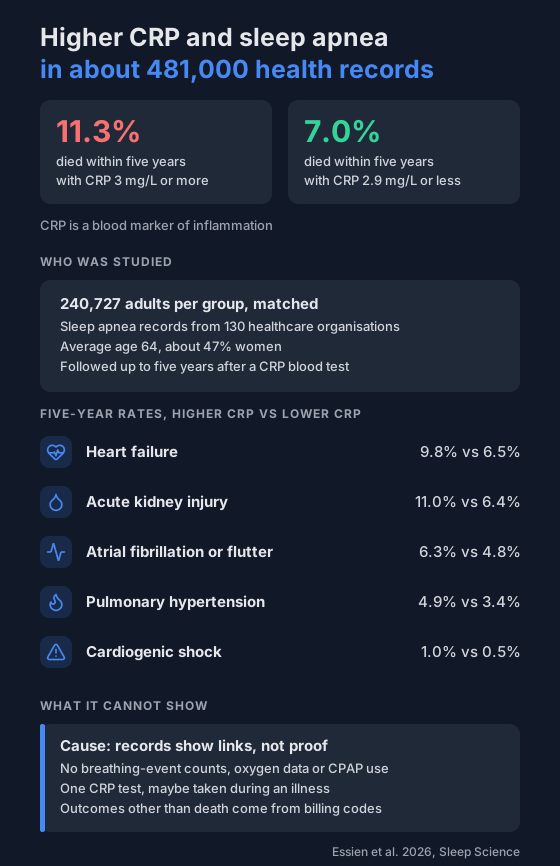
Sleep apnea is linked to heart and blood vessel problems. One suggested route is inflammation, which blood tests can pick up as raised C-reactive protein (CRP). A 2026 study asked whether CRP also lines up with who does worse over time among people who already have sleep apnea. In about 481,000 matched adults, higher CRP went with more deaths and more heart events over five years.
Who was studied?
- Adults aged 18 to 90 with a sleep apnea code in their health record and a CRP blood test.
- The records came from 130 healthcare organisations in the TriNetX research network.
- Higher CRP meant 3.0 mg/L or more. Lower meant 2.9 mg/L or less. The authors took the cut point from published heart risk thresholds.
- The groups were matched on age, sex, race, ethnicity, kidney disease, metabolic disorders and high blood pressure. That left 240,727 people in each group, with an average age of 64 and about 47% women.
- Before matching, 601,398 people had higher CRP and 240,742 had lower CRP, so about 360,000 people in the higher group were left out.
- They were followed for up to five years from the first record with both sleep apnea and a CRP result.
What did it find?
Over five years, the higher CRP group had more of every outcome in the paper's results table.
- Deaths: 11.3% against 7.0%. Five-year survival was 83.2% against 89.4%.
- Heart failure: 9.8% against 6.5%.
- Acute kidney injury: 11.0% against 6.4%.
- Atrial fibrillation or flutter: 6.3% against 4.8%.
- Pulmonary hypertension: 4.9% against 3.4%.
- Cardiogenic shock: 1.0% against 0.5%.
- Ventricular tachycardia: 2.3% against 1.8%.
The hazard ratio for death was 1.70, and the ratios for the others ran from 1.2 to 2.0. The smallest relative gap was for cerebrovascular disease, at 7.4% against 6.6%.
What can't it show?
It's a retrospective study of health records, so it shows what went together, not what caused what. The authors report no funding and no conflicts of interest. The authors list several reasons to be careful.
- Missing measures. Breathing events per hour, oxygen dips, CPAP use, smoking, activity and diet weren't available. Any of them could explain part of the gap.
- One CRP test. CRP rises with infections and other illness. A test taken during a flare could put someone in the higher group by accident. The authors think this would more likely shrink the gap than widen it.
- Billing codes. Sleep apnea and the heart, kidney and lung outcomes came from billing codes, which can be wrong or incomplete.
- Who gets a CRP test. Only people with a CRP result in these health systems were included, so they may not represent everyone with sleep apnea.
- Matching has limits. It balances the factors that were recorded, not the ones that weren't.
The authors say randomised trials would be needed to show whether acting on CRP changes outcomes. Their paper didn't test any therapy.
Some percentages in the paper's results table are higher than the counts divided by 240,727 would give. For example, heart failure is printed as 18,308 people (9.8%) against 13,213 (6.5%), which would be 7.6% and 5.5% of each group. The paper doesn't say which denominators it used, so this article gives the percentages as printed.
What can you do with this?
An overnight oximeter doesn't measure CRP, and this study didn't use one. CRP is a blood test your doctor orders, usually for other reasons.
The authors had no oxygen data, so they couldn't say whether the CRP link holds apart from overnight oxygen dips. An oximeter records time below 90% and the ODI. Separate studies have looked at how those line up with heart outcomes, such as ODI and coronary artery disease and time below 90% and heart failure.
If you have sleep apnea plus heart or kidney problems, your doctor is the person to say what a CRP result means for you. You can share your oximeter data with them.
Not a medical device. Does not diagnose, treat or prevent any condition. Discuss results and changes with a clinician.
References
- Essien E, Agyekum A, Carboo A, Amoako G, Owusu-Achiaw J, Governor SB. C-Reactive Protein as a Predictor of Cardiovascular Events and Mortality in Obstructive Sleep Apnea: A Propensity-Matched Analysis Using the TriNetX Research Network. Sleep Science. 2026;19(2):1-9. doi:10.1055/s-0046-1829074