Acid Reflux, CPAP and Time Below 90%
A 2026 study of 580 sleep clinic patients found reflux symptom scores tracked time below 90% and ODI more closely than breathing events per hour. In 112 patients, scores fell over 6 months on CPAP.
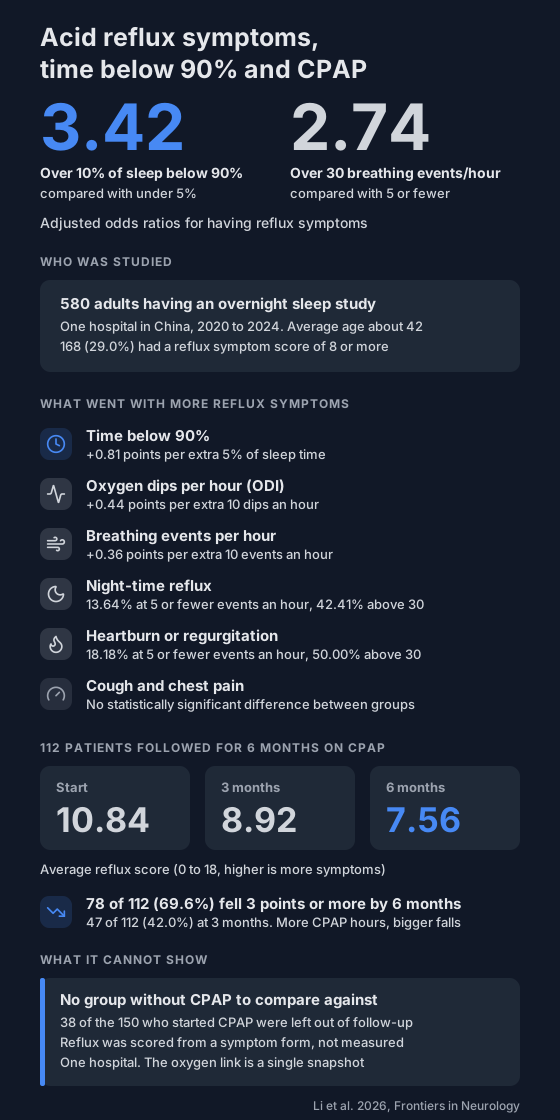
Sleep apnea and acid reflux often turn up in the same person. The authors of a 2026 study say earlier research mostly counted breathing events per hour.
Their study, published in March 2026, also looked at overnight oxygen. Reflux symptom scores tracked time below 90% and ODI more closely than breathing events per hour. It then followed 112 patients for 6 months on CPAP.
For the wider evidence on the link, see sleep apnea and acid reflux.
Who was studied?
- 580 adults aged 18 to 70 who had an overnight sleep study at one hospital in Shijiazhuang, China, between 2020 and 2024.
- Their average age was about 42, and about a third were women.
- Nobody had taken acid-lowering medication in the previous 8 weeks.
- Everyone filled in a reflux symptom form called GERD-Q on the day of the sleep study. It scores the past week from 0 to 18.
- 168 of them (29.0%) scored 8 or more, which the study counted as having reflux symptoms.
What went with higher reflux scores?
All four sleep measures did, after adjusting for age, sex, BMI, diet, smoking, alcohol and exercise:
- Time below 90%: 0.81 points higher for each extra 5% of sleep time.
- ODI: 0.44 points higher for each extra 10 dips an hour.
- Breathing events per hour: 0.36 points higher for each extra 10 events an hour.
- Lowest SpO2: a lower low point went with a higher score.
The authors call time below 90% and ODI the strongest of the four. The figures are per different units, so they aren't a like-for-like ranking.
The odds of having reflux symptoms point the same way:
- More than 10% of sleep below 90%: odds ratio 3.42, compared with under 5%.
- More than 30 breathing events an hour: odds ratio 2.74, compared with 5 or fewer.
- 15 to 30 events an hour: odds ratio 1.87.
- 5 to 15 events an hour: 1.28, which was not statistically significant.
Why would time below 90% track more closely? The authors' explanation is that an event count doesn't capture how long events last or the cumulative strain they put on the body. There's more on that in beyond event counts.
Which reflux symptoms?
- Night-time reflux: reported by 13.64% of people with 5 or fewer events an hour, and 42.41% of those above 30.
- Heartburn or regurgitation: 18.18% against 50.00%.
- Cough and chest pain: 15.91% against 24.68%, with no statistically significant difference across the groups.
These percentages are from the paper's symptom table. Its group sizes don't match the ones in the paper's score table, and the paper doesn't explain why.
What happened on CPAP?
150 patients with 15 or more breathing events an hour and a reflux score of 8 or more started CPAP. 112 of them had CPAP usage data and reflux scores at both 3 and 6 months.
Their average reflux score:
- Start: 10.84
- 3 months: 8.92
- 6 months: 7.56
The study set a drop of 3 points or more as the threshold for a change patients would notice. 47 of the 112 (42.0%) reached it at 3 months, and 78 (69.6%) at 6 months. More hours of CPAP a night went with bigger drops.
What can't it show?
- That CPAP caused the drop. There was no group without CPAP to compare against. The authors say the change can't be put down to CPAP alone.
- What happened to everyone. 38 of the 150 who started CPAP were left out, for reasons that include stopping CPAP, low usage and missed follow-up. The paper says the two groups looked similar at the start.
- Cause, for the oxygen link. That part is a single snapshot, so it shows what went together, not what led to what.
- Actual reflux. It was scored from a symptom form, not measured with a pH probe.
- Everyone. It was one hospital, and follow-up stopped at 6 months.
- Sleep position. It wasn't recorded, and diet was only covered by a general diet quality score.
What can you do with this?
If you get heartburn at night and also snore loudly or wake unrefreshed, mention both to your doctor.
An overnight oximeter records time below 90% and ODI, the two measures this study leaned on. It can't tell you whether you have reflux or sleep apnea. You can share the recordings with your doctor.
On CPAP already? See tracking your oxygen alongside CPAP.
Not a medical device. Does not diagnose, treat or prevent any condition. Discuss results and changes with a clinician.
References
- Li Z, Wo Z, Yuxuan D, Zhiyuan Z, Zhijuan H, Shan S. Obstructive sleep apnea, CPAP therapy, and gastroesophageal reflux symptoms: evidence from a prospective cohort study. Frontiers in Neurology. 2026;17:1778762. doi:10.3389/fneur.2026.1778762