Sleep Apnea and Acid Reflux: Is There a Link?
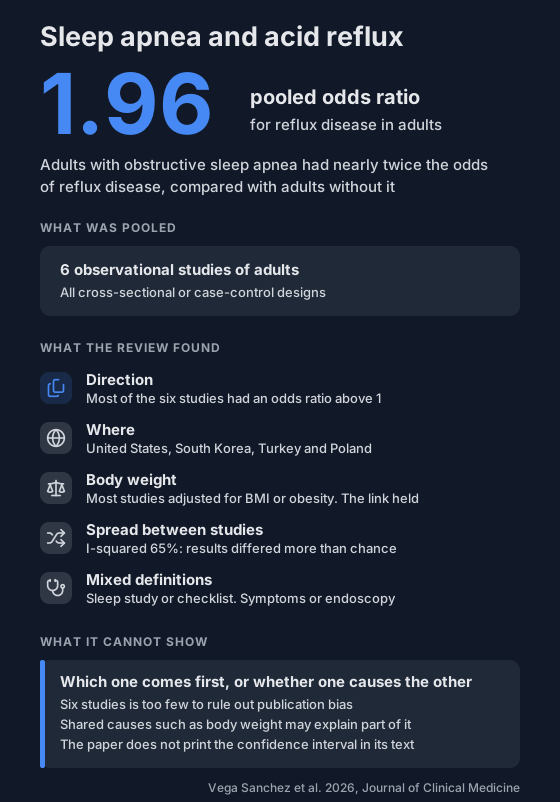
A 2026 meta-analysis pooled six observational studies and found adults with obstructive sleep apnea had nearly twice the odds of reflux disease. It can't say which comes first.
Heartburn at night and sleep apnea often turn up in the same person. Both are also more common with extra body weight, so it's fair to ask whether the link is real or just shared weight.
A meta-analysis published in March 2026 pooled six studies to put a number on it. Adults with obstructive sleep apnea had nearly twice the odds of gastroesophageal reflux disease (GERD).
What did the review pool?
- Six observational studies of adults. The ones in its table were published between 2014 and 2021.
- All were cross-sectional or case-control, so none followed people over time.
- They came from the United States, South Korea, Turkey and Poland.
- The authors searched PubMed, Scopus, Web of Science and Embase, and rated all six studies as high quality on the Newcastle-Ottawa Scale.
The studies didn't all measure the same thing. Some confirmed sleep apnea with an overnight sleep study, and others used a risk checklist or a clinical assessment. Reflux was counted from symptoms in some and from an endoscopy in others.
What did it find?
- The pooled odds ratio was 1.96. That means nearly twice the odds of reflux disease in adults with sleep apnea, compared with adults without it.
- Most of the individual studies had an odds ratio above 1.
- The result was statistically significant.
Odds are not the same as risk, so "twice the odds" doesn't mean "twice as likely".
Is it just body weight?
Not entirely, going by these studies.
- Most of the studies adjusted for BMI or obesity, along with things like age and sex.
- The link was still there after that adjustment.
- The authors say leftover confounding can't be ruled out, because each study adjusted for different things.
For how weight and sleep apnea go together, see the obesity and sleep apnea study.
Why might the two be connected?
The authors list a few proposed mechanisms. None of them was tested in this review.
- When the airway closes, the effort to breathe lowers the pressure in the chest, which may pull stomach contents upward.
- Broken sleep and oxygen dips may affect the valve at the bottom of the food pipe.
- Reflux at night may also disturb sleep, so it could run both ways.
What can't it show?
- Direction. Snapshot studies can't say whether sleep apnea leads to reflux, reflux worsens breathing during sleep, or both come from a shared cause.
- A precise size. The results differed between studies more than chance would explain (I-squared 65%), so the authors say to read 1.96 with caution.
- Why the studies differed. Six studies were too few for subgroup analysis.
- Publication bias. The funnel plot looked symmetrical, but the authors say six studies are too few for that to mean much.
- Other populations. The studies came from four countries.
Three more things from reading the paper itself:
- The text gives the pooled odds ratio but not its confidence interval, or the result of each study.
- Its table of studies lists the sample size for only one of the six (186 people).
- The forest plot cites a slightly different set of six studies from the table, so it isn't clear exactly which six were pooled.
The authors say the evidence supports doctors being more aware of reflux symptoms in people with sleep apnea, not routine testing of everyone. They also call for trials on whether CPAP changes reflux outcomes, which this review did not examine.
What can you do with this?
- If you have sleep apnea and get heartburn or regurgitation at night, mention both to your doctor. The same goes if you have reflux and also snore loudly or wake unrefreshed.
- A late dinner is one thing you can log against your overnight oxygen. Use compare nights to put two recordings side by side.
- Not sure whether sleep apnea is worth raising? The risk check takes a couple of minutes and gives you something to bring to the appointment.
Not a medical device. Does not diagnose, treat or prevent any condition. Discuss results and changes with a clinician.
References
- Vega Sanchez M, Córdova F, Mosquera Cisneros V, Rodríguez Tates M, Chauca Bajaña L, Quiguango Farias D, Flores Araque M, Velasquez Ron B. Obstructive Sleep Apnea and Gastroesophageal Reflux Disease: A Systematic Review and Meta-Analysis of Observational Studies. Journal of Clinical Medicine. 2026;15(7):2518. doi:10.3390/jcm15072518