CPAP and Night-Time Urination: A 2026 Study
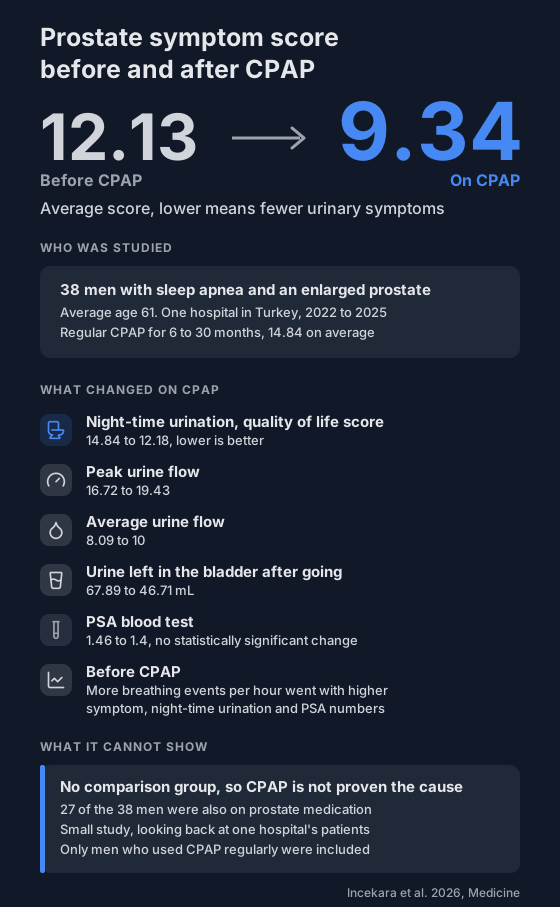
A 2026 study followed 38 men with sleep apnea and an enlarged prostate. After at least 6 months of regular CPAP, their urinary symptom scores were lower and urine flow was higher, but there was no comparison group.
Getting up at night to pee is usually blamed on the prostate. Sleep apnea is linked to it too, and many older men have both.
A study published in July 2026 looked at men with both conditions and compared their urinary symptoms before and after CPAP. The numbers were better on CPAP, but the study had no comparison group, so it can't show that CPAP was the reason.
Who was in the study?
- 38 men at one hospital in Turkey, aged 47 to 78, average age 61.
- All had obstructive sleep apnea with 15 or more breathing events per hour on an overnight sleep study. The average was 58.21 events per hour.
- Their lowest overnight SpO2 averaged 76.63%.
- All had an enlarged prostate (benign prostatic hyperplasia).
- All had used CPAP regularly for at least 6 months: 4 hours a night, 5 nights a week, checked from the machine's memory card. The average time on CPAP was 14.84 months, with a range of 6 to 30.
- 27 of the 38 were also on prostate medication, and it stayed the same throughout.
The researchers started with 352 sleep apnea patients and found 53 who had an enlarged prostate and used CPAP regularly. They left out 15 who'd had prostate surgery or another procedure, or had another condition that affects urination.
It was a retrospective study. The "before" numbers came from medical records, and the "after" numbers were collected at a follow-up visit.
What changed on CPAP?
Five of the six measures were statistically significantly better after CPAP (all P < .001).
| Measure | Before CPAP | After CPAP |
|---|---|---|
| Prostate symptom score (lower is better) | 12.13 | 9.34 |
| Night-time urination quality of life score (lower is better) | 14.84 | 12.18 |
| Peak urine flow | 16.72 | 19.43 |
| Average urine flow | 8.09 | 10 |
| Urine left in the bladder after going (mL) | 67.89 | 46.71 |
| PSA blood test | 1.46 | 1.4 |
- The prostate symptom score was the study's main outcome.
- PSA didn't change by a statistically significant amount. The authors say PSA also depends on prostate size and inflammation, and may need longer to shift.
- The authors call the drop in leftover urine modest. The after-CPAP figure was still close to the 50 mL threshold doctors commonly use.
The study didn't count how many times the men got up at night. The night-time urination figure is a questionnaire score for how much it affects daily life.
Did more breathing events mean worse symptoms?
Before CPAP, yes, though the links were weak to modest.
Men with more breathing events per hour tended to have:
- Higher PSA (r = 0.400).
- Higher prostate symptom scores (r = 0.397).
- Higher night-time urination scores (r = 0.333).
There was no statistically significant link between breathing events and urine flow or leftover urine.
Why would sleep apnea affect urination?
The paper gives two ideas from earlier research. It didn't test either one.
- When the airway is blocked, pressure swings in the chest raise a hormone (natriuretic peptide) that earlier studies have linked to more night-time urination.
- Low oxygen overnight may reduce blood flow to the bladder and prostate.
For more on low overnight oxygen, see what T90 means.
What can't it show?
A lot, and the authors say most of this themselves.
- No comparison group. The change could come from CPAP, the prostate medication, natural ups and downs, or scores drifting back toward average.
- Medication. 27 men were on alpha-blockers or similar drugs. The authors can't rule out that the result is the two therapies combined.
- Small and single-centre. 38 men from one hospital.
- Only regular CPAP users. Men who didn't keep up with CPAP weren't included. See what helps people stick with CPAP.
- Uneven timing. Time on CPAP ranged from 6 to 30 months.
- No correction for multiple tests. Six outcomes were tested without adjusting for it. The authors' reason is that the outcomes were chosen in advance.
The authors call for randomised controlled trials with more people.
What does this mean for you?
- Frequent night-time toilet trips have many causes. The authors suggest doctors ask men with an enlarged prostate about sleep apnea symptoms, and ask men with sleep apnea about urinary symptoms.
- If you get up a lot at night and also snore or wake unrefreshed, mention both to your doctor. The sleep apnea risk check gives you something to bring along.
- On CPAP already? You can track your overnight oxygen alongside it and log your night-time toilet trips next to each night.
- Night-time toilet trips are one of the ways sleep apnea shows up in older adults.
Not a medical device. Does not diagnose, treat or prevent any condition. Discuss results and changes with a clinician.
References
- İncekara Y, Erbay G, Çiçek S, Şanli A, Kiliçarslan M. Changes in lower urinary tract symptoms and uroflowmetric parameters after CPAP therapy in patients with obstructive sleep apnea syndrome and benign prostatic hyperplasia: A retrospective study. Medicine. 2026;105(31):e49922. doi:10.1097/MD.0000000000049922