Controlled Breathing vs Thin Air: SpO2 Study
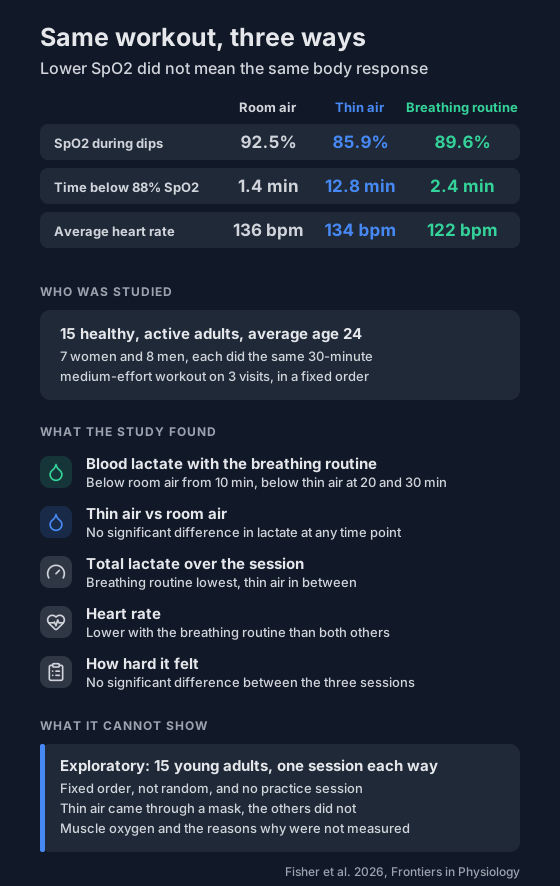
A 2026 study had 15 young adults do the same 30-minute workout in room air, in thin air and with a breath-hold breathing routine. Both lowered finger SpO2, but blood lactate and heart rate behaved differently.
A lower SpO2 reading is often read as "less oxygen, so the body works harder". A small study published in September 2026 found it's not that simple.
Two different ways of lowering SpO2 during the same workout led to different results for blood lactate and heart rate.
Who was studied?
- 15 healthy, recreationally active adults, 7 women and 8 men, average age 24.
- 16 started; 1 dropped out before the last visit.
- People with heart, lung, nerve or metabolic conditions were excluded.
- Each did the same 30-minute medium-effort workout on 3 visits: bodyweight, light resistance bands, a small ball and a chair, paced by a video and a metronome.
- Visits were at least 48 hours apart.
What were the three sessions?
- Room air. Breathing as usual.
- Thin air. Air with 15% oxygen instead of about 21%, through a face mask, breathing as usual.
- Controlled breathing. A set pattern of a short breath in, a long breath out and a 6 to 10 second breath hold, timed to each movement for the whole 30 minutes.
This was a supervised lab protocol, and anyone with a reason not to exercise in thin air or hold their breath was excluded. The researchers' earlier pilot found this pattern brings repeated SpO2 dips.
What happened to SpO2?
Both lowered it, in different ways. The oximeter software reported the average SpO2 during dips, not across the whole session:
- Room air: 92.5%.
- Thin air: 85.9%.
- Controlled breathing: 89.6%.
Time spent below 88% was 1.4 minutes in room air, 12.8 minutes in thin air and 2.4 minutes with the breathing routine. Only thin air differed significantly from the other two on this measure. Thin air kept SpO2 down the whole time. The breathing routine gave repeated dips with recovery in between.
What happened to lactate and heart rate?
The authors expected both low-oxygen sessions to raise blood lactate. Neither did:
- With the breathing routine, lactate was lower than in room air at 10, 20 and 30 minutes and after recovery, and lower than in thin air at 20 and 30 minutes.
- Thin air and room air didn't differ significantly at any single time point.
- Total lactate across the session was lowest with the breathing routine, and lower in thin air than in room air. After allowing for each person's starting lactate, thin air and room air no longer differed significantly.
- Average heart rate was 136 bpm in room air, 134 bpm in thin air and 122 bpm with the breathing routine. Only the breathing routine stood out.
- How hard it felt didn't differ significantly: about 10 to 11 on a 6 to 20 effort scale in all three, averaged over every reading including rest.
So the SpO2 number alone didn't tell you what was going on in the body.
What can't it show?
- It was exploratory, with 15 young, healthy adults.
- The sessions were in a fixed order, room air, then thin air, then the breathing routine, with no practice session. The authors say order effects can't be ruled out.
- Only the thin-air session used a mask, which may have changed how it felt.
- They didn't measure muscle oxygen, carbon dioxide or breathing effort, so why this happened is still untested.
- Finger SpO2 shows oxygen in the blood, not in the muscles.
- It was a supervised lab session, so it doesn't show whether the routine is safe or useful outside one.
- American Public University, where two of the authors work, funded the study.
What does it mean for your own readings?
- In this study, two drops in SpO2 came with different heart rate and lactate.
- A long, steady drop and many short dips gave very different time below 88%, so time below a level tells you something an average doesn't.
- For another case where finger SpO2 and tissue oxygen part ways, see brain oxygen vs finger SpO2 at altitude.
- For a different breathing technique tested in thin air, see breathing technique and SpO2 in thin air.
- Readings taken while you move are less reliable in general, as this accuracy test shows.
Not a medical device. Does not diagnose, treat or prevent any condition. Discuss results and changes with a clinician.
References
- Fisher AJ, Hirsch J, Walker K, Rothstein A, Herrenbruck A. Controlled breathing is associated with lower blood lactate than normobaric hypoxia despite comparable peripheral oxygen saturation during moderate-intensity exercise: an exploratory crossover study. Frontiers in Physiology. 2026;17:1916547. doi:10.3389/fphys.2026.1916547