Altitude, SpO2 and Thinking: A Peru Study
A 2026 study tested 200 young adults in four Peruvian cities up to 5,100 m. SpO2 averaged 81.6% at the top, where the lowest thinking-test scores clustered, but a person's own SpO2 and hemoglobin weren't independently linked to their score.
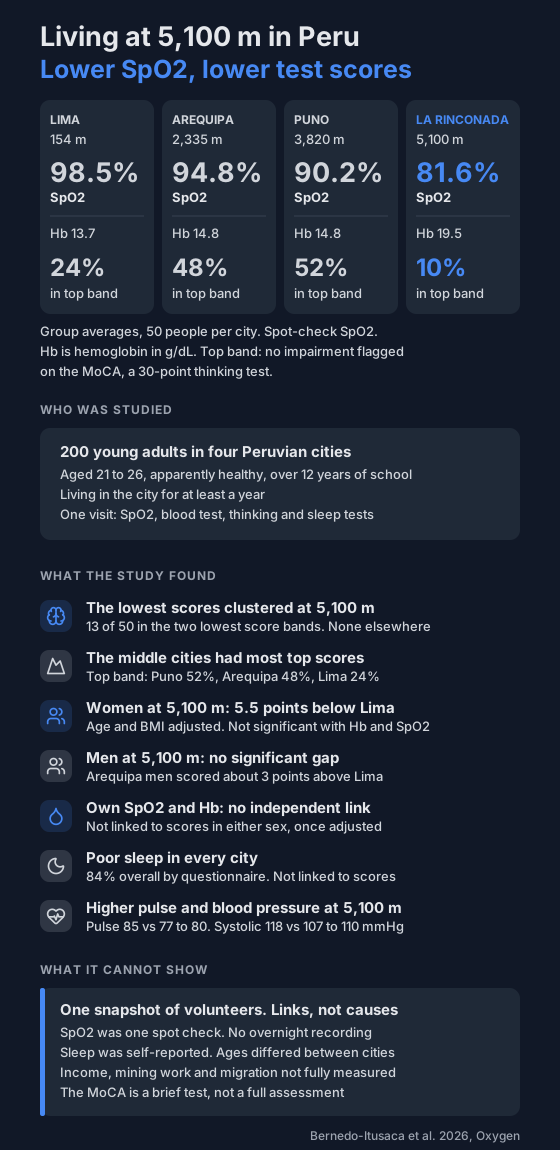
It's often assumed that the less oxygen you have, the worse your brain works. A 2026 study from Peru tested that in people who live at altitude all year, not visitors.
It found the lowest thinking-test scores in the highest town. But once the authors adjusted for other factors, a person's own SpO2 wasn't independently linked to their score.
Who was studied?
- 200 apparently healthy adults aged 21 to 26, 50 in each of four Peruvian cities.
- Lima (154 m), Arequipa (2,335 m), Puno (3,820 m) and La Rinconada (5,100 m), a mining town.
- All had lived there for at least a year and had more than 12 years of schooling.
- People with known sleep disorders, mental health conditions, heavy drinking, smoking or drug use were left out.
Each person was seen once. The team took a single pulse oximeter reading, pulse and blood pressure, and a finger-prick blood test for hemoglobin. They also did the MoCA, a 30-point thinking test, and the Pittsburgh Sleep Quality Index (PSQI), a sleep questionnaire.
How low did SpO2 go?
Average SpO2 fell with each step up:
- Lima: 98.5%
- Arequipa: 94.8%
- Puno: 90.2%
- La Rinconada: 81.6%
The drop got steeper higher up. Hemoglobin went the other way, from 13.7 g/dL in Lima to 19.5 g/dL in La Rinconada. Pulse and systolic blood pressure were also higher there.
For why your numbers read lower in the mountains, see blood oxygen at altitude.
What happened to the test scores?
The paper sorts MoCA results into bands. Share of people in the top band, where no impairment was flagged:
- Lima: 24%
- Arequipa: 48%
- Puno: 52%
- La Rinconada: 10%
The two lowest bands turned up only in La Rinconada, in 13 of its 50 people. So the middle cities did best, and sea-level Lima came in third.
Did a person's own SpO2 explain their score?
Not on its own, in the adjusted models. The authors ran models for men and women separately, using Lima as the comparison.
- Women in La Rinconada scored 5.5 points lower than women in Lima, after adjusting for age and BMI. Once hemoglobin and SpO2 were added, that gap was no longer statistically significant. Only 18 of the women tested were from La Rinconada, so this estimate is uncertain.
- Men in La Rinconada showed no statistically significant gap from Lima in either model. Men in Arequipa scored about 3 points higher than Lima.
- Puno scored higher than Lima in the first model, by about 2 points in women and 3.7 in men.
- SpO2 and hemoglobin had no independent link with the score in either sex.
So the lowest scores clustered in the highest town, but the authors couldn't pin them on a single blood number.
What about sleep?
Poor sleep was common everywhere: 168 of the 200 people (84%) scored as poor sleepers on the PSQI. In Lima it was all 50. Sleep quality was not significantly linked to test scores (p = 0.17).
Sleep was only measured by questionnaire. Nobody wore an overnight oximeter, so the study can't say what anyone's oxygen did at night. For what that looks like, see overnight oxygen in miners at 3,800 m.
What can't it show?
- Cause. It's a single snapshot, so it shows what went together, not what caused what.
- Everyone. Volunteers were recruited through local outreach, 50 per city, so they may not represent each city.
- Fair comparisons. Average age ranged from 21 in Lima to 26 in Puno, and BMI was higher in La Rinconada. Income, mining work and where people grew up weren't fully measured. The authors say most of the La Rinconada group had moved there from elsewhere.
- A full assessment. The MoCA is a brief test, and the authors call the detailed results exploratory.
- Overnight oxygen. SpO2 was one spot reading at the visit.
The paper also has some figures that don't line up, such as a sleep table whose groups add up to 201 people, not 200.
What can you do with this?
If you live or spend time at altitude, an overnight oximeter shows what your SpO2 does while you sleep, not just at one moment. You can share the recordings with your doctor.
If you notice changes in your memory or concentration, talk to a doctor.
For a short-term view, see mood and thinking at 4,500 m.
Not a medical device. Does not diagnose, treat or prevent any condition. Discuss results and changes with a clinician.
References
- Bernedo-Itusaca ME, Merma-Valero JM, Cruz-Riquelme TM, Ccorimanya-Suni RM, Pancaya-Flores ME, Guevara-Mamani ZM, Chambi-Rodrigo D, Coa-Coila MA, Apaza-Cansaya W, Apaza-Quispe MM, Hancco-Monrroy DE, Coila CAL, Salazar-Granara A, Yang M, et al. Higher Prevalence of Cognitive Impairment in Residents of High-Altitude Regions. Oxygen. 2026;6(3):16. doi:10.3390/oxygen6030016