Short Sleep Before Altitude: A 2026 Trial
17 healthy men spent 5 hours at a simulated 3,500 m after a typical night and after 3 hours of sleep or less. SpO2 was 89.8% both times, but breath size, heart rate and two inflammation markers shifted.
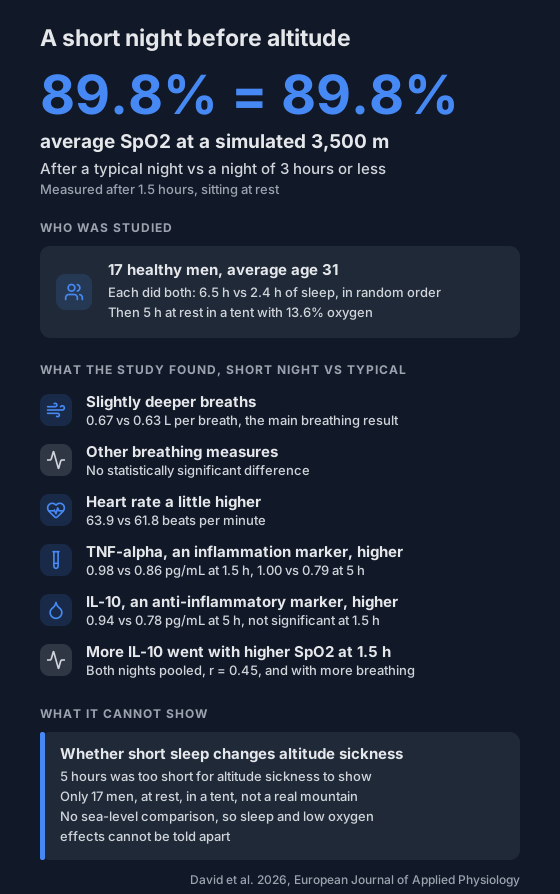
Trips to altitude often start after a short night: an early flight, a late drive, a night in a hut. A small 2026 study linked poor sleep before a climb with more altitude sickness, but that study used self-rated sleep in 15 students. A 2026 French trial tested it directly: what does one short night do to your breathing and oxygen when you then go up?
The short answer: SpO2 came out the same. Breath size, heart rate and two blood markers of inflammation shifted a little.
Who was studied?
- 17 healthy men, average age 31, with no sleep complaints.
- None had been at 3,500 m or higher in the previous three months.
- Each man did both conditions, in random order, at least a week apart.
- Typical night: in bed 10 pm to 6 am, 6.5 hours of sleep on average.
- Short night: kept awake with board games until 3 am, 2.4 hours of sleep on average.
- Sleep was measured with a wrist activity tracker.
- The study was run and funded by French military health research bodies.
- The next morning they sat at rest for 5 hours in a tent with 13.6% oxygen, about what you breathe at 3,500 m.
What did it find?
After 1.5 hours in the tent, the men breathed through a mask for 10 minutes while an ear sensor read their SpO2.
- SpO2: 89.8% after both nights. No statistically significant difference.
- Breath size: 0.67 L per breath after the short night, 0.63 L after the typical one. This was the study's main breathing result.
- Other breathing measures: breathing rate, litres per minute and the rest showed no statistically significant difference once the authors corrected for running many tests.
- Heart rate: 63.9 bpm after the short night, 61.8 after the typical one.
- Hemoglobin: no statistically significant difference, which the authors say fits less than a day at altitude.
The authors read this as the body working a little harder, with deeper breaths and a faster pulse, to keep oxygen where it would have been anyway. Litres breathed per minute did not go up significantly, though, so that reading rests mostly on breath size and heart rate. For more on why SpO2 drops at altitude in the first place, see blood oxygen at altitude.
What about inflammation?
Blood was taken at 1.5 hours and 5 hours in the tent.
- TNF-alpha, a marker that rises with inflammation, was higher after the short night at both times: 0.98 vs 0.86 pg/mL, then 1.00 vs 0.79 pg/mL.
- IL-10, a marker that damps inflammation down, was higher after the short night at 5 hours: 0.94 vs 0.78 pg/mL. At 1.5 hours there was no statistically significant difference.
- IL-8 showed no statistically significant difference.
At 1.5 hours, with both nights pooled, higher IL-10 went with more breathing and a higher SpO2 (r = 0.45 for SpO2). That pool is 34 measurements from 17 men, so each man counts twice. It's a link, not proof that IL-10 drives breathing.
What can't it tell you?
- Altitude sickness. Five hours at rest was too short for it to show up, so the trial says nothing about who gets sick.
- Which factor did what. There was no sea-level comparison and no blood sample before entering the tent, so the effect of short sleep alone can't be separated from low oxygen.
- Everyone. 17 young, healthy men. Women were left out because breathing at altitude varies with the menstrual cycle.
- A real mountain. It was a tent at sea-level air pressure, with people sitting still for one morning.
- Size of the effect. The differences were small, and the study was originally sized for a reaction-time test, not for these measures.
The authors call for larger studies with men and women, at real altitude and over longer stays.
What can you do with this?
If you're heading up after a short night, this trial suggests your resting SpO2 may look much the same as after a typical night. Your heart rate may run a couple of beats higher.
If you track a trip with an oximeter, log your hours of sleep beside each reading. The authors make the same point for research: altitude studies should record how much people slept. A short-sleep smartwatch study found a higher resting heart rate in people who usually sleep 6 hours or less.
Not a medical device. Does not diagnose, treat or prevent any condition. Discuss results and changes with a clinician.
References
- David L, Touron J, Erkel MC, Drogou C, Pontiggia A, Beauchamps V, Malle C, Nespoulous O, Comte U, Malgoyre A, Sauvet F, Beidleman BA, Koulmann N, Gomez-Merino D, et al. Impact of acute sleep restriction on resting ventilation and cytokine levels in normobaric hypoxia, and their association. European Journal of Applied Physiology. 2026;126(6):3157-3168. doi:10.1007/s00421-025-06105-5