Breathing Pause Length and Oxygen Levels
A 2026 study of 959 adults with sleep apnea added the longest breathing pause to the usual measures and found four groups, including one with long pauses but mid-range event counts.
Sleep apnea is usually graded by how many times an hour your breathing stops or gets shallow. That count says nothing about how long each event lasts.
A 2026 study from Beijing added the longest pause of the night to the usual measures. It found four groups of patients, and one of them had long pauses with only a mid-range event count.
We've covered a study on average event length and oxygen burden before. This one looks at the single longest event, and at which kinds of patient it picks out.
Who was in the study?
- 959 adults who had a night in the sleep lab at one Beijing hospital between 2020 and 2023.
- All had sleep apnea on that sleep study.
- 773 were men and 173 were women; sex wasn't recorded for 13.
- 40 more people were left out because some of their measures were missing.
What did they measure?
The researchers sorted people by seven measures at once:
- Age, BMI and neck size.
- Breathing events per hour.
- The lowest oxygen reading of the night.
- The longest full pause in breathing.
- The longest shallow-breathing event.
A computer method called cluster analysis then put similar people together. It settled on four groups.
What were the four groups?
Averages for each group:
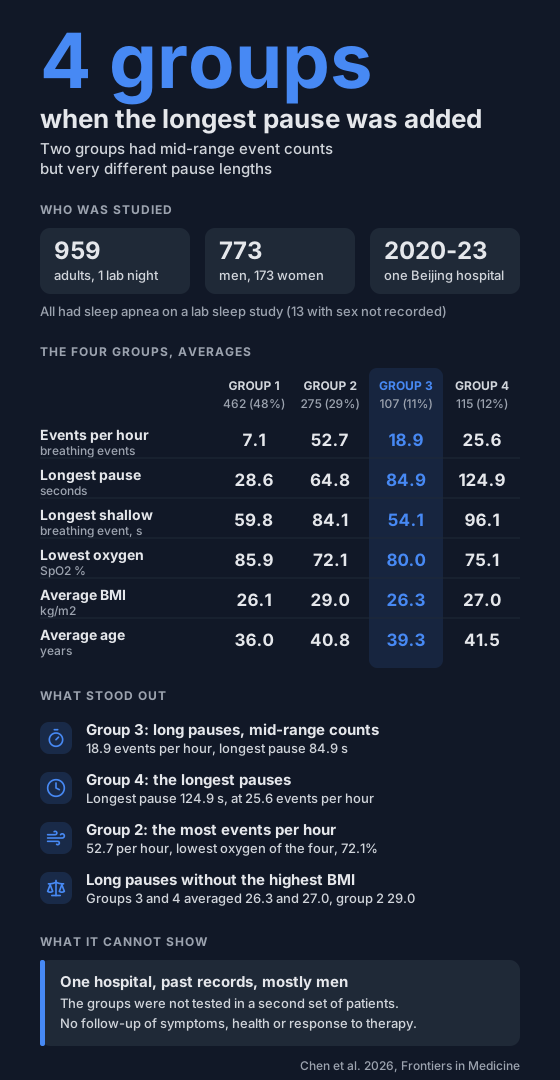
- Group 1 (462 people): 7.1 events per hour, longest pause 28.6 seconds, lowest oxygen 85.9%.
- Group 2 (275 people): 52.7 events per hour, longest pause 64.8 seconds, lowest oxygen 72.1%. They had the highest BMI (29.0) and the largest necks.
- Group 3 (107 people): 18.9 events per hour, longest pause 84.9 seconds, lowest oxygen 80.0%.
- Group 4 (115 people): 25.6 events per hour, longest pause 124.9 seconds, lowest oxygen 75.1%. Their longest shallow-breathing event was also the longest, at 96.1 seconds.
So group 3 had about a third of group 2's event count, but its longest pause was 20 seconds longer. Group 4's longest pause averaged over two minutes, at half of group 2's event count.
Was it just about weight?
Not in these groups. Groups 3 and 4 had long pauses without the highest BMI.
- Group 3's BMI (26.3) and neck size were about the same as group 1's.
- Group 4's BMI was 27.0, against 29.0 in group 2.
The authors suggest other things may drive pause length, like how easily the airway closes, how steady breathing control is and how easily you wake. This study didn't measure those.
What doesn't it tell you?
- Whether it matters for health. Nobody was followed up for symptoms, heart health or response to therapy.
- Whether the groups hold up. The groups weren't tested in a second set of patients, and the authors call them exploratory.
- Whether pause length adds anything. The groups were built from these same measures, so they differ on them by design. The authors say the study doesn't show pause length is independent of the event count.
- How reliable one long event is. The longest pause is a single event. It can depend on the number of events, sleep length, sleep stage, position, how the study was scored, or one unusual moment.
- Everyone. It's past records from one hospital, and mostly men.
What can you do with this?
An overnight oximeter doesn't measure breathing pauses, and home oximetry is not a sleep study. Your report does show more than a count of oxygen dips. The lowest reading and time below 90% (T90) show how deep and how long your low readings went.
Here's how to read your report and how to share it with your doctor.
Not a medical device. Does not diagnose, treat or prevent any condition. Discuss results and changes with a clinician.
References
- Chen M, Yang J, Yang Y, Wang Z, Lai Y, Lei H. Respiratory event duration reveals novel phenotypes beyond the apnea-hypopnea index in obstructive sleep apnea. Frontiers in Medicine. 2026;13:1960647. doi:10.3389/fmed.2026.1960647