Bilevel vs CPAP: Does It Add Hours of Use?
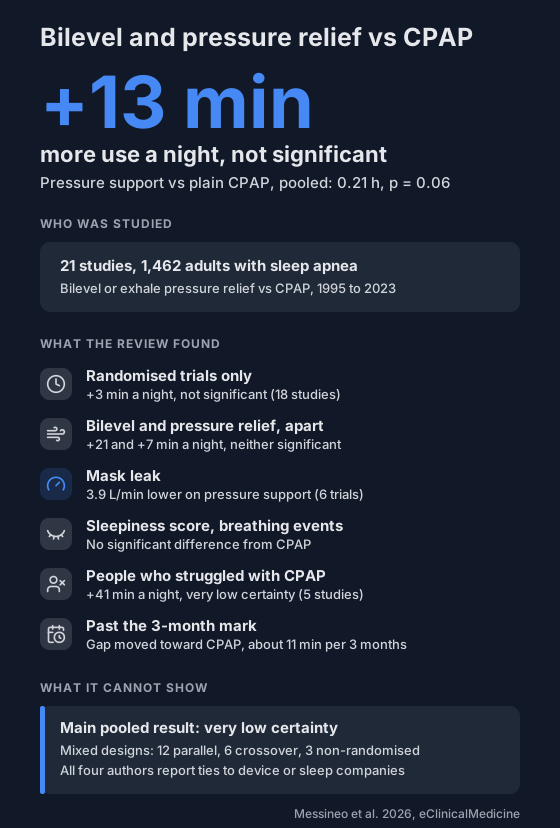
A 2026 review of 21 studies and 1,462 adults found bilevel PAP and exhale pressure relief added about 13 minutes a night over plain CPAP, which was not statistically significant. Leak was lower.
Breathing out against constant pressure is one of the complaints people have about CPAP. Bilevel machines and the "pressure relief" setting on most CPAP machines lower the pressure as you breathe out, and they're often offered to make CPAP easier to stick with.
A 2026 review pooled every study it could find that compared them with plain CPAP. On average, they didn't add a statistically significant amount of nightly use.
What are bilevel and pressure relief?
- Bilevel PAP (BPAP) uses two set pressures: a higher one as you breathe in and a lower one as you breathe out.
- Exhale pressure relief is a setting on many CPAP machines, sold under names like C-Flex, A-Flex and EPR. It drops the pressure a little, usually 1 to 3 cmH2O, each time you breathe out.
The review grouped both as "pressure support", because both lower the pressure on the out-breath.
Who was in the review?
- 21 studies with 1,462 adults with obstructive sleep apnea, published from 1995 to 2023.
- 12 were standard randomised trials, 6 were crossover trials where people tried both machines, and 3 were not randomised.
- Most people were new to CPAP. Five studies looked at people who already struggled with it.
- People with heart failure, COPD or obesity hypoventilation were left out, and no study had an average BMI over 40.
- Use was measured in hours a night, at the longest follow-up each study reported (2 weeks to a year).
Did pressure support add hours of use?
Not by a statistically significant amount.
- All 21 studies: 0.21 hours (about 13 minutes) more a night than CPAP. The 95% confidence interval ran from 0.01 hours less to 0.44 hours more (p = 0.06). The authors rated the certainty very low.
- Randomised trials only (18 studies): 0.05 hours (about 3 minutes) more, not significant. Certainty was the second highest of four grades.
- Bilevel alone: 0.35 hours more, not significant.
- Pressure relief alone: 0.12 hours more, not significant.
The authors used half an hour a night as the smallest difference that would matter to patients. The overall result was well under that.
The chance of giving up on the machine was also similar on pressure support and CPAP.
The authors note that bilevel machines cost more, and conclude that routine use in otherwise healthy adults with sleep apnea isn't supported by this evidence.
What else did it compare?
- Mask leak: 3.9 L/min lower on pressure support (6 trials, low certainty). The authors put this down to the lower pressure on each out-breath.
- Daytime sleepiness score: no significant difference in how much it fell.
- Breathing events per hour while using it: no significant difference overall. Bilevel alone had slightly fewer, a gap the authors judged too small to matter clinically.
For why leak matters, see mask leak and CPAP use.
What about people who struggled with CPAP?
This was a smaller, exploratory part of the review. In five studies of people who had trouble with CPAP, all using bilevel, it added 0.68 hours (about 41 minutes) a night.
The authors rated that evidence very low:
- Two of the five studies weren't randomised.
- One study drove most of the effect. Without it the result was no longer significant.
- Without both non-randomised studies, the three remaining trials still showed a statistically significant 0.6 hours more.
They conclude it's too weak to support bilevel for this group, and that better trials are needed.
Does the gap change over time?
In the review's analysis, longer studies leaned more toward CPAP. Past 3 months, the gap shifted by about 0.18 hours (11 minutes) toward CPAP for every extra 3 months.
The authors suggest either people come to prefer CPAP, or pressure support needs closer follow-up to keep use up. Few studies ran longer than 3 months, so this is a pattern across studies, not a measured decline in people.
What doesn't it tell you?
- Firm answers. Mixing randomised, crossover and non-randomised studies cut the certainty of the main result to very low.
- Unblinded effects. Some studies weren't blinded, and extra attention like mask refitting can raise use on its own.
- Long-term use. Few studies ran past 3 months.
- Everyone. People with heart failure, COPD or obesity hypoventilation weren't included, and no study had an average BMI over 40.
- Independence. The review had no funding, but all four authors report income, consulting or shares with sleep or device companies, including Philips and SleepRes.
The paper's own numbers don't all line up. Its main table lists 1,454 participants, not 1,462. It describes the CPAP-struggle group as 244 people in the text and 333 in a table. And the text says the gap reached about 45 minutes after a year, while its own slope gives about 33 minutes over the 9 months past the 3-month mark.
What can you do with this?
Which machine and settings you use is a decision for you and your sleep team. If CPAP is hard to use, tell them what's bothering you.
For more on what helps people keep going, see the review on sticking with CPAP and early CPAP discomfort and use.
Your machine logs hours and leak. An overnight oximeter records your oxygen and pulse, so you can track your oxygen alongside CPAP on any machine.
Not a medical device. Does not diagnose, treat or prevent any condition. Discuss results and changes with a clinician.
References
- Messineo L, Bakker JP, Noah WH, White DP. The effect of bilevel ventilation or modified continuous positive airway pressure on treatment adherence in adults with obstructive sleep apnea: a systematic review and meta-analysis. eClinicalMedicine. 2026;97:103993. doi:10.1016/j.eclinm.2026.103993