Wrist-Tracked Sleep Stages and Disease Risk
A 2026 UK Biobank study of 95,559 wrist tracker wearers, followed for about 9 years, linked more estimated REM and deep sleep, and 6 to 8 hours of sleep, to lower risk of many later diseases.
Most sleep and health studies ask people how long they sleep. People aren't very good at judging that.
A study published in September 2026 used a week of wrist tracker data instead. It linked estimated REM sleep, deep sleep, sleep length and broken sleep to 1,049 diseases over the following nine years.
Who was in the study?
- 95,559 people from UK Biobank, a large UK health study.
- They were 40 to 69 when they joined, average age 56.
- Between 2013 and 2015 they wore a movement sensor on their dominant wrist for 7 days.
- An algorithm called SleepNet turned the wrist movement into sleep stages.
- New illnesses came from hospital records, up to April 2024.
The median tracked sleep was about 6.5 hours a day. That included about 82 minutes of REM sleep and 103 minutes of deep sleep.
What did it find?
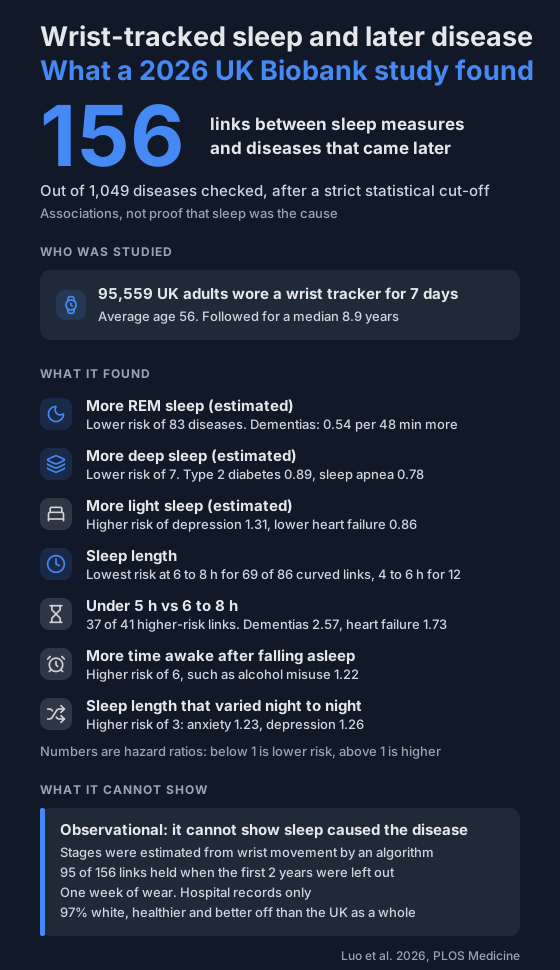
It found 156 links that passed a strict cut-off for testing so many diseases at once.
- More REM sleep: lower risk of 83 diseases. Per 48 minutes more, the hazard ratio was 0.54 for dementias, 0.74 for heart failure and 0.83 for atrial fibrillation.
- More deep sleep: lower risk of 7 diseases. Type 2 diabetes was 0.89, depression 0.86 and sleep apnea 0.78.
- More light sleep: higher risk of depression (1.31) but lower risk of heart failure (0.86).
- More total sleep: lower risk of 50, including type 2 diabetes (0.89).
- More time awake after falling asleep: higher risk of 6, including alcohol misuse (1.22).
- Sleep length that varied a lot from day to day: higher risk of 3, including anxiety (1.23) and depression (1.26).
Each figure compares people at the 25th and 75th percentile of that measure. For REM, that gap was 48 minutes. A hazard ratio below 1 means lower risk, above 1 means higher.
How much sleep went with the lowest risk?
For 86 diseases, risk rose at both short and long sleep, or curved in some other way.
- For 69 of them, risk was lowest at 6 to 8 hours.
- For 12, it was lowest at 4 to 6 hours.
- For 5, it was lowest at the long end of the range.
Compared with 6 to 8 hours, under 5 hours accounted for 37 of 41 higher-risk links. Dementias were 2.57, heart failure 1.73 and sleep apnea 1.52.
Long sleep had far fewer links. At 8 to 9 hours, depression was 1.55. The authors say depression can make people sleep longer, so that link may run the other way.
What can't it tell you?
- Cause. It's observational. The authors say it can't show that sleep caused any of these diseases.
- Which came first. When the first 2 years were left out, 95 of the 156 links held. The authors say early illness may have changed some people's sleep before it was found.
- Real sleep stages. SleepNet agreed with a sleep lab only modestly. On average its total sleep was about 48 minutes off, and it undercounted REM by about 17 minutes.
- Habits. One week of wear may not reflect years of sleep.
- All illness. Only hospital records were used, not GP visits.
- Everyone. 97% were white, and UK Biobank volunteers are healthier and better off than the UK as a whole.
The paper's closing line says 6 to 8 hours "can effectively reduce the risk" of many diseases. Its own limitations section says cause can't be shown.
What can you do with this?
Read the stage numbers on any wrist or ring tracker as estimates. For how close they get, see how accurate smart rings are for sleep and how valid smartwatch numbers are.
The 6 to 8 hours here is on this algorithm's scale, which differed from a sleep lab by about 48 minutes on average. So your own tracker's hours won't line up exactly.
Trends across many nights tell you more than one night. If your tracker keeps showing very short or very broken sleep, or you're tired during the day, discuss it with your doctor.
If you snore or someone has heard you stop breathing, the sleep apnea risk check helps you decide whether to raise it.
Not a medical device. Does not diagnose, treat or prevent any condition. Discuss results and changes with a clinician.
References
- Luo J, Liu R, Yin J, Cao W, Sun S, Chen R. Accelerometer-derived real-world sleep stages and risk of incident diseases: A UK Biobank cohort study and phenome-wide association analysis. PLOS Medicine. 2026;23(9):e1005213. doi:10.1371/journal.pmed.1005213