Time Below 90% and a Brainstem MRI Study
In 30 older adults scanned with 7T MRI, time below 90% oxygen went with lower integrity of a small brainstem region once age, sex and BMI were accounted for. The simple correlation was not statistically significant.
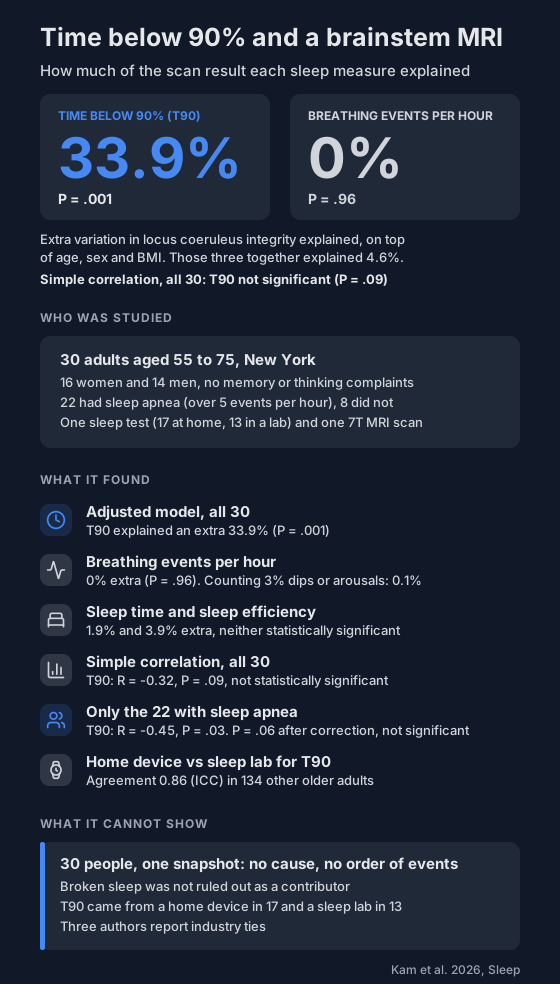
Sleep apnea is usually graded by how many breathing events you have per hour. A small 2026 study asked whether that count, or the time spent below 90% oxygen (T90), lines up better with the state of one small part of the brainstem.
In its adjusted analysis, T90 did and the event count didn't. It was 30 people and one snapshot, and not every analysis reached statistical significance.
What is the locus coeruleus?
It's a small cluster of cells in the brainstem.
- It's the brain's main source of noradrenaline, and it helps keep you awake and paying attention.
- The paper notes it's the earliest brain region to build up the abnormal tau protein seen in Alzheimer's disease.
- It's too small for a standard MRI to show well, so the researchers used a 7 Tesla scanner.
The scan gives a figure the authors call structural integrity. It's a relative measure of MRI contrast in that region, not a cell count.
Who was studied?
- 30 adults aged 55 to 75 in New York, average age 66.
- 16 women and 14 men, average BMI 29.
- Nobody had memory or thinking complaints.
- 17 came from a sleep clinic and had a home sleep test with a WatchPAT device.
- 13 came from a community study of ageing and had an overnight study in a sleep lab.
- 22 had sleep apnea, defined as more than 5 breathing events per hour. 8 did not.
- Median T90 across the group was 4.9 minutes.
What did they find?
The answer depends on which analysis you look at.
Simple correlation, all 30 people.
- T90 and locus coeruleus integrity: R = -0.32, P = .09. Not statistically significant.
- Breathing events per hour: R = -0.03, P = .88. Not statistically significant.
Only the 22 with sleep apnea.
- T90: R = -0.45, P = .03. More time below 90% went with lower integrity.
- After allowing for the two comparisons made, that became P = .06, which is no longer below the study's .05 line.
- In the 8 without sleep apnea there was no significant link.
Adjusted model, all 30 people.
- Age, sex and BMI together explained 4.6% of the variation in integrity.
- Adding T90 explained a further 33.9% (P = .001).
- Adding breathing events per hour explained 0% more (P = .96).
- A second event count, which also includes 3% dips and arousals, added 0.1% (P = .82).
- Total sleep time added 1.9% (P = .48) and sleep efficiency 3.9% (P = .31).
So the headline result comes from the adjusted model. The plain full-sample correlation on its own was not significant.
Could a home device measure T90 well enough?
More than half the group had a home test, so the authors checked. In a separate group of 134 older adults, each wore the home device and had a sleep lab study on the same night. Agreement between the two T90 figures was 0.86 on a 0 to 1 scale (intraclass correlation).
What can't it show?
- It's very small. 30 people, 8 of them without sleep apnea. The authors list the sample size as a limitation.
- It's a snapshot. Each person had one sleep test and one scan, so it can't show that low oxygen came first or caused anything.
- The direction could run the other way. The authors think low oxygen is more likely the upstream factor, but say changes in this brain region could in theory affect breathing during sleep.
- Broken sleep wasn't ruled out. Sleep apnea causes both oxygen dips and awakenings. The two test types also measured arousals differently.
- T90 came from two methods. 17 people's figures came from the home device and 13 from the sleep lab, analysed together.
- No memory or thinking test results are reported. The study says nothing about dementia risk for any one person.
- No one was followed over time. Whether sleep apnea therapy changes the scan result over time was not tested. The authors name that as future work.
For a wider look at this area, see sleep apnea and Alzheimer's biomarkers.
Who paid for it?
US National Institutes of Health grants.
Three of the 22 authors report industry ties:
- Two have had research support from Fisher & Paykel Healthcare, a CPAP maker. Both hold patents on sleep apnea testing and CPAP methods, several licensed to that company, and one also consults for it.
- One has been a paid consultant for Jazz Pharmaceuticals and Axsome Therapeutics in the last 3 years.
The paper's disclosure statement also lists the first two among the authors with nothing to declare, then gives the ties above.
What can you do with this?
- If your oximeter reports T90, you can log it next to your ODI. They measure different things: how long against how often.
- One night's figure doesn't tell you much. A trend over weeks is more useful to bring to an appointment.
- A home oximeter is not a sleep study and it can't tell you anything about your brain.
- If your overnight oxygen numbers concern you, discuss them with a doctor. Here's how to share your recordings.
Not a medical device. Does not diagnose, treat or prevent any condition. Discuss results and changes with a clinician.
References
- Kam K, Gaggi NL, Parekh A, Valencia DI, Quintana Licona DA, Hishinuma SS, Martillo KR, Chu SS, Varga AW VII, Hwang J, Williams MK, Mullins AE, Tolbert TM, Balchandani P, et al. High obstructive sleep apnea hypoxic burden associates with reduced locus coeruleus structural integrity on 7T MRI in older adults. Sleep. 2026;49(3):zsaf398. doi:10.1093/sleep/zsaf398