Sleep Apnea and Alzheimer's Biomarkers Study
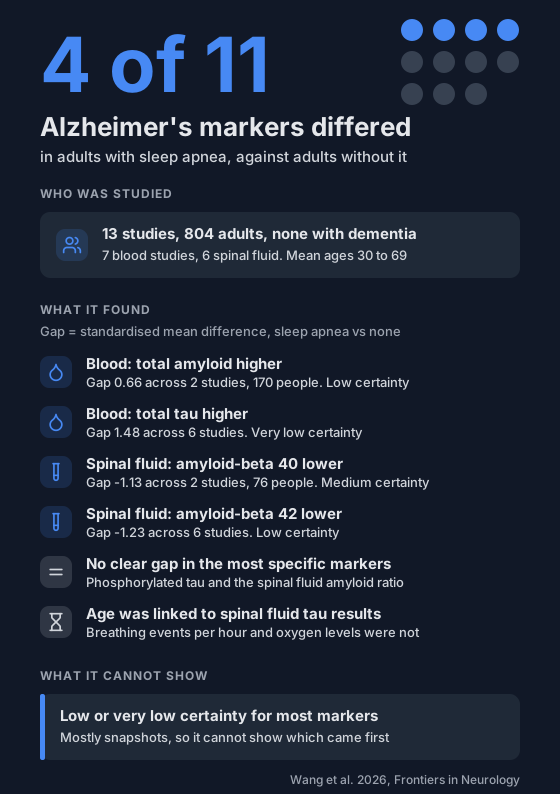
A 2026 meta-analysis of 13 studies found that 4 of 11 Alzheimer's-linked markers differed in adults with sleep apnea. The markers most specific to Alzheimer's did not, and the evidence is weak.
Amyloid and tau are the two proteins that build up in the brain in Alzheimer's disease. Labs measure them in blood and spinal fluid.
A 2026 meta-analysis, a study that pools earlier studies, asked whether those levels differ in adults with obstructive sleep apnea. Some did, but the ones most specific to Alzheimer's did not.
Who was studied?
- 13 studies with 804 adults.
- 7 measured blood (528 people) and 6 measured spinal fluid.
- Sleep apnea was confirmed by a sleep study or home sleep test.
- Nobody had dementia. In 9 studies everyone passed memory and thinking tests.
- Average ages ranged from 29.7 to 69.0.
What differed?
The authors compared 11 markers. Four differed, measured as a standardised mean difference (a way to pool different lab tests):
- Blood total amyloid was higher with sleep apnea: 0.66, from 2 studies and 170 people.
- Blood total tau was higher: 1.48, from 6 studies.
- Spinal fluid amyloid-beta 40 was lower: -1.13, from 2 studies and 76 people.
- Spinal fluid amyloid-beta 42 was lower: -1.23, from 6 studies.
What didn't differ?
Seven markers showed no clear difference. They include phosphorylated tau and the spinal fluid amyloid 42/40 ratio, which the authors call the markers most specific to Alzheimer's.
They conclude the evidence does not support a direct link between sleep apnea and established Alzheimer's-type brain changes. They add that this is not proof of no link.
Did age or breathing events matter?
- Age was linked to the spinal fluid tau results.
- Breathing events per hour, oxygen levels and BMI were not.
- Studies of only the highest grade of sleep apnea tended to show a bigger spinal fluid amyloid-beta 42 gap (-1.58 against -0.94) - not formally tested.
The authors say the few studies of CPAP and these markers were too small and short to draw conclusions.
How strong is the evidence?
- The authors rated certainty low or very low for most markers. Only two reached the second-highest of four grades.
- Most studies were single snapshots, so they can't show which came first. Early Alzheimer's changes could also disturb sleep and breathing.
- For blood total tau and spinal fluid amyloid-beta 42, the range expected in a new study included no difference.
- Funnel plots hinted at publication bias for blood total tau.
- The review was English-only and registered after its search.
What can you do with this?
This study says nothing about your own risk. Worried about your memory or sleep? Talk to your doctor.
An oximeter can't measure amyloid or tau. It can log your overnight oxygen dips, and you can share the recordings with your doctor.
Not a medical device. Does not diagnose, treat or prevent any condition. Discuss results and changes with a clinician.
References
- Wang J, Che L, Su R, Wang X. Associations between obstructive sleep apnea and Alzheimer's disease-related biomarkers (amyloid-β and tau) in blood and cerebrospinal fluid: a systematic review and meta-analysis. Frontiers in Neurology. 2026;17:1817426. doi:10.3389/fneur.2026.1817426