Lowest Overnight Heart Rate and Brain Vessels
A 2026 study of 630 adults with sleep apnea found that a higher lowest heart rate of the night went with slightly higher odds of small vessel disease on a brain MRI. It can't show cause.
Your heart rate drops while you sleep. A 2026 study asked whether the lowest point it reaches says anything about the small blood vessels in your brain.
Who was studied?
- 630 adults aged 18 to 65 with sleep apnea, at one hospital in China, 2021 to 2023.
- Average age 44, and 85% were men.
- Each had a night in a sleep lab, blood tests and a brain MRI, with the MRI in the same week as the sleep study.
- Nobody had insomnia, a past stroke, atrial fibrillation, heart failure or kidney disease.
What is small vessel disease?
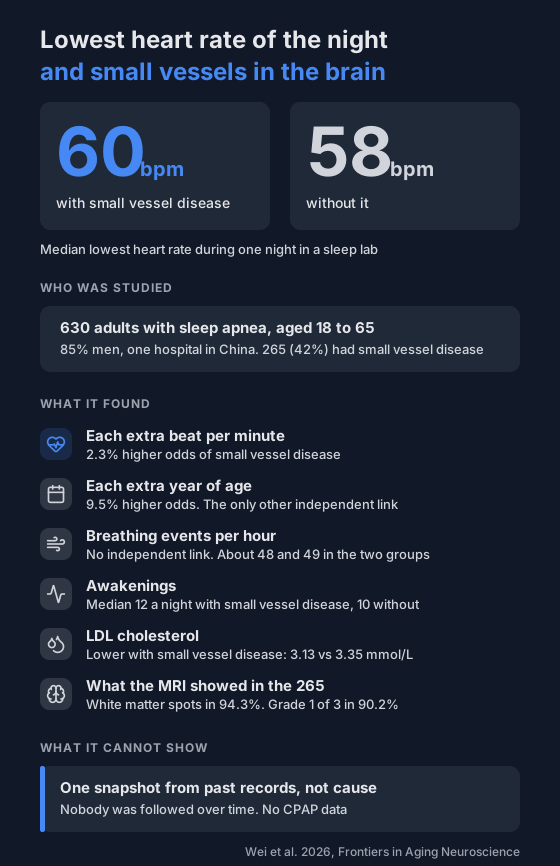
It's damage to the brain's smallest blood vessels, seen on an MRI. 265 of the 630 people (42%) had it. In 94.3% of them it showed as white matter spots, and 90.2% were at grade 1 on a scale that runs to 3.
What did the heart rate show?
The median lowest heart rate of the night was 60 bpm in people with small vessel disease and 58 bpm in people without.
After allowing for age, sex, marital status, high blood pressure, diabetes, smoking, statins and beta-blockers:
- Each extra beat per minute went with 2.3% higher odds of small vessel disease.
- Each extra year of age went with 9.5% higher odds.
Breathing events per hour weren't linked, at about 48 in one group and 49 in the other. Adding them to the model didn't change the heart rate result. Neither did leaving out people on statins.
Lowest oxygen level was a median of 73% in both groups.
More on overnight heart rate patterns.
What else differed?
People with small vessel disease:
- Woke more often, a median of 12 times against 10.
- More often had high blood pressure, 37.5% against 24.7%.
- Had lower LDL cholesterol, 3.13 against 3.35 mmol/L, which the authors call unexpected.
- More often took statins, 18.9% against 10.1%.
What can't it show?
- It's one snapshot from past records, so it can't show cause, or which came first.
- Unmeasured factors could explain the link.
- One hospital, so it may not apply elsewhere.
- No data on who used CPAP.
The gap between group medians was 2 bpm, and the ranges overlapped. Your own number can't tell you which group you'd be in.
What can you do with this?
Not much yet. An overnight oximeter records heart rate alongside oxygen, so you can log your lowest reading over several nights. If it worries you, share your recordings with your doctor.
Not a medical device. Does not diagnose, treat or prevent any condition. Discuss results and changes with a clinician.
References
- Wei W, Wen Y, Chen F, Liang A, Zhong Q, Shi X, Wei M, Qin L, Lu Y, Zhao M. Association between minimum nocturnal heart rate and cerebral small vessel disease in patients with obstructive sleep apnea. Frontiers in Aging Neuroscience. 2026;18:1848124. doi:10.3389/fnagi.2026.1848124