Overnight Pulse Rate and Cognitive Decline
A 2025 study of 503 older adults found that a more complex overnight pulse rate pattern, measured with a finger sensor, went with slower cognitive decline. Standard variability measures showed no statistically significant link in the main analysis.
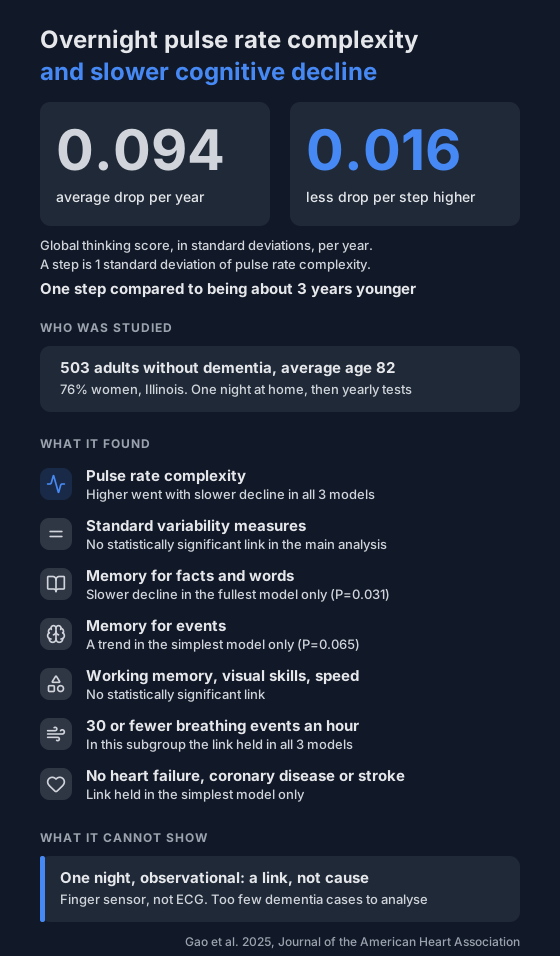
Heart rate variability is usually summed up with a couple of standard numbers. A 2025 study tried a different one, called complexity, on overnight pulse data from a finger sensor. Complexity was linked to how fast thinking scores fell over the next few years. The standard numbers weren't, in the main analysis.
Who was studied?
- 503 older adults from the Rush Memory and Aging Project in northeastern Illinois.
- Average age 82. 76% were women.
- None had dementia at the start.
- Each wore a WatchPAT 300 finger sensor at home for one night.
- They took 19 thinking and memory tests each year, for up to 4.5 years.
What is pulse rate complexity?
The time between one pulse and the next changes all the time. Standard measures ask how much it changes. Complexity asks how unpredictable the pattern is.
- The study used a measure called distribution entropy.
- It runs from 0 to 1. Higher means a more complex pattern.
- It was worked out in 10-minute windows between midnight and 5 am, when 77% of the participants were asleep.
- In this group it ranged from 0.04 to 0.65, with an average of 0.30.
The researchers calculated it themselves from the raw pulse signal, in their own software. The paper doesn't say whether any consumer device reports it, and as far as we know home oximeter reports don't.
For what your device does report overnight, see overnight heart rate and CVHR.
What did it find?
The test results were combined into one global score, in standard deviations.
- On average the global score fell by 0.094 a year.
- Each standard deviation higher in complexity went with 0.016 less of a fall per year.
- The authors compare that to being about 3 years younger at the start.
- The link held after adjusting for heart and vessel conditions, blood pressure medication, sleep time, breathing events per hour, low mood and anxiety. There it was 0.019 a year, compared to being about 2.5 to 3 years younger.
Complexity had no statistically significant link to where the scores started, only to how fast they fell.
What about the standard measures?
Three were tested: the average time between pulses, how much that time varied, and high-frequency power.
- None had a statistically significant link to decline in the global score or in any single area in the main analysis.
- In the two subgroups below, two of them were linked to slower decline in some memory scores, in some models.
- The authors describe the standard measures' results as not significant or less consistent.
How well a pulse sensor matches an ECG for these measures is covered in wearable HRV against ECG.
Did it hold for every kind of thinking?
No.
- Memory for facts and words: slower decline with higher complexity, statistically significant only in the most adjusted model.
- Memory for events: a trend in the least adjusted model that fell short of significance.
- Working memory, visual skills and speed: no statistically significant link.
Did it hold in subgroups?
- People with 30 or fewer breathing events per hour: yes, in all three models.
- People without heart failure, coronary artery disease or stroke: only in the least adjusted model.
- After also adjusting for the starting score: only in the least adjusted model. The other two fell just short.
What can't it show?
- It's an observational study. It shows a link, not that pulse rate complexity affects thinking.
- One night was recorded per person.
- The pulse came from a finger light sensor, not an ECG. The authors say ECG studies are needed to confirm it.
- Only a small group went on to cognitive impairment or dementia during follow-up, so the study couldn't look at dementia itself.
- The group lacked racial diversity, and not every health condition or medication was accounted for.
- There are no cut-off values. The authors say those still need to be worked out.
- The work was funded by foundations, hospital funds and government research grants. Two authors declared paid advisory roles with a company, and one of them a research gift from it, which they say are unrelated to this work.
What can you do with it?
Not much yet with your own data. The measure came from the researchers' own calculation, and the study gives no cut-off values. The study used one night from a finger sensor, the same kind of signal an overnight oximeter records.
If you're worried about memory, talk to your doctor. Related reading: sleep apnea risk and memory.
Not a medical device. Does not diagnose, treat or prevent any condition. Discuss results and changes with a clinician.
References
- Gao C, Lim ASP, Haghayegh S, Cai R, Yang J, Yu L, Ibanez A, Buchman AS, Bennett DA, Gao L, Hu K, Li P. Reduced Complexity of Pulse Rate Is Associated With Faster Cognitive Decline in Older Adults. Journal of the American Heart Association. 2025;14(10):e041448. doi:10.1161/JAHA.125.041448