Testosterone Therapy and Sleep Apnea: A Study
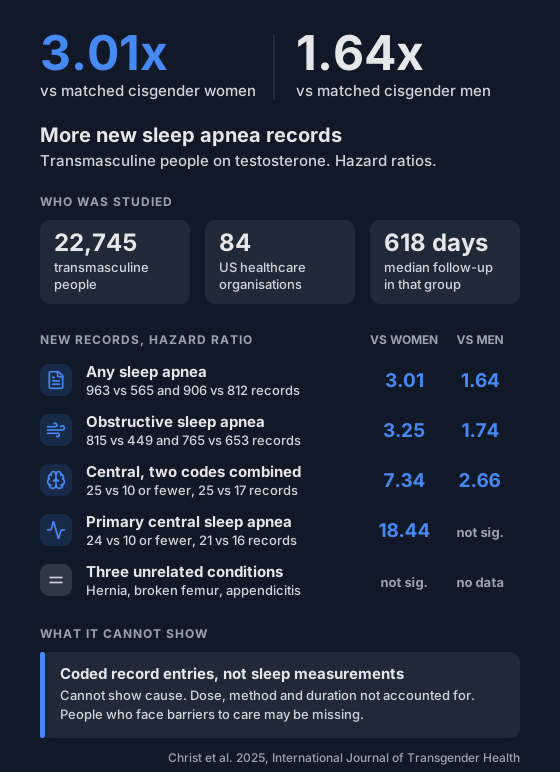
A US health records study followed 22,745 transmasculine people on testosterone therapy. New sleep apnea records were more common than in matched cisgender women (hazard ratio 3.01) and matched cisgender men (1.64).
Sleep apnea is recorded more often in cisgender men than in cisgender women before menopause. Testosterone is one suggested reason, but studies of cisgender men taking it have given mixed results.
A study of US health records looked at transmasculine people on testosterone therapy. New sleep apnea records were more common in that group than in matched cisgender women and in matched cisgender men.
It counted codes in medical records. Nobody's sleep was measured.
Who was in the study?
- The data came from TriNetX, a database of anonymised health records from 84 US healthcare organisations, covering 2004 to 2024.
- 22,745 transmasculine people: female sex assigned at birth, a gender incongruence code, and a record of testosterone, through the skin or by injection.
- Anyone with sleep apnea on record before starting testosterone was left out (605 people).
- Follow-up started 3 months after the first testosterone record.
- Half of the group were followed for 618 days or more, and the median time on testosterone was 522 days.
Who were they compared with?
Two groups with no testosterone record and no earlier sleep apnea record:
- 22,745 cisgender women, median follow-up 1,096 days.
- 22,225 cisgender men, median follow-up 866 days, compared with 22,225 of the transmasculine group.
So the figures against men come from 22,225 people per group, not 22,745.
Each person was paired with a similar person from the comparison group. The methods section lists the matching factors as demographics, BMI, smoking, alcohol, opioid use and an underactive thyroid. The abstract lists BMI, smoking and the number of outpatient visits instead.
What did the records show?
The paper reports hazard ratios. A hazard ratio of 2 means the rate of new records was twice as high.
| New record | Against cisgender women | Against cisgender men |
|---|---|---|
| Any sleep apnea | 3.01 (963 vs 565 records) | 1.64 (906 vs 812 records) |
| Obstructive sleep apnea | 3.25 (815 vs 449) | 1.74 (765 vs 653) |
| Central sleep apnea, two codes combined | 7.34 (25 vs 10 or fewer) | 2.66 (25 vs 17) |
- All six results were statistically significant.
- The hazard ratios are bigger than the raw counts suggest. The paper doesn't explain the gap. It does report a shorter median follow-up in the transmasculine group (618 days, against 1,096 and 866).
- The 7.34 is from the paper's table and abstract. Its results text prints 7.39 for the same comparison.
- Central sleep apnea was rare in every group, so those two figures are uncertain. The 95% confidence interval for 7.34 runs from 2.52 to 21.41, and for 2.66 from 1.31 to 5.40.
- For the primary central sleep apnea code alone, the hazard ratio was 18.44 against cisgender women (24 records vs 10 or fewer), with a 95% confidence interval from 4.24 to 80.12. Against cisgender men it was 1.78 (21 vs 16 records), which was not statistically significant.
- A code for low breathing during sleep with no known cause was also more common: 3.63 against cisgender women and 3.22 against cisgender men, from 37 records in the transmasculine group against 18 in each comparison group.
Could it be that this group just sees doctors more?
The authors tested that. They ran the same comparison for three conditions that hormone therapy is unlikely to affect: inguinal hernia, a broken femur and acute appendicitis. They found no statistically significant difference between the transmasculine group and cisgender women for any of them.
The paper reports this check against cisgender women only. The numbers are in an appendix that we could not read.
What doesn't it tell you?
It's a retrospective records study, so it shows a link and not a cause. The authors list these limits:
- Codes, not sleep tests. Hospitals code differently, so sleep apnea types may be misfiled, under-recorded or over-recorded. The "unspecified sleep apnea" code may include people whose sleep apnea was never confirmed.
- Who is missing. People who face barriers to healthcare may not be in the database. The authors say transgender people may face more of these barriers, which would mean the study underestimates sleep apnea in this group.
- Care elsewhere. Records from outside the network are not included.
- Changes over time. People were matched on what was recorded at the start. Later changes, such as weight, were not fully accounted for.
- The testosterone itself. Dose and the way it was taken vary and could affect the result. The authors also say they lacked usable data on how long people stayed on it.
The paper's funding statement lists one item: one author has received research grants from Belun Technology to run validation trials.
The authors ask clinicians to stay alert to sleep apnea in people on testosterone therapy and to tell patients about it. They also call for studies that measure sleep directly.
For related research, see steroid cycles and sleep breathing and PCOS and sleep quality.
What can you do with this?
This study is not a reason to change hormone therapy. Any decision about it is one to make with your doctor.
If you snore loudly, someone has heard you stop breathing in your sleep, or you're exhausted during the day, tell your doctor. For the other signs, read snoring vs sleep apnea.
Not sure? The sleep apnea risk check takes about a minute and helps you decide whether to talk to a doctor.
An overnight oximeter can't tell you whether you have sleep apnea. It records what your oxygen and pulse did, and you can share that with your doctor.
Not a medical device. Does not diagnose, treat or prevent any condition. Discuss results and changes with a clinician.
References
- Christ A, Loria M, Tabernacki T, Chiang AA. Sleep apnea risk in transmasculine individuals on testosterone therapy: A population-based cohort study. International Journal of Transgender Health. 2025;27(4):2173-2182. doi:10.1080/26895269.2025.2560084