CPAP Break and Sex Hormones: A 2026 Study
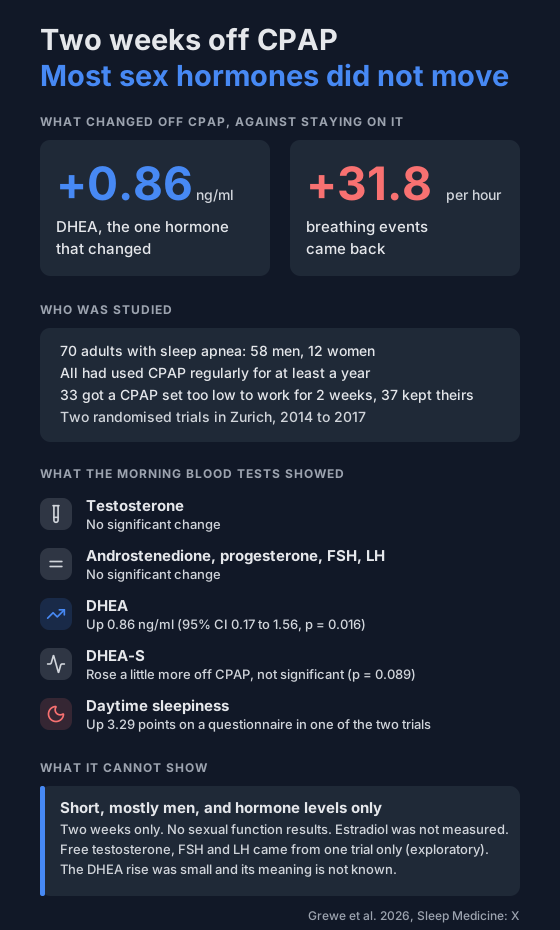
Two randomised trials took 33 regular CPAP users off effective CPAP for two weeks. Testosterone and most other sex hormones showed no significant change. Only DHEA rose, by a small amount.
Problems with sex drive and sexual function are common in people with sleep apnea. Earlier research found that CPAP helps with them, but doesn't reliably change testosterone or estradiol. A 2026 study from Zurich checked whether other sex hormones respond to CPAP.
Who was studied?
The data came from two randomised trials run between 2014 and 2017.
- 70 adults with sleep apnea: 58 men and 12 women, 11 of them past menopause.
- All had used CPAP for at least a year, on more than 80% of days.
- Breathing events averaged about 51 per hour when they were first tested.
37 people kept their usual CPAP. 33 were switched for two weeks to CPAP set too low to work. Blood was taken at the start and after the two weeks.
Did the break bring the apnea back?
Yes. Against the CPAP group:
- Breathing events rose by 31.8 per hour.
- The oxygen desaturation index, the number of oxygen dips per hour, rose by 31.5.
- In one of the two trials, a daytime sleepiness score rose by 3.29 points.
What happened to the hormones?
Mostly nothing. The study found no significant effect on:
- Testosterone.
- Androstenedione, progesterone and 17-hydroxyprogesterone.
- FSH and LH, the pituitary hormones that drive the ovaries and testes.
One hormone moved. DHEA, a weak hormone the body turns into other sex hormones, rose by 0.86 ng/ml (95% CI 0.17 to 1.56, p = 0.016). Starting levels were about 2.1 ng/ml.
The authors expected a fall. Their explanation is that DHEA is also released as part of the body's stress response. They suggest sexual problems in sleep apnea may run through stress pathways, which the study did not test.
DHEA-S, a related hormone, rose a little more off CPAP, but not significantly (p = 0.089). People with higher diastolic blood pressure had higher DHEA.
What are the limits?
- Two weeks is short, and the effects were small.
- 58 of the 70 were men, so the results say little about women.
- Estradiol was not measured.
- Free testosterone, FSH and LH came from one trial only, so those results are exploratory.
- The DHEA-S result was an extra analysis added afterwards.
- The trials were designed to study brain blood vessels and exhaled breath, not hormones.
- The paper reports hormone levels only, and the authors call for studies that measure sexual function itself.
What can you do with this?
The break was supervised by researchers, and any change to your own therapy is a decision for you and your doctor.
On CPAP already? See tracking your oxygen alongside CPAP.
Not a medical device. Does not diagnose, treat or prevent any condition. Discuss results and changes with a clinician.
References
- Grewe FA, Thiel S, Haile SR, Peitzsch M, Schwarz EI, Sievi NA, Beuschlein F, Kohler M, Gaisl T. Effects of CPAP withdrawal on sex hormone levels in patients with obstructive sleep apnoea: data from two randomised, controlled trials. Sleep Medicine: X. 2026;12:100201. doi:10.1016/j.sleepx.2026.100201