PCOS and Sleep: What a 2026 Review Found
A 2026 review pooled 21 studies of sleep in women with PCOS. Both sleep questionnaires showed worse scores with PCOS, but only 2 of 10 overnight sleep-test measures differed.
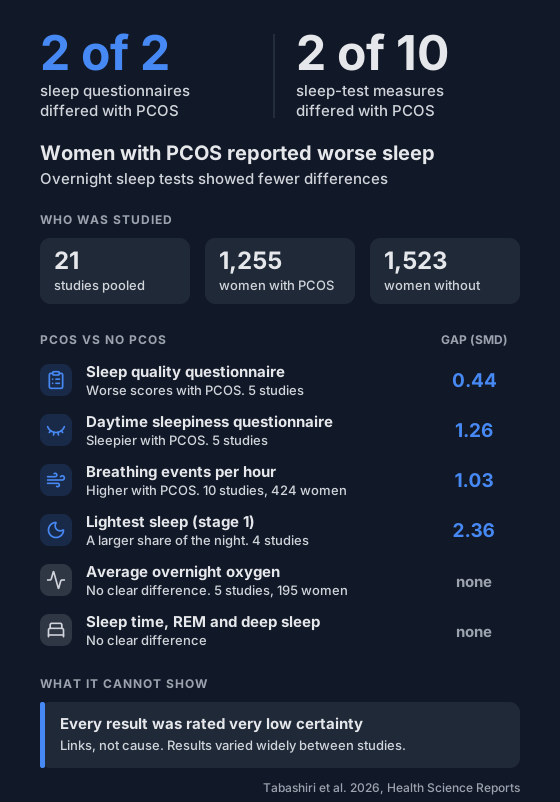
Polycystic ovary syndrome (PCOS) is a hormone condition that affects 5% to 18% of women of reproductive age. A review published in September 2026 pooled the studies that compared sleep in women with and without PCOS. Women with PCOS reported worse sleep on both questionnaires. Overnight sleep tests showed a difference on only 2 of 10 measures.
Who was in the review?
- 21 studies, found in a search up to August 2024.
- 1,255 women with PCOS and 1,523 without.
- 14 studies on adults and 7 on teenagers.
- 11 focused on overweight or obese women.
- All were observational: 12 cross-sectional, 7 case-control and 2 cohort studies.
What did women report?
The review reports each gap as a standardized mean difference (SMD). A bigger number means a wider gap.
- Sleep quality: worse with PCOS, SMD 0.44 across 5 studies and 1,375 women.
- Daytime sleepiness: higher with PCOS, SMD 1.26 across 5 studies and 310 women.
Both figures come after the authors dropped one study from each in a sensitivity check. Before that, the gaps were larger: 0.87 and 2.83.
What did the sleep tests measure?
Two of the ten measures from overnight lab sleep studies differed:
- Breathing events per hour: higher with PCOS, SMD 1.03 across 10 studies and 424 women.
- Stage 1 sleep, the lightest stage: a larger share of the night with PCOS, SMD 2.36 across 4 studies.
The other eight showed no clear difference. They included brief arousals, REM, deep sleep, total sleep time and average overnight oxygen. The review didn't pool oxygen dip counts like ODI.
Is it just weight?
Partly, the authors say. The data couldn't be pooled by weight, so they describe single studies:
- In two studies, the gaps shrank when the comparison group was also obese.
- In one US study, daytime sleepiness was more common with PCOS in non-obese women (75.0% against 22.5%) and in obese women (82.1% against 54.5%).
- The same study found sleep-disordered breathing that called for therapy in 8.3% against 0% of non-obese women, and 19.5% against 4.5% of obese women.
- Androgen levels and metabolic syndrome made no clear difference within the PCOS group.
How strong is the evidence?
Weak, the authors say.
- Every pooled result was rated "very low" certainty.
- Results varied widely between studies.
- The breathing events result showed signs of publication bias.
- Observational studies show links, not cause.
What can you do with this?
The authors say sleep should be part of routine PCOS check-ups. If you have PCOS and sleep badly or feel sleepy in the day, tell your doctor. Got overnight recordings? Here's how to share them.
Not a medical device. Does not diagnose, treat or prevent any condition. Discuss results and changes with a clinician.
References
- Tabashiri A, Kanani P, Saei Ghare Naz M, Ramezani Tehrani F. Polycystic Ovary Syndrome and Subjective and Objective Assessments of Sleep Quality: A Systematic Review and Meta-Analysis. Health Science Reports. 2026;9(9):e73223. doi:10.1002/hsr2.73223