Walking and Sleep in Older Psychiatric Patients
A 2026 trial in northern Iran gave older psychiatric inpatients supervised 30-minute walks three times a week for four weeks. Their self-rated sleep score fell more than with routine care, but the trial was small and its analysis was changed after the fact.
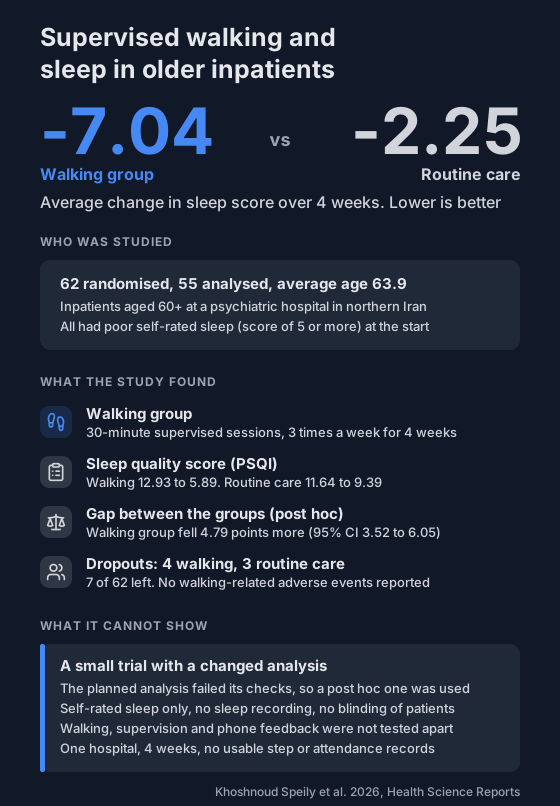
Exercise is often named as a way to sleep better, but the authors say few studies have tested phone-supported walking in older adults in hospital. A 2026 trial in northern Iran tested supervised walking in older people staying in a psychiatric hospital. It was small, and its authors list a long set of limits.
Who was studied?
- Inpatients aged 60 or over at a psychiatric hospital in Guilan Province, Iran.
- All scored 5 or more on the Pittsburgh Sleep Quality Index (PSQI), a self-rated sleep questionnaire where higher means worse sleep.
- People with dementia, delirium, a fall in the past year or a walking aid were excluded, and a doctor had to clear them for walking.
- 62 were randomised, 31 to each group, between April and September 2024.
- 55 were analysed: 27 walking and 28 routine care. The average age was 63.9 and 70.9% were men.
The paper doesn't say how long people had been in hospital or how long they stayed. Anyone discharged or transferred during the four weeks left the trial: four of the seven dropouts were discharged early and two were transferred. How long they had been ill varied: 38.2% for under 10 years and 34.5% for more than 20.
What did the walking group do?
- Sessions of 30 minutes, three times a week, for four weeks. That's 12 sessions.
- Each had a 5-minute warm-up and a 5-minute cool-down, on a flat path in the hospital courtyard.
- A researcher walked with them and checked their pulse with a fingertip oximeter to keep the effort at 40% to 60% of their heart rate reserve.
- The researcher counted steps with a phone app and gave live feedback. The patients didn't use the app themselves.
Both groups kept their usual hospital care, including medication and other therapies. Medication didn't change during the trial.
What did it find?
The PSQI runs from 0 to 21, and lower is better.
| Start | After 4 weeks | Change | |
|---|---|---|---|
| Walking group | 12.93 | 5.89 | -7.04 |
| Routine care | 11.64 | 9.39 | -2.25 |
- In the post hoc change-score comparison, the walking group fell 4.79 points more (95% confidence interval 3.52 to 6.05).
- The authors report a large effect size (Cohen's d 2.09, 95% confidence interval 1.44 to 2.77) and p below 0.001.
- No walking-related adverse events were reported.
Scores fell in both groups, which is why routine care alone is a useful comparison. The walking group also started with a higher (worse) average score, 12.93 against 11.64, and the authors say poor starting scores may leave more room to fall.
What should you be careful about?
- The analysis was changed. The planned analysis (ANCOVA, which adjusts for starting scores) failed its assumption checks. The authors switched to comparing change scores between groups, and call that a post hoc change.
- The groups differed at the start. In the paper's Table 1, 57.1% of the routine care group and 18.5% of the walking group couldn't read or write, and 50.0% against 22.2% rated their finances as poor.
- It's small. Seven people had no final score and were left out, and the paper couldn't compare them with those who stayed.
- Sleep was self-rated. There was no sleep recording, and patients knew which group they were in. Only the person scoring the questionnaires and the statistician were blinded.
- Several things changed at once. The group got walking, a researcher's company, pulse checks and phone feedback. The authors say the effect can't be assigned to any one of them, and they can't rule out an effect of the extra attention.
- Little clinical detail. The authors say information on people's psychiatric conditions, how ill they were and their psychiatric medication was limited, so those differences can't be ruled out.
- Dose wasn't recorded. Attendance and step counts were not kept in a usable form.
- It's one hospital, for four weeks. The patients were convenience-sampled, so the result may not carry over to other settings, and nothing was tested beyond the four weeks.
The authors say the whole package may be an add-on to routine care in this group, and shouldn't be taken as a replacement for medication. They call for larger, multi-centre trials with longer follow-up and objective sleep measures.
What can you take from it?
- It's an early signal, not proof that walking changes sleep.
- If you want to see how your own days relate to your nights, log your activity and compare it with your overnight readings. Exercise timing and daily activity have their own studies.
- For another small exercise trial in older adults, see exercise and sleep in older veterans with PTSD.
- If you've had poor sleep for a while, tell your doctor.
Not a medical device. Does not diagnose, treat or prevent any condition. Discuss results and changes with a clinician.
References
- Khoshnoud Speily S, Mansour-Ghanaei R, Soleimani R, Maroufizadeh S. Effect of a Researcher-Supervised Walking Program With Smartphone-Based Step Monitoring on Sleep Quality in Older Psychiatric Inpatients: A Randomized Controlled Trial. Health Science Reports. 2026;9(11):e73413. doi:10.1002/hsr2.73413